U.S. consumer debt hit $18.56 trillion in Q3 2026 as non-mortgage delinquencies stabilized
Equifax national Market Pulse data shows HELOC debt growth and stabilizing non-mortgage write-offs amid resilient consumer borrowing
Highlights:
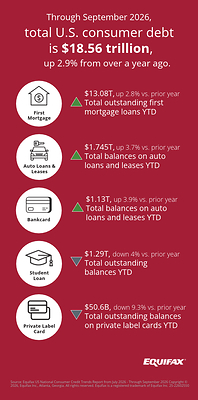
- Total U.S. consumer debt rose 2.9% year-over-year to $18.56 trillion in September 2026, driven by growth in mortgage debt and home equity lines of credit.
- Mortgage obligations remain the largest driver of consumer debt, with total outstanding first mortgage loans reaching $13.08 trillion in September 2026.
- Non-mortgage debt write-offs year-to-date through September 2026 came in at $104.9 billion, compared to $104.4 billion the previous year.
ATLANTA, Nov. 11, 2026 /PRNewswire/ -- Equifax® (NYSE: EFX) has released its Market Pulse Third Quarter U.S. Consumer Credit Trends, which includes U.S. national consumer credit data and trends through September 2026 sourced from Equifax proprietary data. Driven by continued growth in mortgage debt and home equity lines of credit, total U.S. consumer debt reached $18.56 trillion in September 2026 — a 2.9% increase year-over-year. While mortgage obligations remain the largest driver of consumer debt, non-mortgage debt write-offs held steady year-to-date at $104.9 billion, pointing to overall resilience across consumer portfolios despite shifting economic pressures.
Continued debt growth driven by mortgage and double-digit HELOC expansion
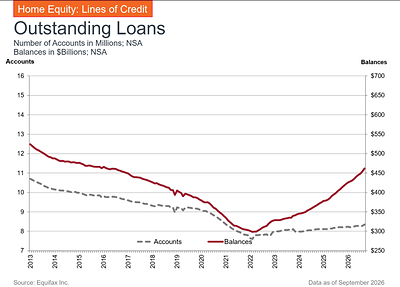
In September 2026, HELOC balances expanded to $461.9 billion, marking a significant 13.3% year-over-year increase from $407.7 billion in September 2025 and a 1.7% month-over-month rise from $454.2 billion in August 2026. HELOCs now account for 3.4% of total outstanding mortgage debt, reflecting a sustained, accelerated growth trajectory throughout the third quarter as homeowners continue to leverage accumulated home equity.
"Homeowners continue to leverage their accumulated home equity, as evidenced by double-digit year-over-year growth in HELOC balances," said Emmaline Aliff, Advisory Leader at Equifax. "Even as overall borrowing expands, mortgage-related debt remains the cornerstone of consumer balance sheets, offering structural stability backed by real estate assets."
Stabilization across non-mortgage portfolios as write-offs hold steady and delinquencies ease
- Non-mortgage consumer debt reached $4.79 trillion in September 2026, which includes $1.745 trillion in auto loans, $1.287 trillion in student loans, and $1.126 trillion in bankcards.
- Year-to-date non-mortgage write-offs totaled $104.9 billion, reflecting steady performance compared to $104.4 billion the previous year.
- Severe delinquency rates (more than 60 days past due) across key revolving categories like bankcards were down 9 basis points to 2.74% from September 2025, while private label cards were down 40 basis points to 3.85%.
- Bankcard write-offs stand at 52.4 basis points, down from 55.5 basis points a year prior.
"There is a remarkably resilient segment of the population managing economic pressures with steady repayment behavior, yet we cannot overlook the consumers who are experiencing real financial friction," added Aliff. "The top-line improvement is a positive sign, but the underlying reality is complex as elevated borrowing costs and persistent inflation continue to stretch household budgets across lower-income tiers."
Diverse trends across auto, bankcard, and student loan asset classes
- Auto loan and lease balances rose 3.7% year-over-year to $1.745 trillion in September 2026, even as auto loan severe delinquency rates dropped 7 basis points to 1.50%.
- Bankcard balances grew 3.9% to $1.13 trillion, with average utilization dropping slightly to 20.3%.
- Meanwhile, student loan balances continued their downward trend, falling 4.0% year-over-year to $1.29 trillion.
Month-over-month and year-over-year results
Total consumer debt balances
|
Month |
Total Consumer Debt |
MoM Change (%) |
YoY Change (%) |
|
July 2026 |
$18.23 |
-0.1 % |
1.6 % |
|
August 2026 |
$18.45 |
1.2 % |
3.0 % |
|
September 2026 |
$18.56 |
0.6 % |
2.9 % |
First mortgage balances
|
Month |
First Mortgage Balances |
MoM Change (%) |
YoY Change (%) |
|
July 2026 |
$12,812 |
-0.2 % |
1.2 % |
|
August 2026 |
$13,003 |
1.5 % |
3.0 % |
|
September 2026 |
$13,075 |
0.5 % |
2.8 % |
Home equity lines of credit (HELOC) balances
|
Month |
HELOC Balances |
MoM Change (%) |
YoY Change (%) |
|
July 2026 |
$448.2 |
0.8 % |
12.5 % |
|
August 2026 |
$454.2 |
1.3 % |
12.4 % |
|
September 2026 |
$461.9 |
1.7 % |
13.3 % |
Auto loan balances
|
Month |
Auto Loan Balances |
MoM Change (%) |
YoY Change (%) |
|
July 2026 |
$1,731 |
0.4 % |
3.3 % |
|
August 2026 |
$1,733 |
0.1 % |
3.3 % |
|
September 2026 |
$1,745 |
0.6 % |
3.7 % |
Bankcard balances
|
Month |
Bankcard Balances |
MoM Change (%) |
YoY Change (%) |
|
July 2026 |
$1,113.7 |
0.5 % |
3.8 % |
|
August 2026 |
$1,120.8 |
0.6 % |
3.6 % |
|
September 2026 |
$1,125.7 |
0.4 % |
3.9 % |
Student loan balances
|
Month |
Student Loan Debt |
MoM Change (%) |
YoY Change (%) |
|
July 2026 |
$1,285 |
-0.2 % |
-3.2 % |
|
August 2026 |
$1,283 |
-0.2 % |
-3.4 % |
|
September 2026 |
$1,287 |
0.3 % |
-4.0 % |
Equifax has been tracking U.S. National Consumer Credit Trends for more than 20 years. Monthly reports can be found on Equifax.com. These reports track originations, balances and delinquencies on U.S. consumer mortgages, auto loans and leases, student loans, bankcards and private label credit cards, and personal loans. To explore Equifax tools that deliver U.S. National Consumer Credit Trends data and key market metrics click here.
ABOUT EQUIFAX INC.
At Equifax (NYSE: EFX), we believe knowledge drives progress. As a global data, analytics, and technology company, we play an essential role in the global economy by helping financial institutions, companies, employers, and government agencies make critical decisions with greater confidence. Our unique blend of differentiated data, analytics, and cloud technology drives insights to power decisions to move people forward. Headquartered in Atlanta and supported by nearly 15,000 employees worldwide, Equifax operates or has investments in 24 countries in North America, Central and South America, Europe, and the Asia Pacific region. For more information, visit Equifax.com.
FOR MORE INFORMATION:
Tiffany Smith for Equifax
mediainquiries@equifax.com

View original content to download multimedia:https://www.prnewswire.com/news-releases/us-consumer-debt-hit-18-56-trillion-in-q3-2026-as-non-mortgage-delinquencies-stabilized-302935687.html
SOURCE Equifax Inc.
Released November 11, 2026