Check the appropriate box: |
| |||
☑ |
Preliminary Proxy Statement |
| ||
☐ |
Confidential, for Use of the Commission Only (as permitted by Rule 14A-6(E)(2)) |
| ||
☐ |
Definitive Proxy Statement |
| ||
☐ |
Definitive Additional Materials |
| ||
☐ |
Soliciting Material under §240.14a-12 |
| ||
Payment of Filing Fee (Check all boxes that apply): |
| |||
☑ |
No fee required. |
| ||
☐ |
Fee paid previously with preliminary materials. |
| ||
☐ |
Fee computed on table in exhibit required by Item 25(b) per Exchange Act Rules 14a-6(i)(1) and 0-11. |
| ||
EFX.AI: Powering the Future Driving higher-performing, AI-powered innovation fueled by proprietary data. Notice of 2026 Annual Meeting and Proxy Statement
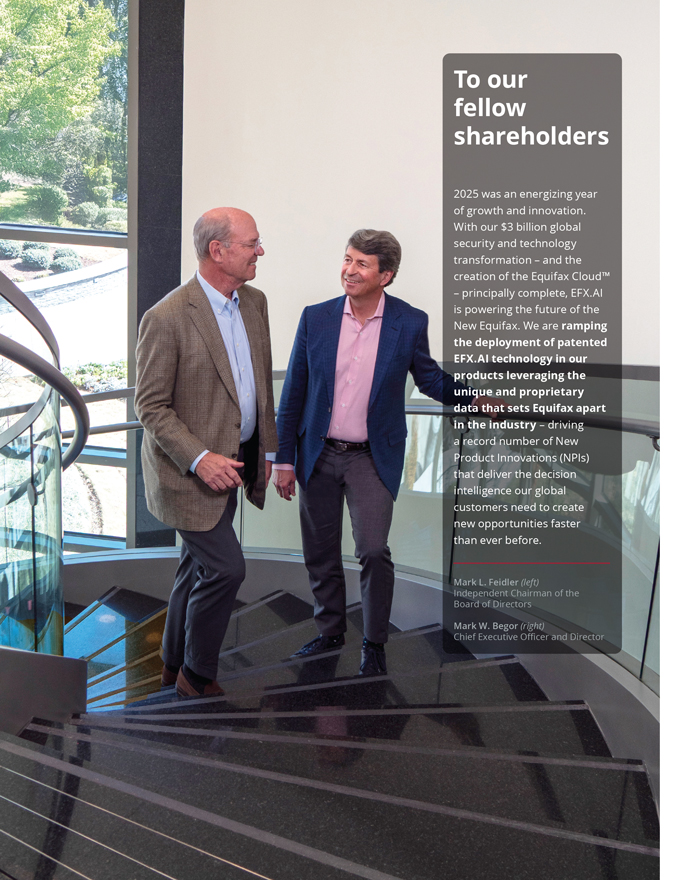
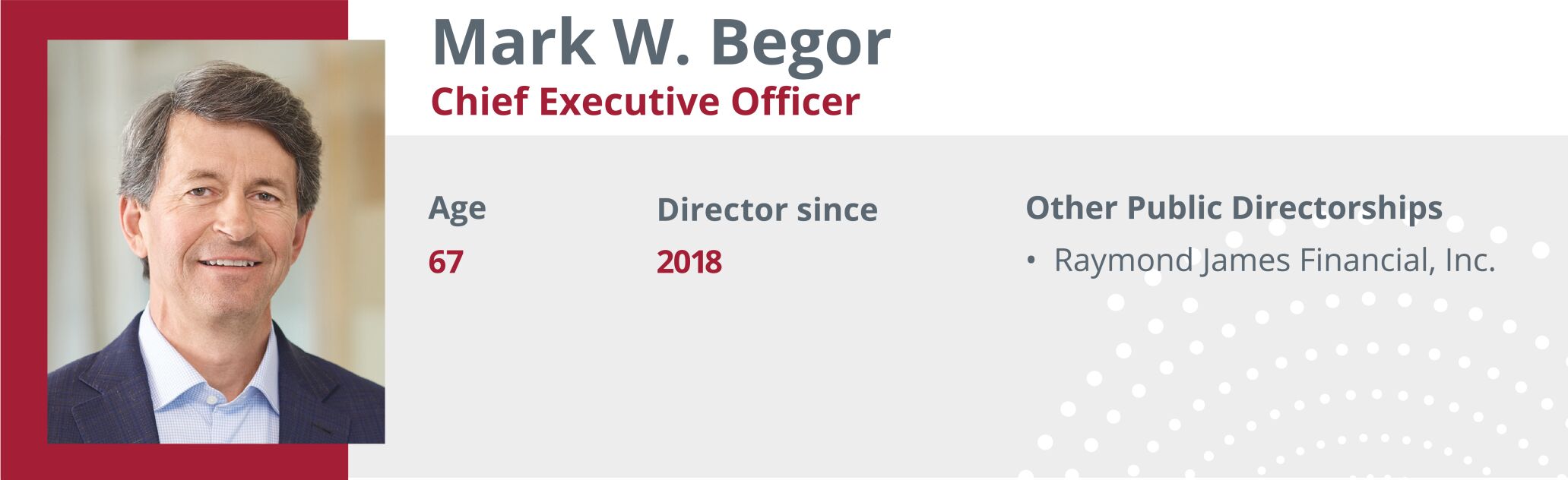
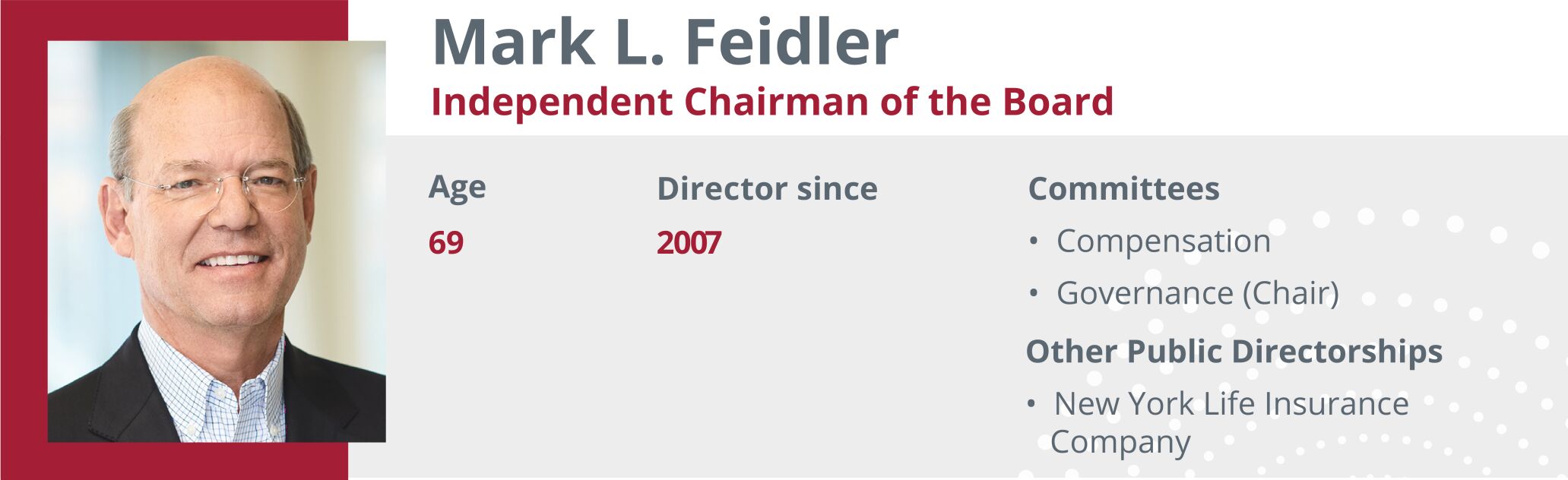
To our fellow shareholders 2025 was an energizing year of growth and innovation. With our $3 billion global security and technology transformation – and the creation of the Equifax Cloud™ – principally complete, EFX.AI is powering the future of the New Equifax. We are ramping the deployment of patented EFX.AI technology in our products leveraging the unique and proprietary data that sets Equifax apart in the industry – driving a record number of New Product Innovations (NPIs) that deliver the decision intelligence our global customers need to create new opportunities faster than ever before. Mark L. Feidler (left) Independent Chairman of the Board of Directors Mark W. Begor (right) Chief Executive Officer and Director
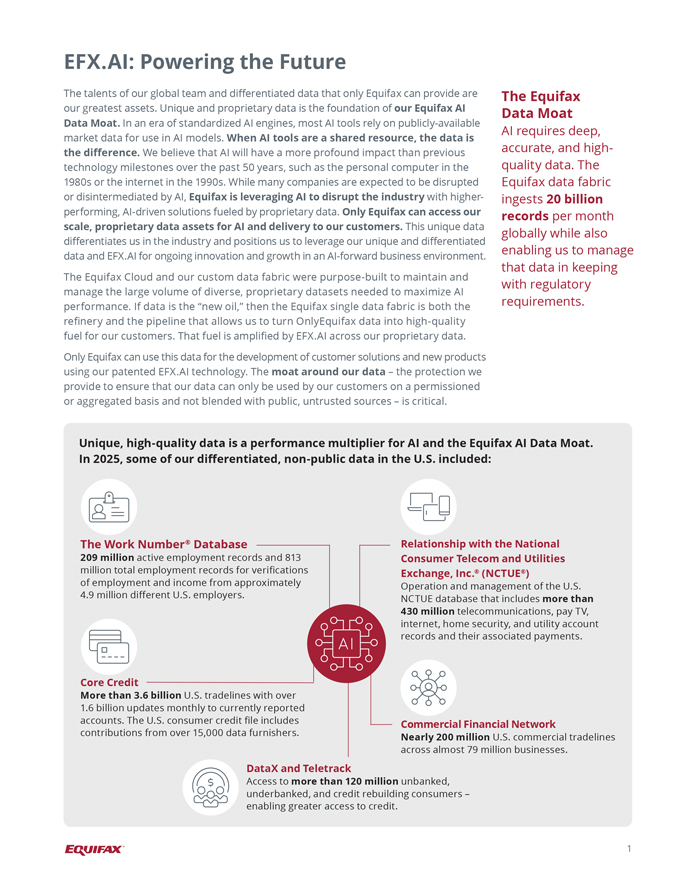
EFX.AI: Powering the Future The talents of our global team and differentiated data that only Equifax can provide are our greatest assets. Unique and proprietary data is the foundation of our Equifax AI Data Moat. In an era of standardized AI engines, most AI tools rely on publicly-available market data for use in AI models. When AI tools are a shared resource, the data is the difference. We believe that AI will have a more profound impact than previous technology milestones over the past 50 years, such as the personal computer in the 1980s or the internet in the 1990s. While many companies are expected to be disrupted or disintermediated by AI, Equifax is leveraging AI to disrupt the industry with higher-performing, AI-driven solutions fueled by proprietary data. Only Equifax can access our scale, proprietary data assets for AI and delivery to our customers. This unique data differentiates us in the industry and positions us to leverage our unique and differentiated data and EFX.AI for ongoing innovation and growth in an AI-forward business environment. The Equifax Cloud and our custom data fabric were purpose-built to maintain and manage the large volume of diverse, proprietary datasets needed to maximize AI performance. If data is the “new oil,” then the Equifax single data fabric is both the refinery and the pipeline that allows us to turn OnlyEquifax data into high-quality fuel for our customers. That fuel is amplified by EFX.AI across our proprietary data. Only Equifax can use this data for the development of customer solutions and new products using our patented EFX.AI technology. The moat around our data – the protection we provide to ensure that our data can only be used by our customers on a permissioned or aggregated basis and not blended with public, untrusted sources – is critical. The Equifax Data Moat AI requires deep, accurate, and high-quality data. The Equifax data fabric ingests 20 billion records per month globally while also enabling us to manage that data in keeping with regulatory requirements. Unique, high-quality data is a performance multiplier for AI and the Equifax AI Data Moat. In 2025, some of our differentiated, non-public data in the U.S. included: The Work Number® Database Relationship with the National 209 million active employment records and 813 Consumer Telecom and Utilities million total employment records for verifications Exchange, Inc.® (NCTUE®) of employment and income from approximately Operation and management of the U.S. 4.9 million different U.S. employers. NCTUE database that includes more than 430 million telecommunications, pay TV, internet, home security, and utility account records and their associated payments. Core Credit More than 3.6 billion U.S. tradelines with over 1.6 billion updates monthly to currently reported accounts. The U.S. consumer credit file includes Commercial Financial Network contributions from over 15,000 data furnishers. Nearly 200 million U.S. commercial tradelines across almost 79 million businesses. DataX and Teletrack Access to more than 120 million unbanked, underbanked, and credit rebuilding consumers – enabling greater access to credit. 1
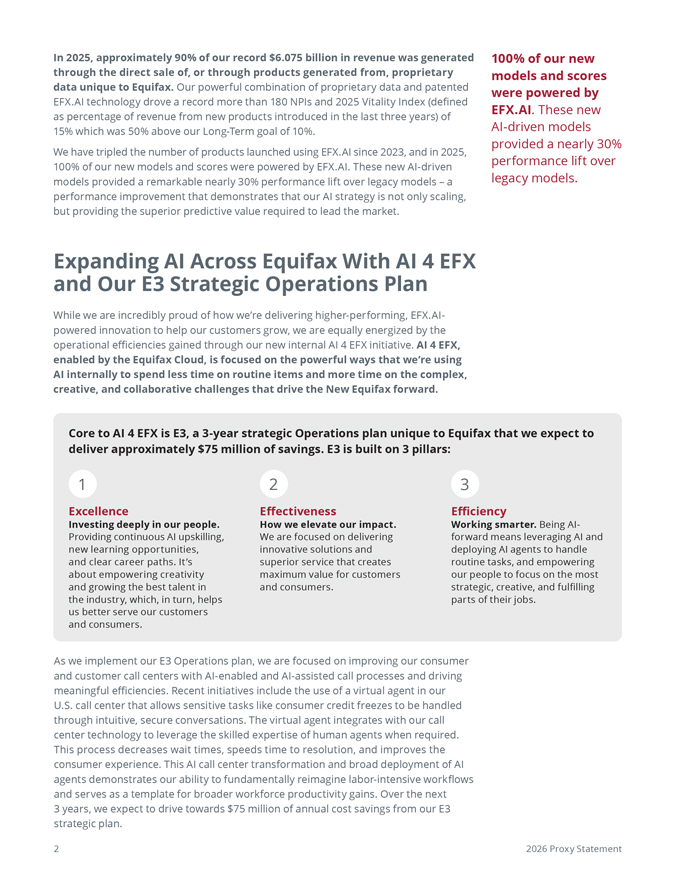
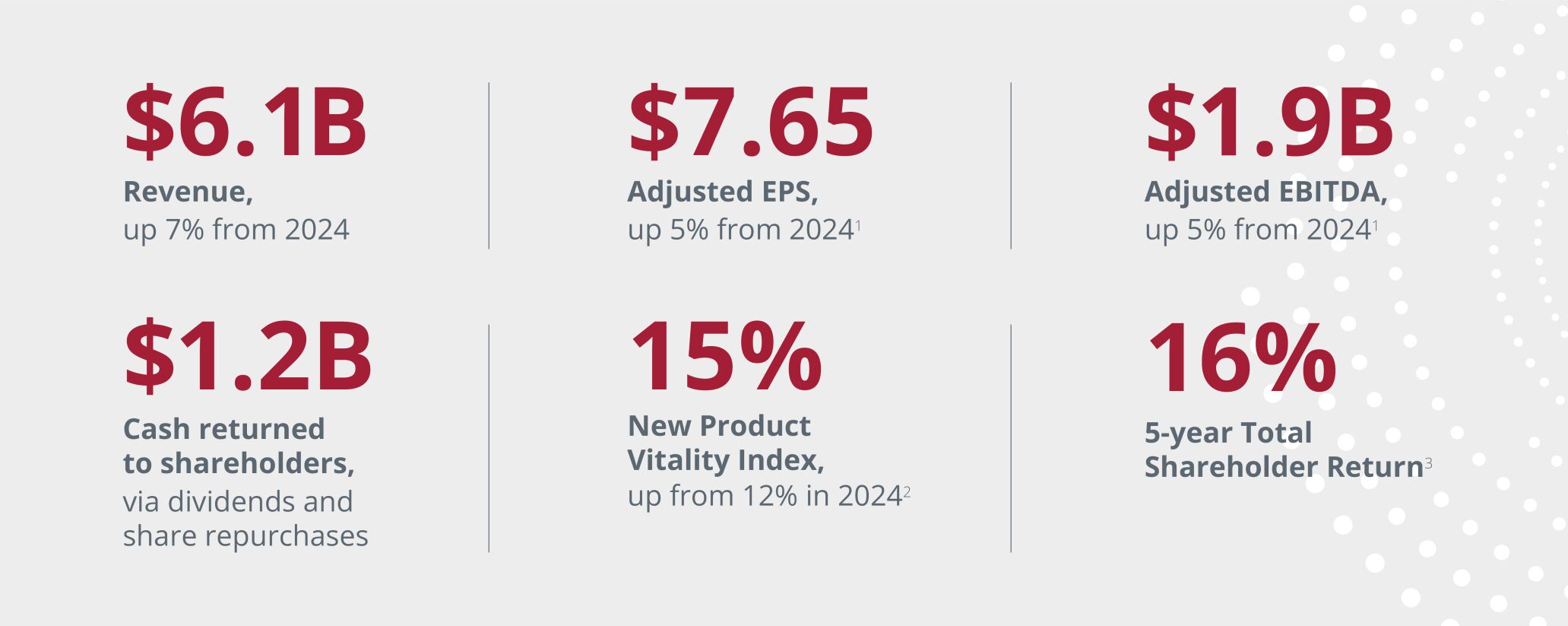
In 2025, approximately 90% of our record $6.075 billion in revenue was generated through the direct sale of, or through products generated from, proprietary data unique to Equifax. Our powerful combination of proprietary data and patented EFX.AI technology drove a record more than 180 NPIs and 2025 Vitality Index (defined as percentage of revenue from new products introduced in the last three years) of 15% which was 50% above our Long-Term goal of 10%. We have tripled the number of products launched using EFX.AI since 2023, and in 2025, 100% of our new models and scores were powered by EFX.AI. These new AI-driven models provided a remarkable nearly 30% performance lift over legacy models – a performance improvement that demonstrates that our AI strategy is not only scaling, but providing the superior predictive value required to lead the market. Expanding AI Across Equifax With AI 4 EFX and Our E3 Strategic Operations Plan While we are incredibly proud of how we’re delivering higher-performing, EFX.AI-powered innovation to help our customers grow, we are equally energized by the operational efficiencies gained through our new internal AI 4 EFX initiative. AI 4 EFX, enabled by the Equifax Cloud, is focused on the powerful ways that we’re using AI internally to spend less time on routine items and more time on the complex, creative, and collaborative challenges that drive the New Equifax forward. 100% of our new models and scores were powered by EFX.AI. These new AI-driven models provided a nearly 30% performance lift over legacy models. Core to AI 4 EFX is E3, a 3-year strategic Operations plan unique to Equifax that we expect to deliver approximately $75 million of savings. E3 is built on 3 pillars: 1 2 3 Excellence Effectiveness Efficiency Investing deeply in our people. How we elevate our impact. Working smarter. Being AI-Providing continuous AI upskilling, We are focused on delivering forward means leveraging AI and new learning opportunities, innovative solutions and deploying AI agents to handle and clear career paths. It’s superior service that creates routine tasks, and empowering about empowering creativity maximum value for customers our people to focus on the most and growing the best talent in and consumers. strategic, creative, and fulfilling the industry, which, in turn, helps parts of their jobs. us better serve our customers and consumers. As we implement our E3 Operations plan, we are focused on improving our consumer and customer call centers with AI-enabled and AI-assisted call processes and driving meaningful efficiencies. Recent initiatives include the use of a virtual agent in our U.S. call center that allows sensitive tasks like consumer credit freezes to be handled through intuitive, secure conversations. The virtual agent integrates with our call center technology to leverage the skilled expertise of human agents when required. This process decreases wait times, speeds time to resolution, and improves the consumer experience. This AI call center transformation and broad deployment of AI agents demonstrates our ability to fundamentally reimagine labor-intensive workflows and serves as a template for broader workforce productivity gains. Over the next 3 years, we expect to drive towards $75 million of annual cost savings from our E3 strategic plan.
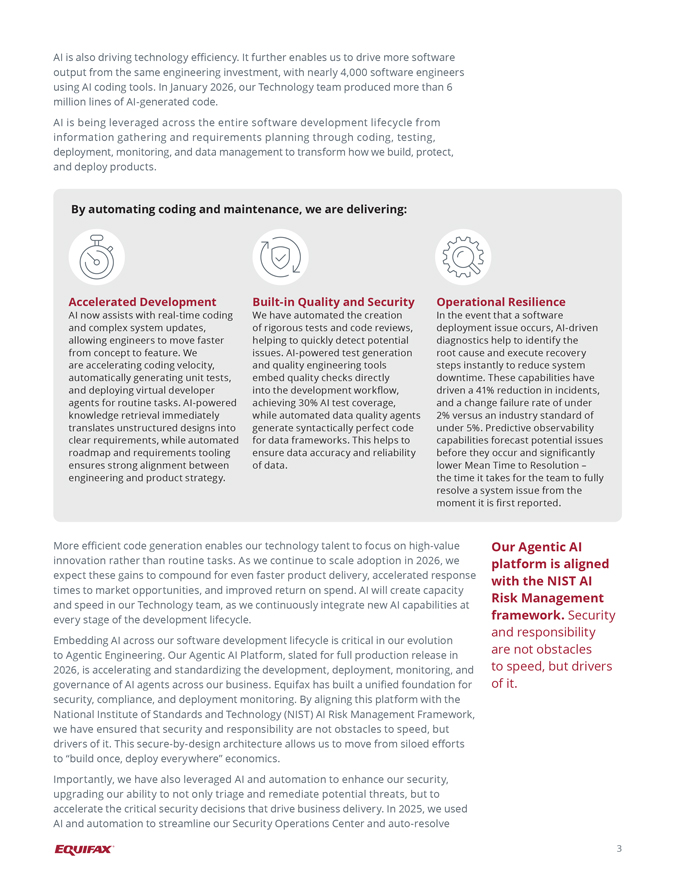
AI is also driving technology efficiency. It further enables us to drive more software output from the same engineering investment, with nearly 4,000 software engineers using AI coding tools. In January 2026, our Technology team produced more than 6 million lines of AI-generated code. AI is being leveraged across the entire software development lifecycle from information gathering and requirements planning through coding, testing, deployment, monitoring, and data management to transform how we build, protect, and deploy products. By automating coding and maintenance, we are delivering: Accelerated Development Built-in Quality and Security Operational Resilience AI now assists with real-time coding We have automated the creation In the event that a software and complex system updates, of rigorous tests and code reviews, deployment issue occurs, AI-driven allowing engineers to move faster helping to quickly detect potential diagnostics help to identify the from concept to feature. We issues. AI-powered test generation root cause and execute recovery are accelerating coding velocity, and quality engineering tools steps instantly to reduce system automatically generating unit tests, embed quality checks directly downtime. These capabilities have and deploying virtual developer into the development workflow, driven a 41% reduction in incidents, agents for routine tasks. AI-powered achieving 30% AI test coverage, and a change failure rate of under knowledge retrieval immediately while automated data quality agents 2% versus an industry standard of translates unstructured designs into generate syntactically perfect code under 5%. Predictive observability clear requirements, while automated for data frameworks. This helps to capabilities forecast potential issues roadmap and requirements tooling ensure data accuracy and reliability before they occur and significantly ensures strong alignment between of data. lower Mean Time to Resolution – engineering and product strategy. the time it takes for the team to fully resolve a system issue from the moment it is first reported. More efficient code generation enables our technology talent to focus on high-value innovation rather than routine tasks. As we continue to scale adoption in 2026, we expect these gains to compound for even faster product delivery, accelerated response times to market opportunities, and improved return on spend. AI will create capacity and speed in our Technology team, as we continuously integrate new AI capabilities at every stage of the development lifecycle. Embedding AI across our software development lifecycle is critical in our evolution to Agentic Engineering. Our Agentic AI Platform, slated for full production release in 2026, is accelerating and standardizing the development, deployment, monitoring, and governance of AI agents across our business. Equifax has built a unified foundation for security, compliance, and deployment monitoring. By aligning this platform with the National Institute of Standards and Technology (NIST) AI Risk Management Framework, we have ensured that security and responsibility are not obstacles to speed, but drivers of it. This secure-by-design architecture allows us to move from siloed efforts to “build once, deploy everywhere” economics. Importantly, we have also leveraged AI and automation to enhance our security, upgrading our ability to not only triage and remediate potential threats, but to accelerate the critical security decisions that drive business delivery. In 2025, we used AI and automation to streamline our Security Operations Center and auto-resolve Our Agentic AI platform is aligned with the NIST AI Risk Management framework. Security and responsibility are not obstacles to speed, but drivers of it.
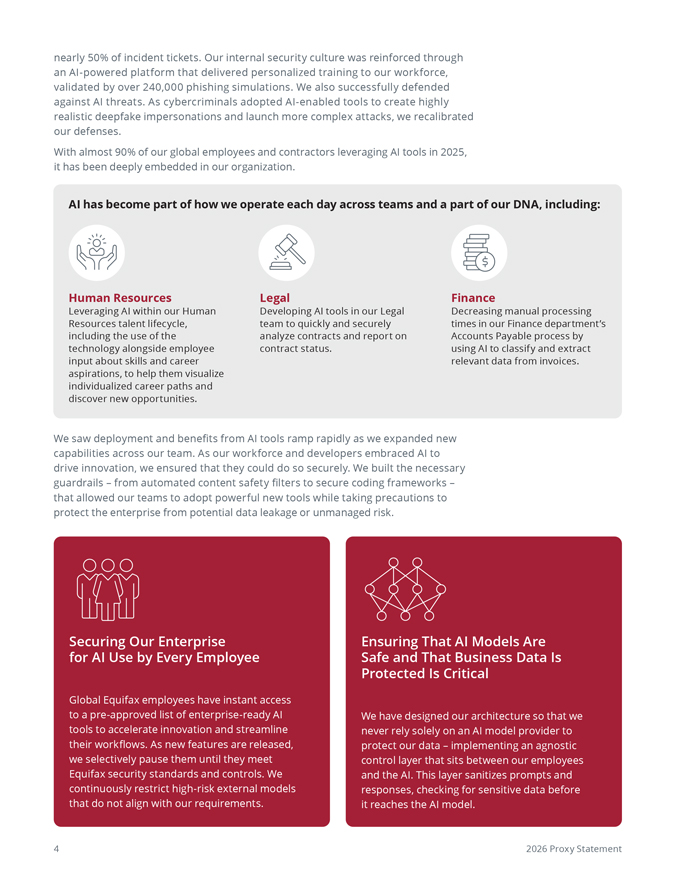
nearly 50% of incident tickets. Our internal security culture was reinforced through an AI-powered platform that delivered personalized training to our workforce, validated by over 240,000 phishing simulations. We also successfully defended against AI threats. As cybercriminals adopted AI-enabled tools to create highly realistic deepfake impersonations and launch more complex attacks, we recalibrated our defenses. With almost 90% of our global employees and contractors leveraging AI tools in 2025, it has been deeply embedded in our organization. AI has become part of how we operate each day across teams and a part of our DNA, including: Human Resources Legal Finance Leveraging AI within our Human Developing AI tools in our Legal Decreasing manual processing Resources talent lifecycle, team to quickly and securely times in our Finance department’s including the use of the analyze contracts and report on Accounts Payable process by technology alongside employee contract status. using AI to classify and extract input about skills and career relevant data from invoices. aspirations, to help them visualize individualized career paths and discover new opportunities. We saw deployment and benefits from AI tools ramp rapidly as we expanded new capabilities across our team. As our workforce and developers embraced AI to drive innovation, we ensured that they could do so securely. We built the necessary guardrails – from automated content safety filters to secure coding frameworks – that allowed our teams to adopt powerful new tools while taking precautions to protect the enterprise from potential data leakage or unmanaged risk. Securing Our Enterprise Ensuring That AI Models Are for AI Use by Every Employee Safe and That Business Data Is Protected Is Critical Global Equifax employees have instant access to a pre-approved list of enterprise-ready AI We have designed our architecture so that we tools to accelerate innovation and streamline never rely solely on an AI model provider to their workflows. As new features are released, protect our data – implementing an agnostic we selectively pause them until they meet control layer that sits between our employees Equifax security standards and controls. We and the AI. This layer sanitizes prompts and continuously restrict high-risk external models responses, checking for sensitive data before that do not align with our requirements. it reaches the AI model.
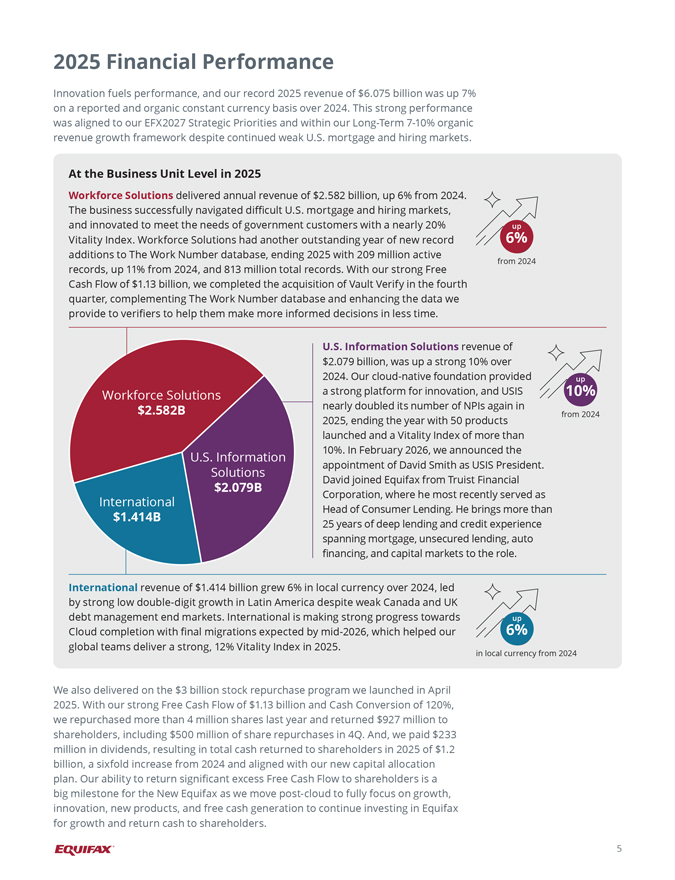
2025 Financial Performance Innovation fuels performance, and our record 2025 revenue of $6.075 billion was up 7% on a reported and organic constant currency basis over 2024. This strong performance was aligned to our EFX2027 Strategic Priorities and within our Long-Term 7-10% organic revenue growth framework despite continued weak U.S. mortgage and hiring markets. At the Business Unit Level in 2025 Workforce Solutions delivered annual revenue of $2.582 billion, up 6% from 2024. The business successfully navigated difficult U.S. mortgage and hiring markets, and innovated to meet the needs of government customers with a nearly 20% up Vitality Index. Workforce Solutions had another outstanding year of new record 6% additions to The Work Number database, ending 2025 with 209 million active from 2024 records, up 11% from 2024, and 813 million total records. With our strong Free Cash Flow of $1.13 billion, we completed the acquisition of Vault Verify in the fourth quarter, complementing The Work Number database and enhancing the data we provide to verifiers to help them make more informed decisions in less time. U.S. Information Solutions revenue of $2.079 billion, was up a strong 10% over 2024. Our cloud-native foundation provided up Workforce Solutions a strong platform for innovation, and USIS 10% $2.582B nearly doubled its number of NPIs again in from 2024 2025, ending the year with 50 products launched and a Vitality Index of more than 10%. In February 2026, we announced the U.S. Information appointment of David Smith as USIS President. Solutions David joined Equifax from Truist Financial $2.079B Corporation, where he most recently served as International Head of Consumer Lending. He brings more than $1.414B 25 years of deep lending and credit experience spanning mortgage, unsecured lending, auto financing, and capital markets to the role. International revenue of $1.414 billion grew 6% in local currency over 2024, led by strong low double-digit growth in Latin America despite weak Canada and UK debt management end markets. International is making strong progress towards up Cloud completion with final migrations expected by mid-2026, which helped our 6% global teams deliver a strong, 12% Vitality Index in 2025. in local currency from 2024 We also delivered on the $3 billion stock repurchase program we launched in April 2025. With our strong Free Cash Flow of $1.13 billion and Cash Conversion of 120%, we repurchased more than 4 million shares last year and returned $927 million to shareholders, including $500 million of share repurchases in 4Q. And, we paid $233 million in dividends, resulting in total cash returned to shareholders in 2025 of $1.2 billion, a sixfold increase from 2024 and aligned with our new capital allocation plan. Our ability to return significant excess Free Cash Flow to shareholders is a big milestone for the New Equifax as we move post-cloud to fully focus on growth, innovation, new products, and free cash generation to continue investing in Equifax for growth and return cash to shareholders.
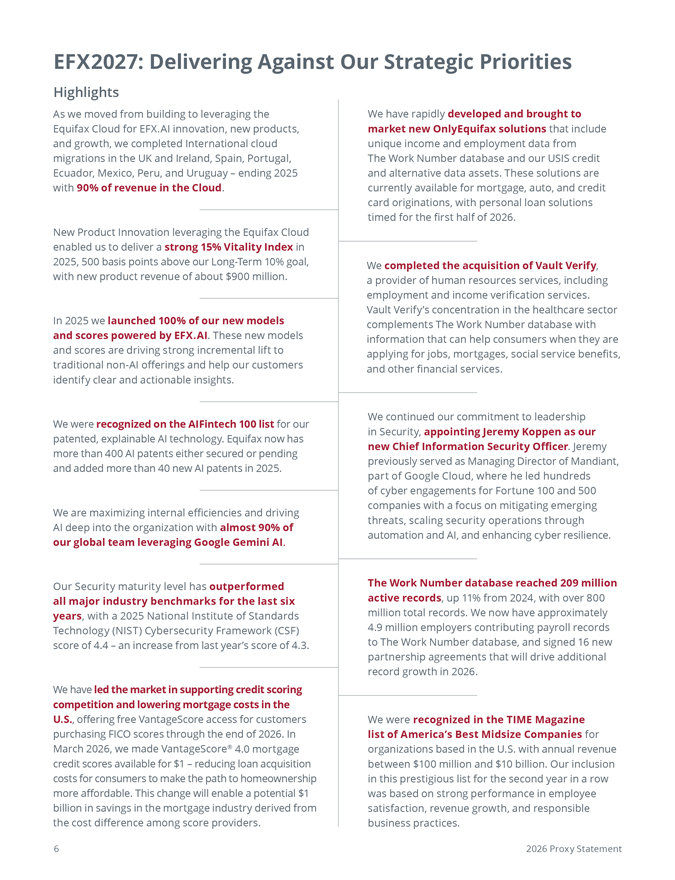
EFX2027: Delivering Against Our Strategic Priorities Highlights As we moved from building to leveraging the We have rapidly developed and brought to Equifax Cloud for EFX.AI innovation, new products, market new OnlyEquifax solutions that include and growth, we completed International cloud unique income and employment data from migrations in the UK and Ireland, Spain, Portugal, The Work Number database and our USIS credit Ecuador, Mexico, Peru, and Uruguay – ending 2025 and alternative data assets. These solutions are with 90% of revenue in the Cloud. currently available for mortgage, auto, and credit card originations, with personal loan solutions timed for the first half of 2026. New Product Innovation leveraging the Equifax Cloud enabled us to deliver a strong 15% Vitality Index in 2025, 500 basis points above our Long-Term 10% goal, We completed the acquisition of Vault Verify, with new product revenue of about $900 million. a provider of human resources services, including employment and income verification services. In 2025 we launched 100% of our new models Vault Verify’s concentration in the healthcare sector and scores powered by EFX.AI. These new models complements The Work Number database with and scores are driving strong incremental lift to information that can help consumers when they are traditional non-AI offerings and help our customers applying for jobs, mortgages, social service benefits, identify clear and actionable insights. and other financial services. We continued our commitment to leadership We were recognized on the AIFintech 100 list for our in Security, appointing Jeremy Koppen as our patented, explainable AI technology. Equifax now has new Chief Information Security Officer. Jeremy more than 400 AI patents either secured or pending previously served as Managing Director of Mandiant, and added more than 40 new AI patents in 2025. part of Google Cloud, where he led hundreds of cyber engagements for Fortune 100 and 500 companies with a focus on mitigating emerging We are maximizing internal efficiencies and driving threats, scaling security operations through AI deep into the organization with almost 90% of automation and AI, and enhancing cyber resilience. our global team leveraging Google Gemini AI. Our Security maturity level has outperformed The Work Number database reached 209 million all major industry benchmarks for the last six active records, up 11% from 2024, with over 800 years, with a 2025 National Institute of Standards million total records. We now have approximately Technology (NIST) Cybersecurity Framework (CSF) 4.9 million employers contributing payroll records score of 4.4 – an increase from last year’s score of 4.3. to The Work Number database, and signed 16 new partnership agreements that will drive additional record growth in 2026. We have led the market in supporting credit scoring competition and lowering mortgage costs in the U.S., offering free VantageScore access for customers We were recognized in the TIME Magazine purchasing FICO scores through the end of 2026. In list of America’s Best Midsize Companies for March 2026, we made VantageScore® 4.0 mortgage organizations based in the U.S. with annual revenue credit scores available for $1 – reducing loan acquisition between $100 million and $10 billion. Our inclusion costs for consumers to make the path to homeownership in this prestigious list for the second year in a row more affordable. This change will enable a potential $1 was based on strong performance in employee billion in savings in the mortgage industry derived from satisfaction, revenue growth, and responsible the cost difference among score providers. business practices.
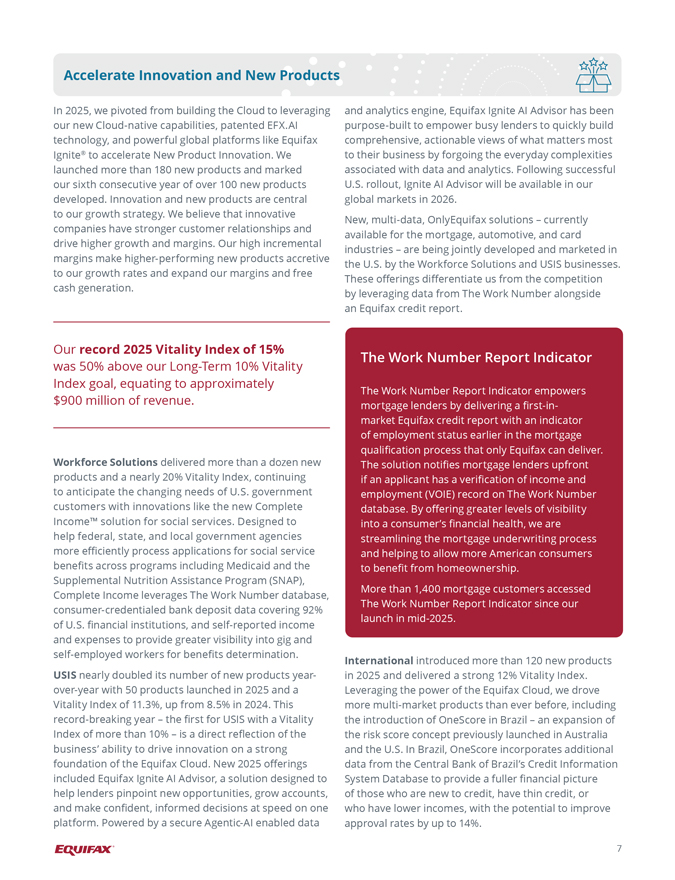
Accelerate Innovation and New Products In 2025, we pivoted from building the Cloud to leveraging and analytics engine, Equifax Ignite AI Advisor has been our new Cloud-native capabilities, patented EFX.AI purpose-built to empower busy lenders to quickly build technology, and powerful global platforms like Equifax comprehensive, actionable views of what matters most Ignite® to accelerate New Product Innovation. We to their business by forgoing the everyday complexities launched more than 180 new products and marked associated with data and analytics. Following successful our sixth consecutive year of over 100 new products U.S. rollout, Ignite AI Advisor will be available in our developed. Innovation and new products are central global markets in 2026. to our growth strategy. We believe that innovative New, multi-data, OnlyEquifax solutions – currently companies have stronger customer relationships and available for the mortgage, automotive, and card drive higher growth and margins. Our high incremental industries – are being jointly developed and marketed in margins make higher-performing new products accretive the U.S. by the Workforce Solutions and USIS businesses. to our growth rates and expand our margins and free These offerings differentiate us from the competition cash generation. by leveraging data from The Work Number alongside an Equifax credit report. Our record 2025 Vitality Index of 15% The Work Number Report Indicator was 50% above our Long-Term 10% Vitality Index goal, equating to approximately The Work Number Report Indicator empowers $900 million of revenue. mortgage lenders by delivering a first-in-market Equifax credit report with an indicator of employment status earlier in the mortgage qualification process that only Equifax can deliver. Workforce Solutions delivered more than a dozen new The solution notifies mortgage lenders upfront products and a nearly 20% Vitality Index, continuing if an applicant has a verification of income and to anticipate the changing needs of U.S. government employment (VOIE) record on The Work Number customers with innovations like the new Complete database. By offering greater levels of visibility Income™ solution for social services. Designed to into a consumer’s financial health, we are help federal, state, and local government agencies streamlining the mortgage underwriting process more efficiently process applications for social service and helping to allow more American consumers benefits across programs including Medicaid and the to benefit from homeownership. Supplemental Nutrition Assistance Program (SNAP), More than 1,400 mortgage customers accessed Complete Income leverages The Work Number database, The Work Number Report Indicator since our consumer-credentialed bank deposit data covering 92% launch in mid-2025. of U.S. financial institutions, and self-reported income and expenses to provide greater visibility into gig and self-employed workers for benefits determination. International introduced more than 120 new products USIS nearly doubled its number of new products year- in 2025 and delivered a strong 12% Vitality Index. over-year with 50 products launched in 2025 and a Leveraging the power of the Equifax Cloud, we drove Vitality Index of 11.3%, up from 8.5% in 2024. This more multi-market products than ever before, including record-breaking year – the first for USIS with a Vitality the introduction of OneScore in Brazil – an expansion of Index of more than 10% – is a direct reflection of the the risk score concept previously launched in Australia business’ ability to drive innovation on a strong and the U.S. In Brazil, OneScore incorporates additional foundation of the Equifax Cloud. New 2025 offerings data from the Central Bank of Brazil’s Credit Information included Equifax Ignite AI Advisor, a solution designed to System Database to provide a fuller financial picture help lenders pinpoint new opportunities, grow accounts, of those who are new to credit, have thin credit, or and make confident, informed decisions at speed on one who have lower incomes, with the potential to improve platform. Powered by a secure Agentic-AI enabled data approval rates by up to 14%.
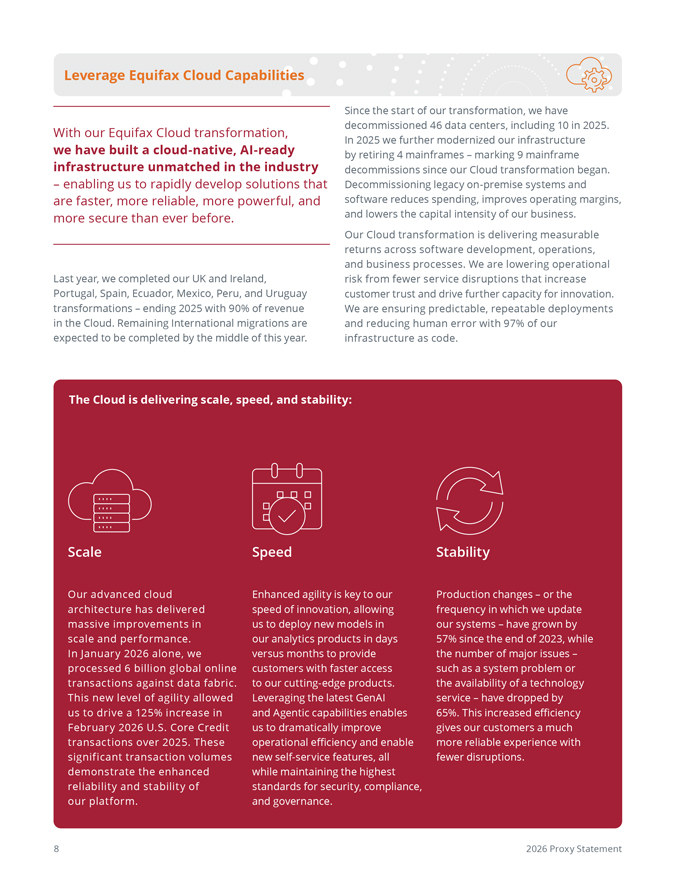
Leverage Equifax Cloud Capabilities Since the start of our transformation, we have decommissioned 46 data centers, including 10 in 2025. With our Equifax Cloud transformation, In 2025 we further modernized our infrastructure we have built a cloud-native, AI-ready by retiring 4 mainframes – marking 9 mainframe infrastructure unmatched in the industry decommissions since our Cloud transformation began. – enabling us to rapidly develop solutions that Decommissioning legacy on-premise systems and are faster, more reliable, more powerful, and software reduces spending, improves operating margins, more secure than ever before. and lowers the capital intensity of our business. Our Cloud transformation is delivering measurable returns across software development, operations, and business processes. We are lowering operational Last year, we completed our UK and Ireland, risk from fewer service disruptions that increase Portugal, Spain, Ecuador, Mexico, Peru, and Uruguay customer trust and drive further capacity for innovation. transformations – ending 2025 with 90% of revenue We are ensuring predictable, repeatable deployments in the Cloud. Remaining International migrations are and reducing human error with 97% of our expected to be completed by the middle of this year. infrastructure as code. The Cloud is delivering scale, speed, and stability: Scale Speed Stability Our advanced cloud Enhanced agility is key to our Production changes – or the architecture has delivered speed of innovation, allowing frequency in which we update massive improvements in us to deploy new models in our systems – have grown by scale and performance. our analytics products in days 57% since the end of 2023, while In January 2026 alone, we versus months to provide the number of major issues – processed 6 billion global online customers with faster access such as a system problem or transactions against data fabric. to our cutting-edge products. the availability of a technology This new level of agility allowed Leveraging the latest GenAI service – have dropped by us to drive a 125% increase in and Agentic capabilities enables 65%. This increased efficiency February 2026 U.S. Core Credit us to dramatically improve gives our customers a much transactions over 2025. These operational efficiency and enable more reliable experience with significant transaction volumes new self-service features, all fewer disruptions. demonstrate the enhanced while maintaining the highest reliability and stability of standards for security, compliance, our platform. and governance.
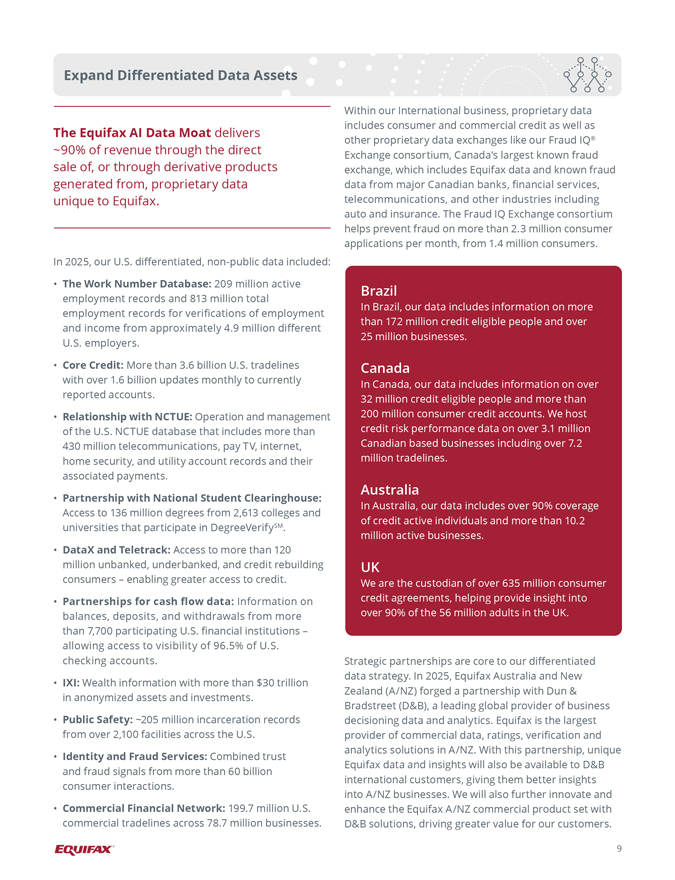
Expand Differentiated Data Assets Within our International business, proprietary data includes consumer and commercial credit as well as The Equifax AI Data Moat delivers other proprietary data exchanges like our Fraud IQ® ~90% of revenue through the direct Exchange consortium, Canada’s largest known fraud sale of, or through derivative products exchange, which includes Equifax data and known fraud generated from, proprietary data data from major Canadian banks, financial services, unique to Equifax. telecommunications, and other industries including auto and insurance. The Fraud IQ Exchange consortium helps prevent fraud on more than 2.3 million consumer applications per month, from 1.4 million consumers. In 2025, our U.S. differentiated, non-public data included: • The Work Number Database: 209 million active Brazil employment records and 813 million total In Brazil, our data includes information on more employment records for verifications of employment than 172 million credit eligible people and over and income from approximately 4.9 million different 25 million businesses. U.S. employers. • Core Credit: More than 3.6 billion U.S. tradelines Canada with over 1.6 billion updates monthly to currently In Canada, our data includes information on over reported accounts. 32 million credit eligible people and more than • Relationship with NCTUE: Operation and management 200 million consumer credit accounts. We host of the U.S. NCTUE database that includes more than credit risk performance data on over 3.1 million 430 million telecommunications, pay TV, internet, Canadian based businesses including over 7.2 home security, and utility account records and their million tradelines. associated payments. Australia • Partnership with National Student Clearinghouse: In Australia, our data includes over 90% coverage Access to 136 million degrees from 2,613 colleges and of credit active individuals and more than 10.2 universities that participate in DegreeVerifySM. million active businesses. • DataX and Teletrack: Access to more than 120 million unbanked, underbanked, and credit rebuilding UK consumers – enabling greater access to credit. We are the custodian of over 635 million consumer • Partnerships for cash flow data: Information on credit agreements, helping provide insight into balances, deposits, and withdrawals from more over 90% of the 56 million adults in the UK. than 7,700 participating U.S. financial institutions – allowing access to visibility of 96.5% of U.S. checking accounts. Strategic partnerships are core to our differentiated data strategy. In 2025, Equifax Australia and New • IXI: Wealth information with more than $30 trillion Zealand (A/NZ) forged a partnership with Dun & in anonymized assets and investments. Bradstreet (D&B), a leading global provider of business • Public Safety: ~205 million incarceration records decisioning data and analytics. Equifax is the largest from over 2,100 facilities across the U.S. provider of commercial data, ratings, verification and analytics solutions in A/NZ. With this partnership, unique • Identity and Fraud Services: Combined trust Equifax data and insights will also be available to D&B and fraud signals from more than 60 billion international customers, giving them better insights consumer interactions. into A/NZ businesses. We will also further innovate and • Commercial Financial Network: 199.7 million U.S. enhance the Equifax A/NZ commercial product set with commercial tradelines across 78.7 million businesses. D&B solutions, driving greater value for our customers.
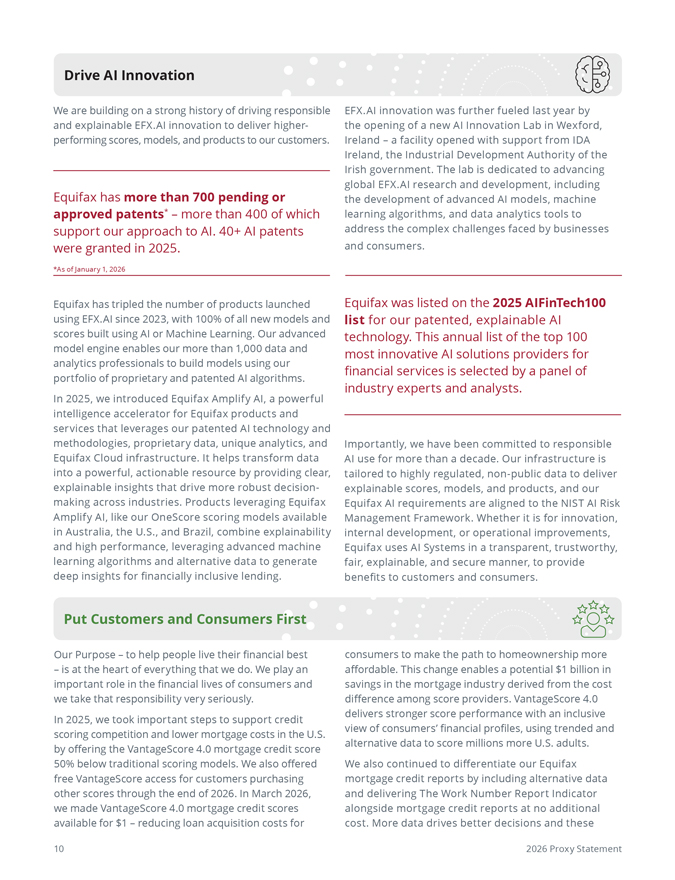
Drive AI Innovation We are building on a strong history of driving responsible EFX.AI innovation was further fueled last year by and explainable EFX.AI innovation to deliver higher- the opening of a new AI Innovation Lab in Wexford, performing scores, models, and products to our customers. Ireland – a facility opened with support from IDA Ireland, the Industrial Development Authority of the Irish government. The lab is dedicated to advancing Equifax has more than 700 pending or global EFX.AI research and development, including the development of advanced AI models, machine approved patents* – more than 400 of which learning algorithms, and data analytics tools to support our approach to AI. 40+ AI patents address the complex challenges faced by businesses were granted in 2025. and consumers. *As of January 1, 2026 Equifax has tripled the number of products launched Equifax was listed on the 2025 AIFinTech100 using EFX.AI since 2023, with 100% of all new models and list for our patented, explainable AI scores built using AI or Machine Learning. Our advanced technology. This annual list of the top 100 model engine enables our more than 1,000 data and most innovative AI solutions providers for analytics professionals to build models using our financial services is selected by a panel of portfolio of proprietary and patented AI algorithms. industry experts and analysts. In 2025, we introduced Equifax Amplify AI, a powerful intelligence accelerator for Equifax products and services that leverages our patented AI technology and methodologies, proprietary data, unique analytics, and Importantly, we have been committed to responsible Equifax Cloud infrastructure. It helps transform data AI use for more than a decade. Our infrastructure is into a powerful, actionable resource by providing clear, tailored to highly regulated, non-public data to deliver explainable insights that drive more robust decision- explainable scores, models, and products, and our making across industries. Products leveraging Equifax Equifax AI requirements are aligned to the NIST AI Risk Amplify AI, like our OneScore scoring models available Management Framework. Whether it is for innovation, in Australia, the U.S., and Brazil, combine explainability internal development, or operational improvements, and high performance, leveraging advanced machine Equifax uses AI Systems in a transparent, trustworthy, learning algorithms and alternative data to generate fair, explainable, and secure manner, to provide deep insights for financially inclusive lending. benefits to customers and consumers. Put Customers and Consumers First Our Purpose – to help people live their financial best consumers to make the path to homeownership more – is at the heart of everything that we do. We play an affordable. This change enables a potential $1 billion in important role in the financial lives of consumers and savings in the mortgage industry derived from the cost we take that responsibility very seriously. difference among score providers. VantageScore 4.0 delivers stronger score performance with an inclusive In 2025, we took important steps to support credit view of consumers’ financial profiles, using trended and scoring competition and lower mortgage costs in the U.S. alternative data to score millions more U.S. adults. by offering the VantageScore 4.0 mortgage credit score 50% below traditional scoring models. We also offered We also continued to differentiate our Equifax free VantageScore access for customers purchasing mortgage credit reports by including alternative data other scores through the end of 2026. In March 2026, and delivering The Work Number Report Indicator we made VantageScore 4.0 mortgage credit scores alongside mortgage credit reports at no additional available for $1 – reducing loan acquisition costs for cost. More data drives better decisions and these
fuller insights are designed to help more Americans live bankruptcy disputes within the month that resulted in their financial best and achieve the American dream a change to a U.S. consumer credit report (regardless of of homeownership. whether that change had any impact on a consumer’s credit score). Our New Product Innovation also plays a critical Offering VantageScore 4.0 mortgage credit role in helping people live their financial best. In the U.S. and Canada, our Optimal Path interactive score scores for $1 provides a 90% savings over planner uses EFX.AI to deliver personalized monthly lenders’ current mortgage credit score recommendations that help consumers reach their costs. This move builds on the February individual credit score goals. This breakthrough offering 2026 economic benefits study from credit is designed to help financial institutions, employers, risk research company Deep Future Analytics benefits providers, and other organizations provide which quantified the impact of Federal Housing consumers with personalized, actionable credit score Finance Agency (FHFA) Director Bill Pulte’s July plans within their existing consumer financial health initiatives and platforms. It was released as part of the 2025 decision to authorize VantageScore 4.0 for U.S. myEquifax application in early 2026. competitive use in GSE-conforming mortgages. More than 200 Equifax mortgage lender customers were testing or in production with Equifax was ranked as a 2025 leader in U.S. VantageScore 4.0 at the end of 2025 given the Alternative Credit Scoring, recognized by significant cost savings opportunity. CB Insights for our unique alternative data sources (information not included in traditional credit reports like telecommunications and We are committed to providing consumers with the utility payment data) and our ability to help resources that they need to increase their financial create a fuller financial picture of those who capability. In 2025, we continued to expand the services we are new to credit or rebuilding their credit. provide to help people better understand their personal finances and the credit system. Examples included: • Further supporting the needs of our 30.3 million Getting the Right Benefits to the myEquifax® users in the U.S. with the launch of a Right People at the Right Time new myEquifax mobile application that gives people a convenient way to monitor their financial health from The Work Number plays a critical role in mobile devices. As of February 1, 2026, the application securing important financial moments such as has been downloaded by more than 1 million consumers. starting a new job, leasing a car, applying for a mortgage, or seeking government benefits. We • Evolving the online U.S. myEquifax experience, have provided tens of millions of U.S. social forging an agreement with Gen Digital to leverage the services verifications for people seeking benefits Engine by Gen platform in 2026 to enhance access to while streamlining government operations and personalized financial products for our 10.2 million helping to ensure the integrity of safety net paid Core Credit™ subscribers. programs – an important component of the One Big Beautiful Bill Act signed into law in July 2025. • The introduction of a reimagined U.S. consumer credit report design. Our industry-leading credit report Getting the right benefits to the right people enables people to more easily view their current at the right time is critical. In 2025, The Work credit score and provides easy-to-read graphics for a Number supported instant income and employment comprehensive view of current and past credit activity, verifications for 58 million people outside of regular empowering consumers to better monitor their credit. business hours, helping to efficiently move forward • Transparently publishing a monthly consumer credit processes like evening auto loan or weekend lease applications. The Work Number is available 24/7 to report accuracy metric on our website, and in 2025 credentialed verifiers with permissible purpose Equifax U.S. consumer credit report accuracy averaged and provides automated verifications to help 99.78% each month. This metric is determined by support the best and fastest possible outcomes. calculating the number of tradelines, collections, and
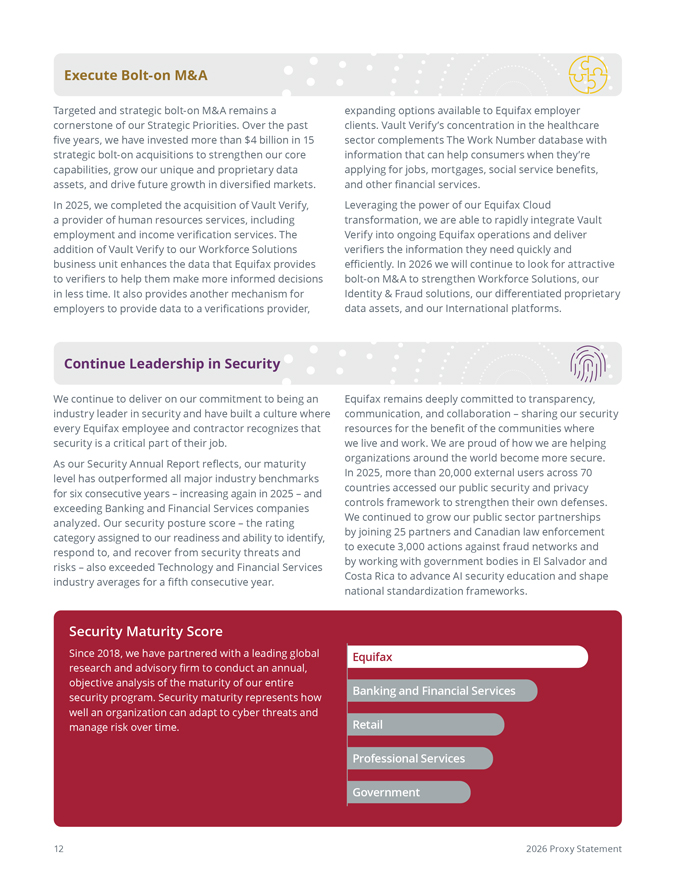
Execute Bolt-on M&A Targeted and strategic bolt-on M&A remains a expanding options available to Equifax employer cornerstone of our Strategic Priorities. Over the past clients. Vault Verify’s concentration in the healthcare five years, we have invested more than $4 billion in 15 sector complements The Work Number database with strategic bolt-on acquisitions to strengthen our core information that can help consumers when they’re capabilities, grow our unique and proprietary data applying for jobs, mortgages, social service benefits, assets, and drive future growth in diversified markets. and other financial services. In 2025, we completed the acquisition of Vault Verify, Leveraging the power of our Equifax Cloud a provider of human resources services, including transformation, we are able to rapidly integrate Vault employment and income verification services. The Verify into ongoing Equifax operations and deliver addition of Vault Verify to our Workforce Solutions verifiers the information they need quickly and business unit enhances the data that Equifax provides efficiently. In 2026 we will continue to look for attractive to verifiers to help them make more informed decisions bolt-on M&A to strengthen Workforce Solutions, our in less time. It also provides another mechanism for Identity & Fraud solutions, our differentiated proprietary employers to provide data to a verifications provider, data assets, and our International platforms. Continue Leadership in Security We continue to deliver on our commitment to being an Equifax remains deeply committed to transparency, industry leader in security and have built a culture where communication, and collaboration – sharing our security every Equifax employee and contractor recognizes that resources for the benefit of the communities where security is a critical part of their job. we live and work. We are proud of how we are helping organizations around the world become more secure. As our Security Annual Report reflects, our maturity In 2025, more than 20,000 external users across 70 level has outperformed all major industry benchmarks countries accessed our public security and privacy for six consecutive years – increasing again in 2025 – and controls framework to strengthen their own defenses. exceeding Banking and Financial Services companies We continued to grow our public sector partnerships analyzed. Our security posture score – the rating by joining 25 partners and Canadian law enforcement category assigned to our readiness and ability to identify, to execute 3,000 actions against fraud networks and respond to, and recover from security threats and by working with government bodies in El Salvador and risks – also exceeded Technology and Financial Services Costa Rica to advance AI security education and shape industry averages for a fifth consecutive year. national standardization frameworks. Security Maturity Score Since 2018, we have partnered with a leading global Equifax research and advisory firm to conduct an annual, objective analysis of the maturity of our entire Banking and Financial Services security program. Security maturity represents how well an organization can adapt to cyber threats and manage risk over time. Retail Professional Services Government
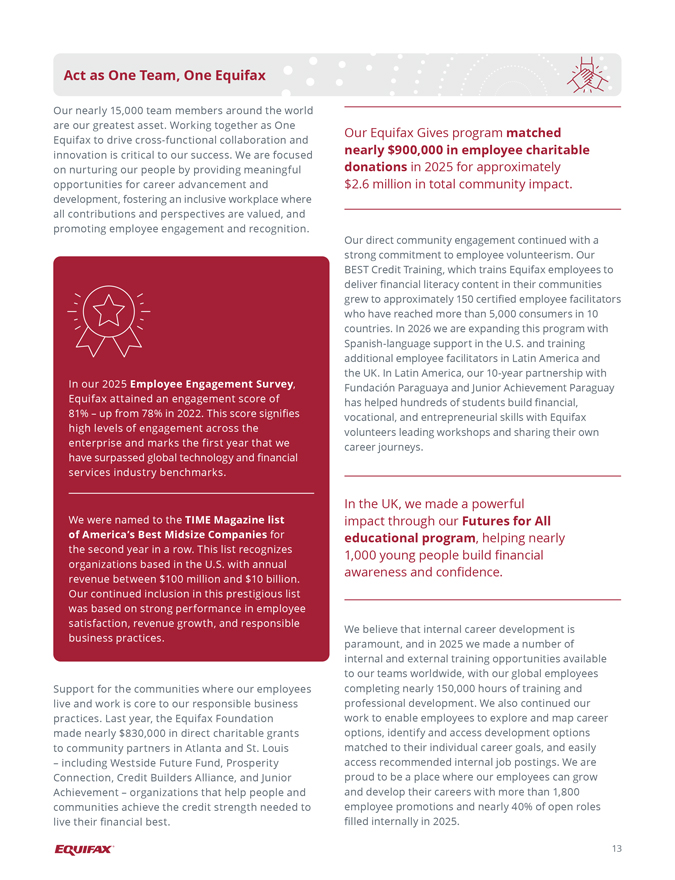
Act as One Team, One Equifax Our nearly 15,000 team members around the world are our greatest asset. Working together as One Our Equifax Gives program matched Equifax to drive cross-functional collaboration and innovation is critical to our success. We are focused nearly $900,000 in employee charitable on nurturing our people by providing meaningful donations in 2025 for approximately opportunities for career advancement and $2.6 million in total community impact. development, fostering an inclusive workplace where all contributions and perspectives are valued, and promoting employee engagement and recognition. Our direct community engagement continued with a strong commitment to employee volunteerism. Our BEST Credit Training, which trains Equifax employees to deliver financial literacy content in their communities grew to approximately 150 certified employee facilitators who have reached more than 5,000 consumers in 10 countries. In 2026 we are expanding this program with Spanish-language support in the U.S. and training additional employee facilitators in Latin America and In our 2025 Employee Engagement Survey, the UK. In Latin America, our 10-year partnership with Equifax attained an engagement score of Fundación Paraguaya and Junior Achievement Paraguay 81% – up from 78% in 2022. This score signifies has helped hundreds of students build financial, high levels of engagement across the vocational, and entrepreneurial skills with Equifax enterprise and marks the first year that we volunteers leading workshops and sharing their own have surpassed global technology and financial career journeys. • Inservices our 2025 industr Employee benchmarks. Engagement Survey, Equifax attained an engagement score of 81% – up from 78% in 2022. This score signifies high levels of engagement In the UK, we made a powerful across We were the named enterprise to the and TIME marks Magazine the first year list that impact through our Futures for All we of have America’s surpassed Best global Midsize technology Companies and financial for educational program, helping nearly services the second industry year benchmarks. in a row. This list recognizes 1,000 young people build financial • We organizations were named based to the in TIME theMagazine U.S. with list annual of America’s awareness and confidence. Best revenue Midsize between Companies $100for million the second and $10 year billion. in a row. This Our list continued recognizes inclusion organization in this based prestigious in the list U.S. with wasannual based revenue on strong between performance $100 million in employee and $10 billion. satisfaction, Our continued revenueinclusion growth, in and this responsible prestig ous We believe that internal career development is list business was based practices. on strong performance in employee paramount, and in 2025 we made a number of satisfaction, revenue growth, and responsible business internal and external training opportunities available practices. to our teams worldwide, with our global employees Support for the communities where our employees completing nearly 150,000 hours of training and live and work is core to our responsible business professional development. We also continued our practices. Last year, the Equifax Foundation work to enable employees to explore and map career made nearly $830,000 in direct charitable grants options, identify and access development options to community partners in Atlanta and St. Louis matched to their individual career goals, and easily – including Westside Future Fund, Prosperity access recommended internal job postings. We are Connection, Credit Builders Alliance, and Junior proud to be a place where our employees can grow Achievement – organizations that help people and and develop their careers with more than 1,800 communities achieve the credit strength needed to employee promotions and nearly 40% of open roles live their financial best. filled internally in 2025.
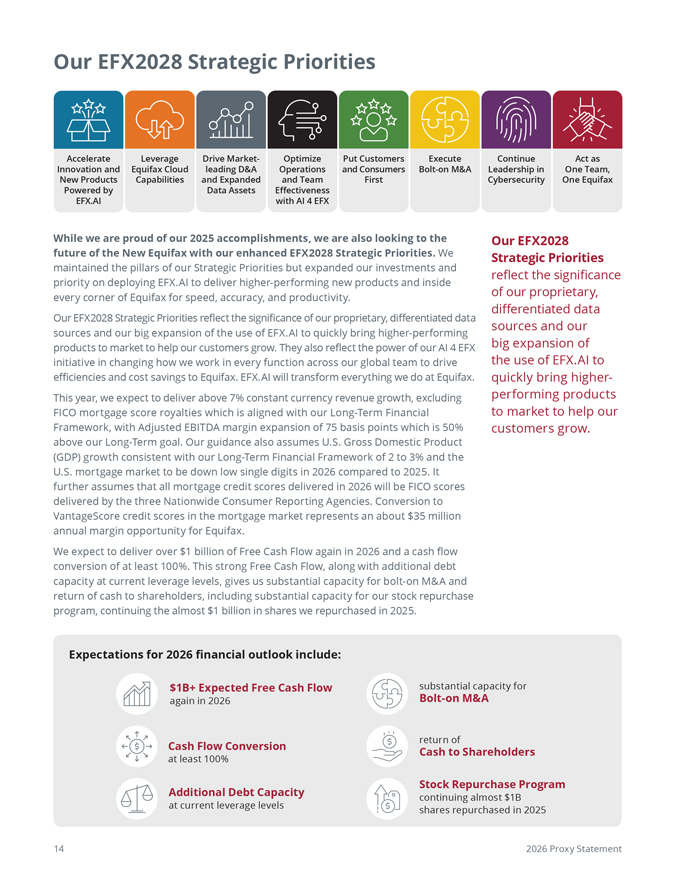
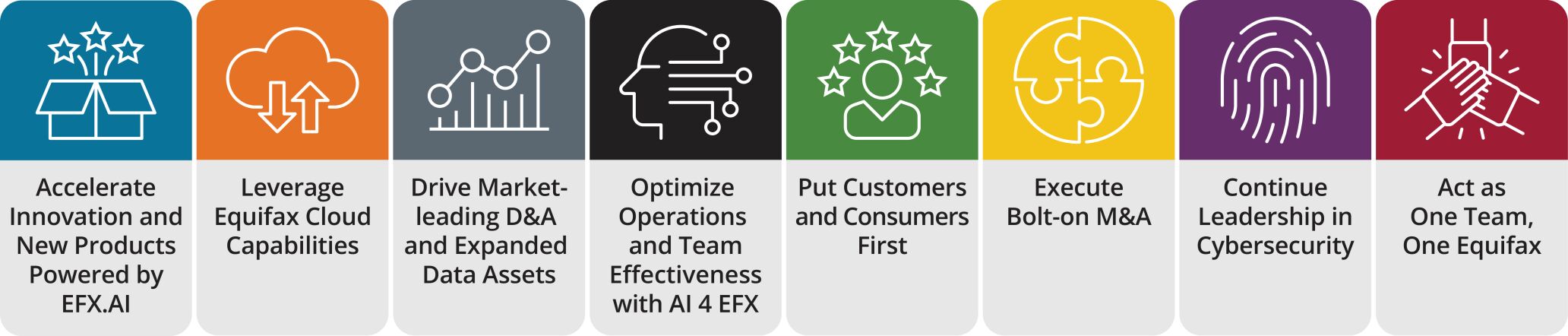
Our EFX2028 Strategic Priorities Accelerate Leverage Drive Market- Optimize Put Customers Execute Continue Act as Innovation and Equifax Cloud leading D&A Operations and Consumers Bolt-on M&A Leadership in One Team, New Products Capabilities and Expanded and Team First Cybersecurity One Equifax Powered by Data Assets Effectiveness EFX.AI with AI 4 EFX While we are proud of our 2025 accomplishments, we are also looking to the Our EFX2028 future of the New Equifax with our enhanced EFX2028 Strategic Priorities. We Strategic Priorities maintained the pillars of our Strategic Priorities but expanded our investments and reflect the significance priority on deploying EFX.AI to deliver higher-performing new products and inside every corner of Equifax for speed, accuracy, and productivity. of our proprietary, differentiated data Our EFX2028 Strategic Priorities reflect the significance of our proprietary, differentiated data sources and our sources and our big expansion of the use of EFX.AI to quickly bring higher-performing products to market to help our customers grow. They also reflect the power of our AI 4 EFX big expansion of initiative in changing how we work in every function across our global team to drive the use of EFX.AI to efficiencies and cost savings to Equifax. EFX.AI will transform everything we do at Equifax. quickly bring higher-This year, we expect to deliver above 7% constant currency revenue growth, excluding performing products FICO mortgage score royalties which is aligned with our Long-Term Financial to market to help our Framework, with Adjusted EBITDA margin expansion of 75 basis points which is 50% customers grow. above our Long-Term goal. Our guidance also assumes U.S. Gross Domestic Product (GDP) growth consistent with our Long-Term Financial Framework of 2 to 3% and the U.S. mortgage market to be down low single digits in 2026 compared to 2025. It further assumes that all mortgage credit scores delivered in 2026 will be FICO scores delivered by the three Nationwide Consumer Reporting Agencies. Conversion to VantageScore credit scores in the mortgage market represents an about $35 million annual margin opportunity for Equifax. We expect to deliver over $1 billion of Free Cash Flow again in 2026 and a cash flow conversion of at least 100%. This strong Free Cash Flow, along with additional debt capacity at current leverage levels, gives us substantial capacity for bolt-on M&A and return of cash to shareholders, including substantial capacity for our stock repurchase program, continuing the almost $1 billion in shares we repurchased in 2025. Expectations for 2026 financial outlook include: $1B+ Expected Free Cash Flow substantial capacity for again in 2026 Bolt-on M&A return of Cash Flow Conversion Cash to Shareholders at least 100% Stock Repurchase Program Additional Debt Capacity continuing almost $1B at current leverage levels shares repurchased in 2025
While the future for many companies will be challenging in the new AI world, we believe the next chapter for Equifax – leveraging our Equifax AI Data Moat of differentiated and proprietary data, new Cloud technology, and expanding EFX.AI capabilities – will be the most exciting in our over 125-year history. Only Equifax can access our unique and scale data assets for AI and delivery to our customers. The New Equifax is purpose built for deploying AI in our products and solutions to deliver higher performance and to deploy AI across our operations to deliver speed, accuracy, and productivity. Equifax is on offense with EFX.AI. We are continuing to invest in our industry-leading Cloud technology, EFX.AI capabilities, proprietary data assets, and new products that Only Equifax can provide to help our customers grow and deliver returns for our shareholders. We are energized by our momentum as we enter 2026, but even more energized about the future of the New Equifax powered by EFX.AI. On behalf of the Equifax Board, leadership team, and our nearly 15,000 global employees, we thank you for your ongoing support and confidence in our business. Thank you, Mark W. Begor Mark L. Feidler Chief Executive Officer Independent Chairman and Director of the Board of Directors
PRELIMINARY PROXY STATEMENT – SUBJECT TO COMPLETION
Notice of 2026 Annual Meeting of Shareholders
Agenda
| 1 |
Elect the ten director nominees named in the accompanying Proxy Statement. | |
| 2 |
Hold a non-binding, advisory vote on the compensation paid to the Company’s named executive officers (commonly referred to as “say-on-pay”). | |
| 3 |
Ratify the appointment of Ernst & Young LLP as the Company’s independent registered public accounting firm for 2026. | |
| 4 |
Hold a non-binding, advisory vote to lower the ownership threshold to call a special meeting of shareholders to 25%. | |
| 5 |
Vote on the shareholder proposal described in the accompanying Proxy Statement, if properly presented at the meeting. | |
|
6 |
Consider other business properly brought before the meeting or any adjournment or postponement thereof. |
|
Date, Time & Location: Thursday, May 7, 2026 8:00 a.m. (CT)
The Ritz-Carlton, St. Louis 100 Carondelet Plaza St. Louis, Missouri 63105
|
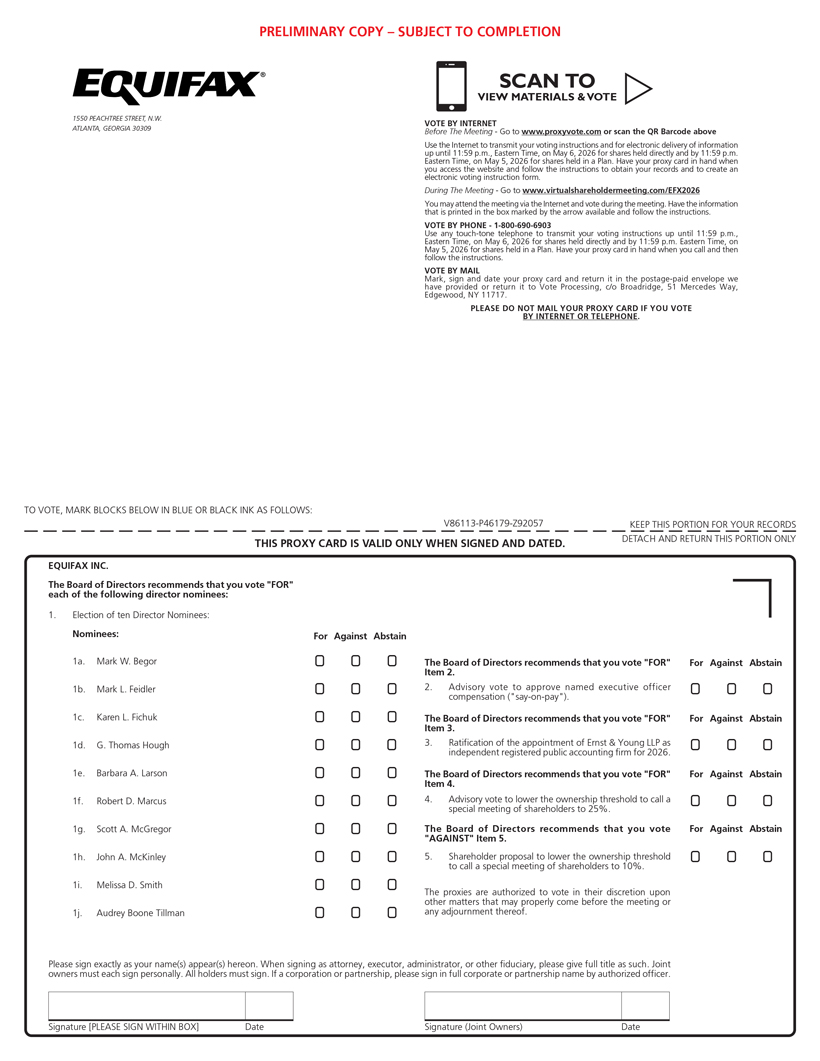
| Review your proxy statement and vote in one of four ways: | ||
|
|
Via the internet Visit the website listed on your proxy card | |
|
|
By telephone Call the telephone number on your proxy card | |
|
|
By mail Sign, date and return your proxy card in the enclosed envelope | |
|
|
Attend the meeting Attend the meeting in person or virtually and cast your vote
| |
Proxies in the form furnished are being solicited by the Board of Directors of Equifax Inc. for this meeting or any adjournment or postponement thereof.
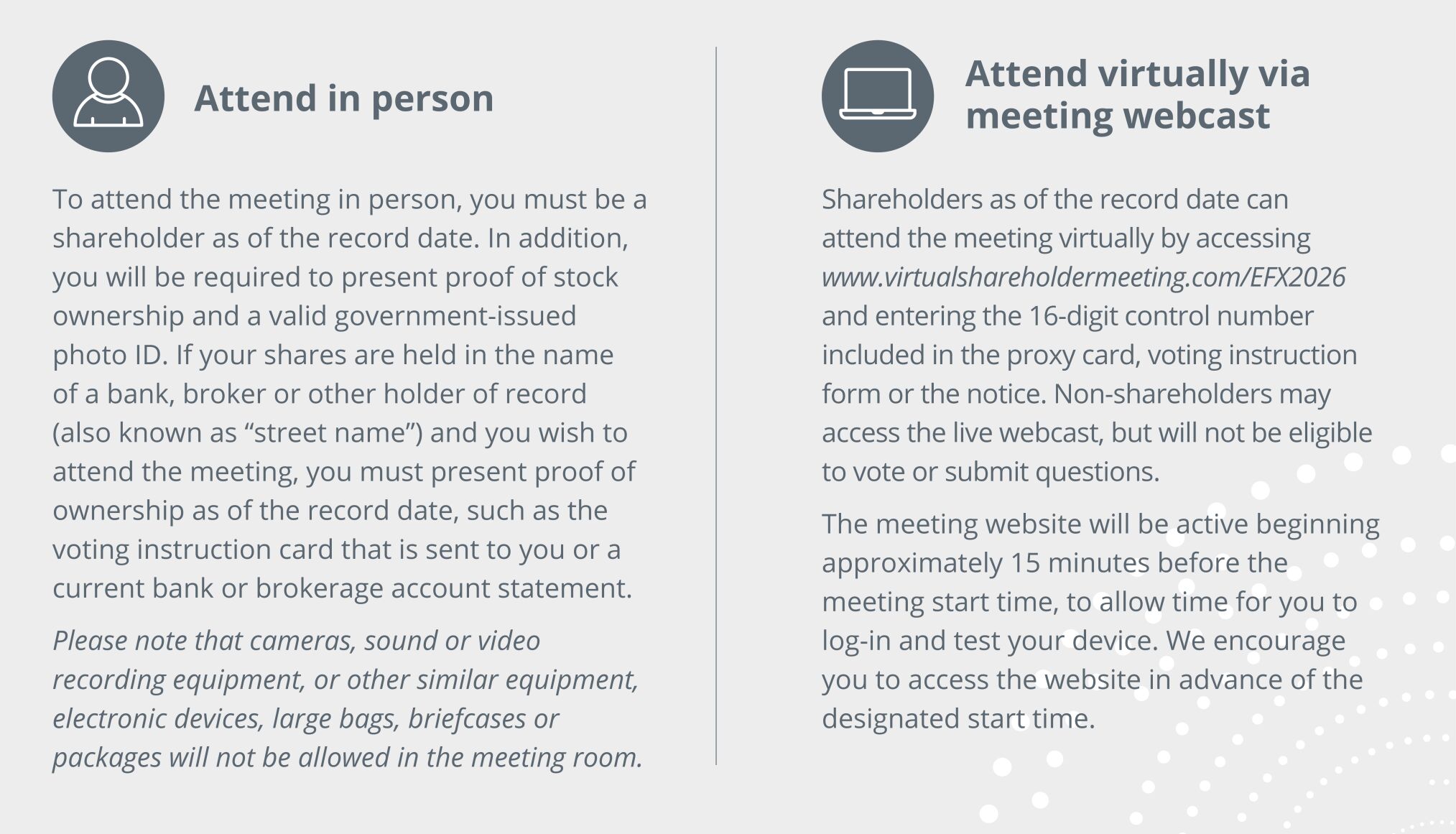
Shareholders are cordially invited to participate in the Annual Meeting by attending in person or attending virtually via our live meeting webcast. See page 134 of the Proxy Statement for more information on how to attend, participate in and vote at the Annual Meeting.
Your vote is very important. Please submit your proxy or voting instructions as soon as possible, whether or not you plan to attend the meeting.
Most shareholders have a choice of voting over the internet, by telephone or by using a traditional proxy card. Please refer to the enclosed proxy materials or the information forwarded by your bank, broker or other holder of record to see which voting methods are available to you.
Proxy materials were first made available to shareholders beginning on March [ ], 2026.
By order of the Board of Directors,
Lisa M. Stockard
SVP, Corporate Secretary
March [ ], 2026
Important Notice Regarding the Availability of Proxy Materials for the Annual Meeting to be held on May 7, 2026. The Notice, Proxy Statement and Annual Report are available at www.proxyvote.com.
|
Election to receive electronic delivery of future annual meeting materials. You can expedite delivery and avoid costly mailings by confirming in advance your preference for electronic delivery. For further information on how to take advantage of this cost-saving service, please see page 137 of the Proxy Statement.
|
| 16 |
2026 Proxy Statement |
Table of Contents
| Proxy Summary | 18 | |||
| 18 | ||||
| 18 | ||||
| 18 | ||||
| 19 | ||||
| 21 | ||||
| 21 | ||||
| 22 | ||||
| 23 | ||||
| 24 | ||||
| 26 | ||||
| Proposal 1 Election of Director Nominees | 28 | |||
| 28 | ||||
| 29 | ||||
| 39 | ||||
| 40 | ||||
| Board Leadership and Corporate Governance | 41 | |||
| 41 | ||||
| 41 | ||||
| 43 | ||||
| 44 | ||||
| 44 | ||||
| 45 | ||||
| 48 | ||||
| 48 | ||||
| 49 | ||||
| Management Succession Planning and Talent Development Process |
49 | |||
| 50 | ||||
| 50 | ||||
| 51 | ||||
| 52 | ||||
| 53 | ||||
| Responsible AI at Equifax | 54 | |||
| Proposal 2 Advisory Vote to Approve Named Executive Officer Compensation | 57 | |||
| 57 | ||||
| 58 | ||||
| Executive Compensation | 59 | |||
| 59 | ||||
| 92 | ||||
| 93 | ||||
| 95 | ||||
| 97 | ||||
| 100 | ||||
| 101 | ||||
| 101 | ||||
| 102 | ||||
| 104 | ||||
| 112 | ||||
| Pay Versus Performance Disclosure |
113 | |||
| 117 | ||||
| 117 | ||||
| Director Compensation | 118 | |||
| 118 | ||||
| 119 | ||||
| 119 | ||||
| 119 | ||||
| 119 | ||||
| Equifax Inc. Board of Directors Deferred Compensation Plan (2022) |
120 | |||
| Security Ownership of Management and Certain Beneficial Owners | 121 | |||
| 121 | ||||
| 122 | ||||
| 123 | ||||
| Audit Committee Report | 124 | |||
| Proposal 3 Ratification of Appointment of Ernst & Young LLP as Independent Registered Public Accounting Firm for 2026 | 125 | |||
| 126 | ||||
| 126 | ||||
| Proposal 4 Advisory Vote to Lower Ownership Threshold to Call a Special Meeting of Shareholders to 25% | 127 | |||
| 129 | ||||
| Proposal 5 Shareholder Proposal to Lower Ownership Threshold to Call a Special Meeting of Shareholders to 10% | 130 | |||
| Questions and Answers about the Annual Meeting | 134 | |||
| Annex A Reconciliation of Non-GAAP Financial Measures | 142 | |||
| Annex B Proposed Amendments to Section 1.2 of the Bylaws | 148 | |||
| Annex C Forward-Looking Statements | 151 | |||
|
|
17 |
Proxy Summary
This summary highlights certain information contained in this Proxy Statement. This summary does not contain all of the information that you should consider, and we encourage you to read the entire Proxy Statement before voting.
Equifax 2026 Annual Meeting Information
| Time and Date: | 8:00 a.m., Central Time, on May 7, 2026 | |||
| Location: | The Ritz-Carlton, St. Louis 100 Carondelet Plaza St. Louis, Missouri 63105 | |||
Items of Business and Voting Recommendations
| Item of Business | Board Vote Recommendation | Further Details | ||||
| 1. | Election of Ten Directors | The Board recommends a vote “FOR” each of our director nominees | See page 28 | |||
| 2. | Non-binding, advisory vote to approve Named Executive Officer Compensation (“Say-on-Pay”) | The Board recommends a vote “FOR” this proposal | See page 57 | |||
| 3. | Ratification of Appointment of Ernst & Young LLP as Independent Registered Public Accounting Firm for 2026 | The Board recommends a vote “FOR” this proposal | See page 125 | |||
| 4. | Non-binding, advisory vote to lower the ownership threshold to call a special meeting of shareholders to 25% | The Board recommends a vote “FOR” this proposal | See page 127 | |||
| 5. | Shareholder proposal as described in this Proxy Statement, if properly presented at the meeting | The Board recommends a vote “AGAINST” this proposal | See page 130 | |||
In addition, shareholders may be asked to consider any other business properly brought before the meeting or any adjournment or postponement thereof.
Voting and Admission Information
Voting
Holders of our common stock as of the record date, March 9, 2026, are entitled to notice of and to vote at our 2026 Annual Meeting. Each share of common stock outstanding on the record date is entitled to one vote for each director nominee and one vote for each of the other proposals to be voted on at our 2026 Annual Meeting. Even if you plan to attend our 2026 Annual Meeting, please cast your vote as soon as possible.
|
Review Your Proxy Statement and Vote in One of Four Ways:
| ||||||
|
|
|
| |||
| Via the internet Visit the website listed on your proxy card |
By telephone Call the telephone |
By mail Sign, date and return |
Attend the meeting Attend the meeting
| |||
| 18 |
2026 Proxy Statement |
Admission
Equifax shareholders as of the record date are entitled to attend the 2026 Annual Meeting. Our 2026 Annual Meeting will be held using a “hybrid” in-person and virtual format. Shareholders of record can attend the meeting in person or virtually using the meeting webcast. Please review the admission procedures in this Proxy Statement under “Questions and Answers about the Annual Meeting.”
Website Content Not Incorporated
References to our website included in this Proxy Statement are provided solely for convenience purposes. Content on our website is not, and shall not be deemed to be, part of this Proxy Statement or incorporated herein or into any of our other filings with the U.S. Securities and Exchange Commission (the “SEC”).
Our Company
Overview
Equifax Inc. is a global data, analytics and technology company. We provide information solutions for businesses, governments and consumers, and we provide human resources business process automation and outsourcing services for employers. We have a large and diversified group of clients, including financial institutions, corporations, government agencies and individuals. Headquartered in Atlanta and supported by nearly 15,000 employees worldwide, Equifax operates or has investments in 24 countries in North America, Central and South America, Europe and the Asia Pacific region.
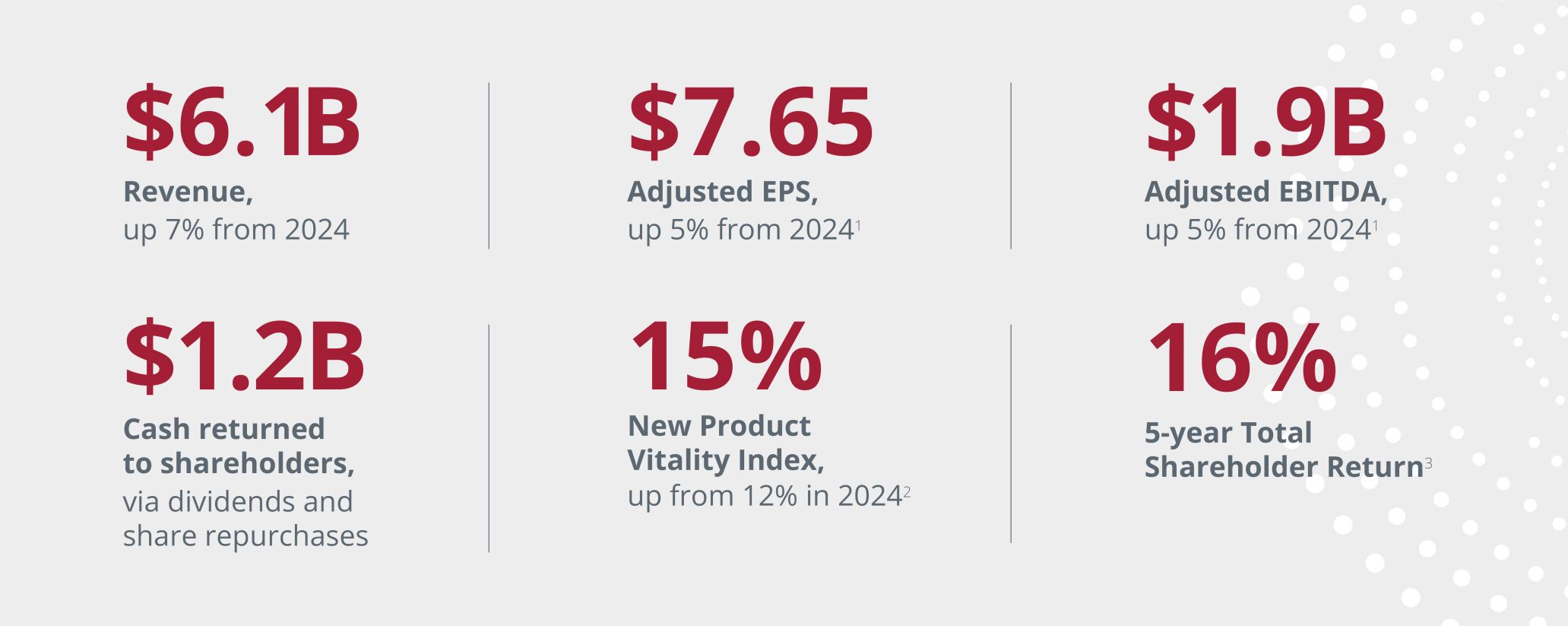
2025 Performance Highlights
| 1 | Adjusted EPS and Adjusted EBITDA are non-GAAP financial measures. Reconciliation of the Company’s non-GAAP financial measures to the corresponding GAAP financial measures can be found in Annex A to this Proxy Statement. |
| 2 | We define “Vitality Index” as the percentage of revenue from new products introduced in the last three years. |
| 3 | As of December 31, 2025. |
|
|
19 |
Strategy
Our enhanced EFX2028 strategic priorities reflect the significance of our proprietary, differentiated data sources and our focus on the use of EFX.AI to quickly bring higher-performing products to market to help our customers grow. They also reflect the power of our internal AI 4 EFX initiative in changing how we work in every function across our global team to drive efficiencies and cost savings to Equifax. With our new Equifax Cloud foundation in place, we are executing against the following strategic priorities:
Our business and strategy are described in more detail in our 2025 Annual Report on Form 10-K filed with the SEC on February 19, 2026. Our 2025 progress against our goals and the link to our 2025 compensation program is described under “Executive Compensation – Compensation Discussion and Analysis – Executive Summary” on page 60.
Who We Are
As a global data, analytics and technology company, we play an essential role in the global economy by helping financial institutions, companies, employers and government agencies make critical decisions with greater confidence. Our unique blend of differentiated data, analytics, and cloud technology drives insights to power decisions to move people forward. Headquartered in Atlanta, Georgia and supported by approximately 15,000 employees worldwide, Equifax operates or has investments in 24 countries in North America, Central and South America, Europe and the Asia Pacific region.
| Our Purpose |
|
Our purpose is helping people live their financial best.
We strive to create economically healthy individuals and communities everywhere we do business. In a single year, our unique data and analytics change millions of lives across the world. |
| Our Values | ||||||
| Our values express who we are, how we work and the behaviors that support our company, our vision and our purpose. They serve as guiding principles for our global team. They are:
| ||||||
|
• Be leaders in security and trusted data stewards
• Lead with integrity and be personally accountable
• Hold high standards in all our markets around the world |
|
• Exceed our customers’ expectations every day
• Deliver value and quality to our customers so we grow together
• Aspire to be our customers’ first call | |||
|
• Deliver results and play to win
• Drive excellent execution
• Have a sense of urgency, agility, and grit |
|
• Work together as one aligned global team
• Assume best intentions from each other
• Foster optimism and have fun together | |||
|
• Be intellectually curious and insights driven
• Optimize our data and technology to sustain market and product leadership
• Drive scalable, profitable growth |
|
• Take initiative to develop ourselves and help others grow
• Value diversity of experience and thought
• Proudly show our Equifax spirit at work and in our communities | |||
| 20 |
2026 Proxy Statement |
Board Refreshment and Composition
Board Refreshment
Board Composition Highlights
|
|
| ||||||||||
|
|
Separate CEO and Chairman roles
| |||||||||||
Shareholder Engagement
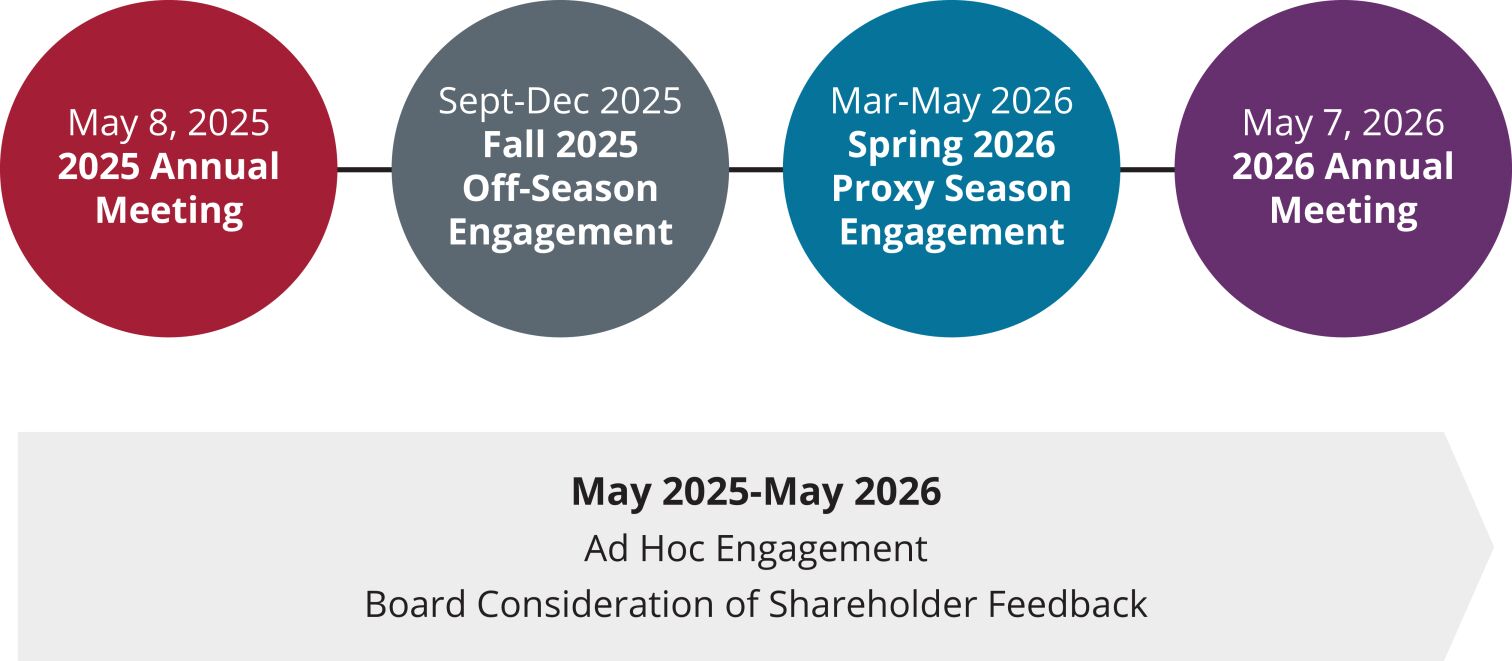
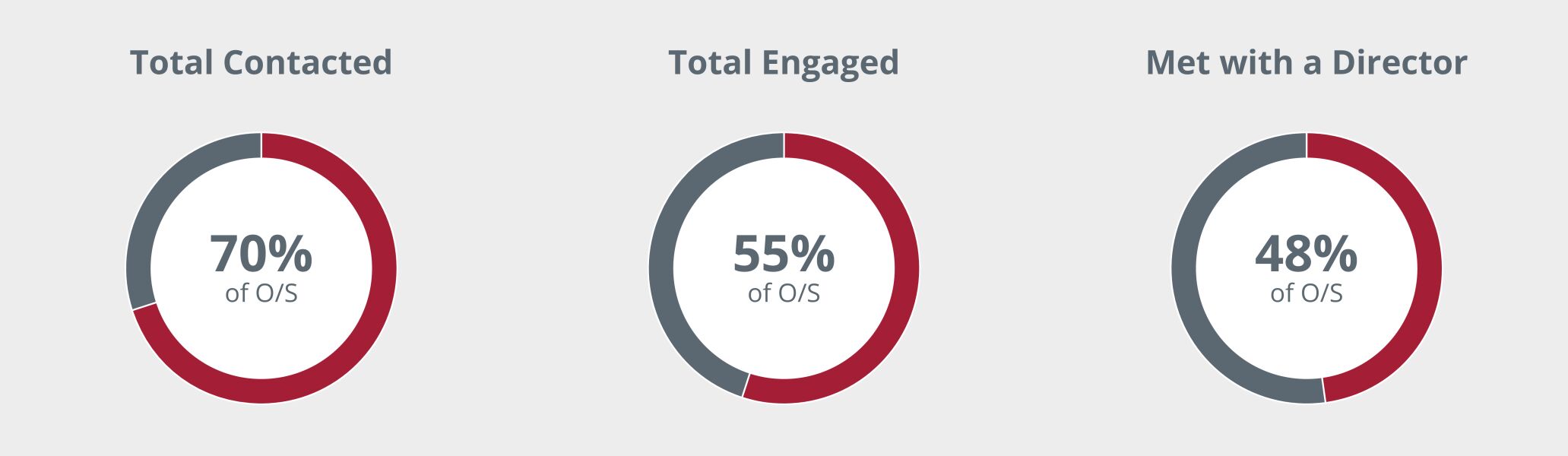
| • | Following our 2025 Annual Meeting, members of management, together with our Independent Chairman or our Compensation Committee Chair for certain conversations, conducted an extensive shareholder outreach program and met with investors holding approximately 55% of our outstanding shares. |
| • | During these one-on-one meetings, we discussed executive compensation, Board governance and oversight (including oversight of artificial intelligence innovation), shareholder rights, initiatives related to consumers and more (see pages 41–42 for an overview of our shareholder engagement program). |
| • | Following these engagements, we continued our long-standing process of sharing feedback received with our Board and relevant Board committees, and taking responsive actions where appropriate (see page 42). |
Since Our 2025 Annual Meeting
|
|
21 |
Responsible Business at Equifax
We have identified a series of responsible business priorities that are aligned with our corporate strategy. By aligning our responsible business priorities with our corporate strategy, we remain focused on the areas that are most relevant to our business, which drives the creation of shareholder value while at the same time positioning our company for long-term sustainability. For more information, see www.equifax.com/about-equifax/responsible-business-priorities.
| Culture and Values |
Security | Privacy | Governance | Consumer Experience |
Financial Inclusion |
Environment | ||||||||||||||||||||
|
|
|
|
|
|
|
||||||||||||||||||||
| 22 |
2026 Proxy Statement |
Our Director Nominees
Our Board recommends that you vote FOR each of the director nominees named below for terms that expire at the 2027 Annual Meeting. The following table provides summary information about each nominee, and you can find additional information under “Proposal 1, Election of Director Nominees” on pages 28–40.
Our Board
|
Mark W. Begor | 67 Chief Executive Officer, Equifax Inc. Director Since: 2018 | |
|
Mark L. Feidler | 69 Independent Chairman, Equifax Inc. Founding Partner, MSouth Equity Partners Director Since: 2007 Committees: Compensation, Governance | |
|
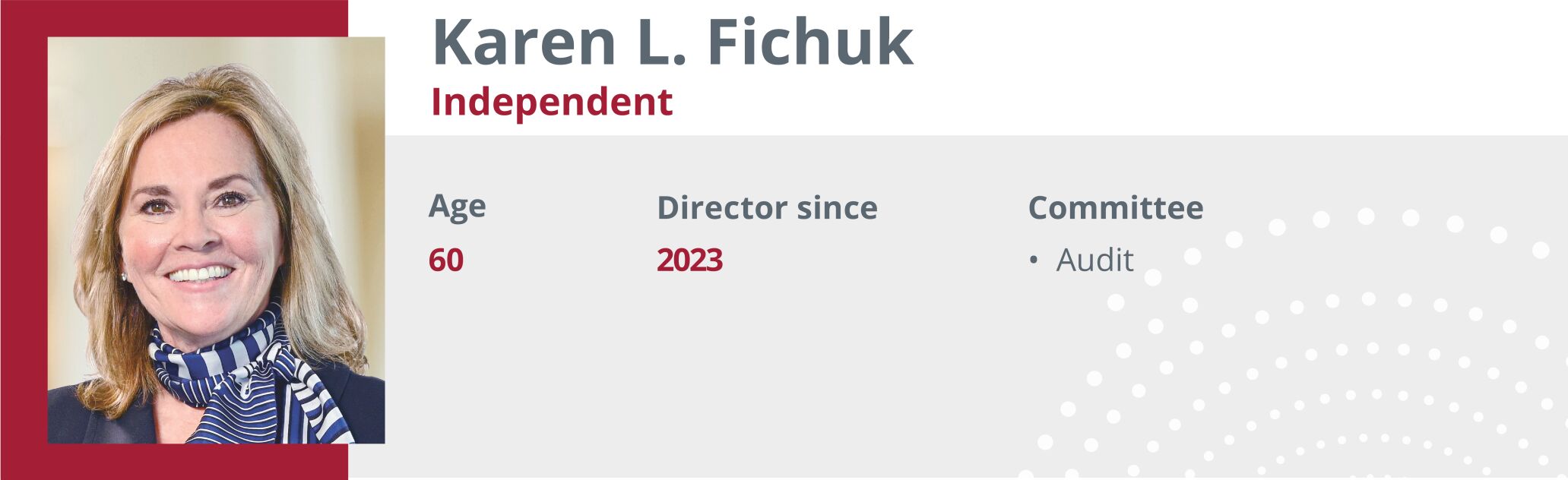
Karen L. Fichuk | 60 Former Chief Executive Officer, Randstad Director Since: 2023 Committee: Audit | |
|
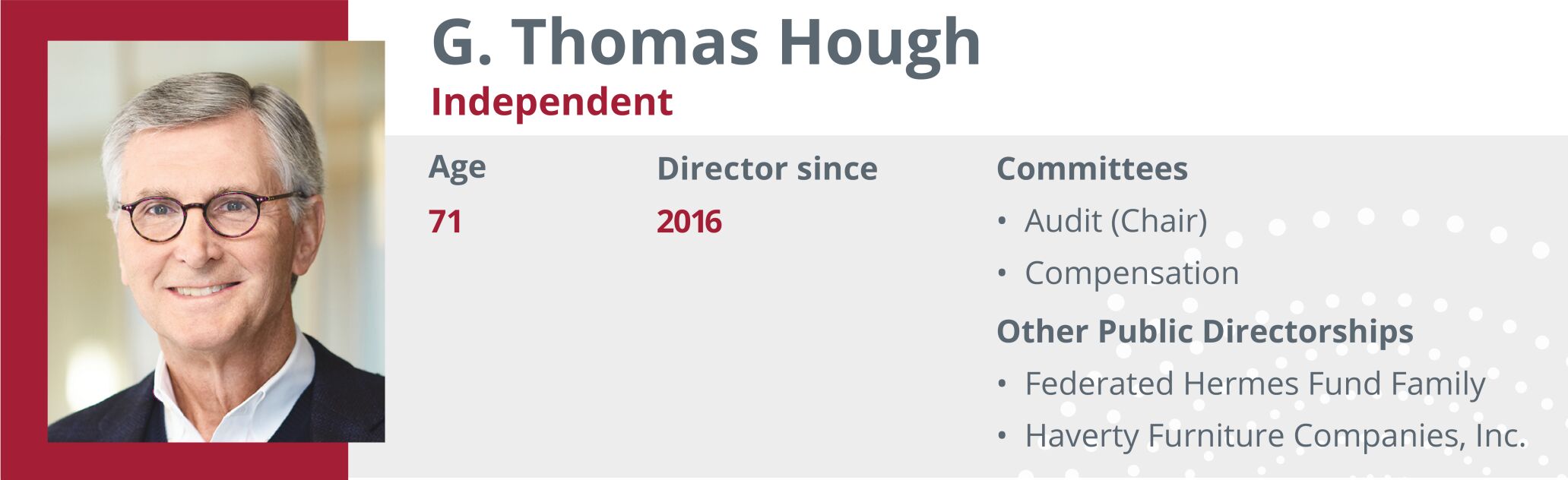
G. Thomas Hough | 71 Retired Americas Vice Chair, Ernst & Young LLP Director Since: 2016 Committees: Audit, Compensation | |
|
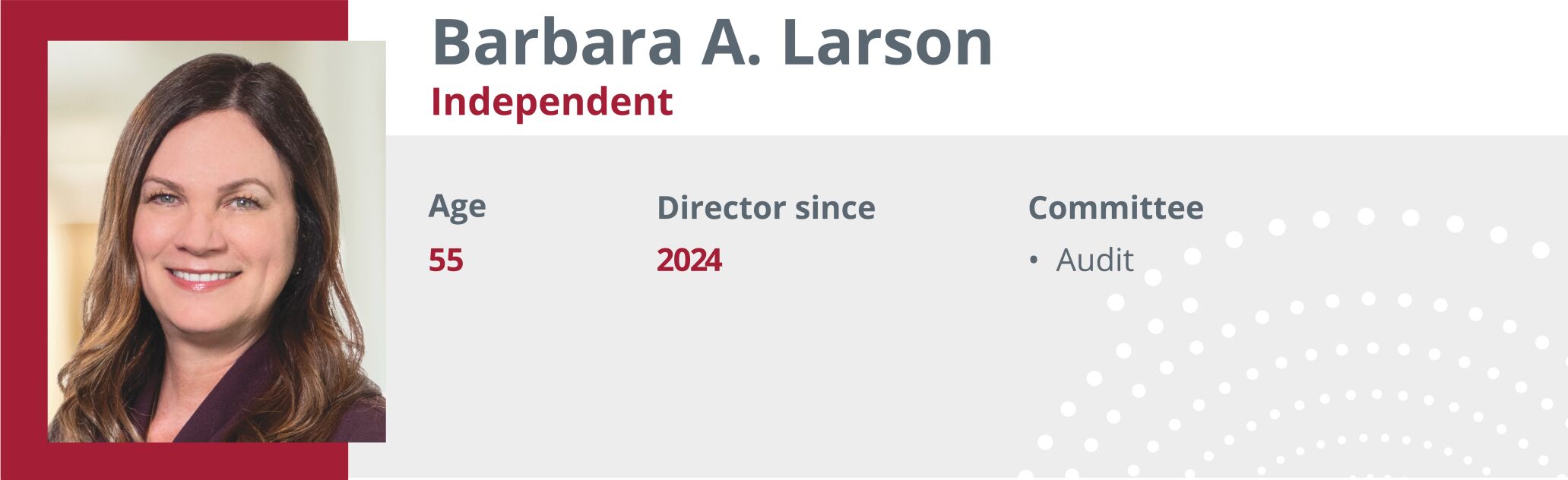
Barbara A. Larson | 55 Chief Financial Officer, Workiva Inc. Director Since: 2024 Committee: Audit | |
|
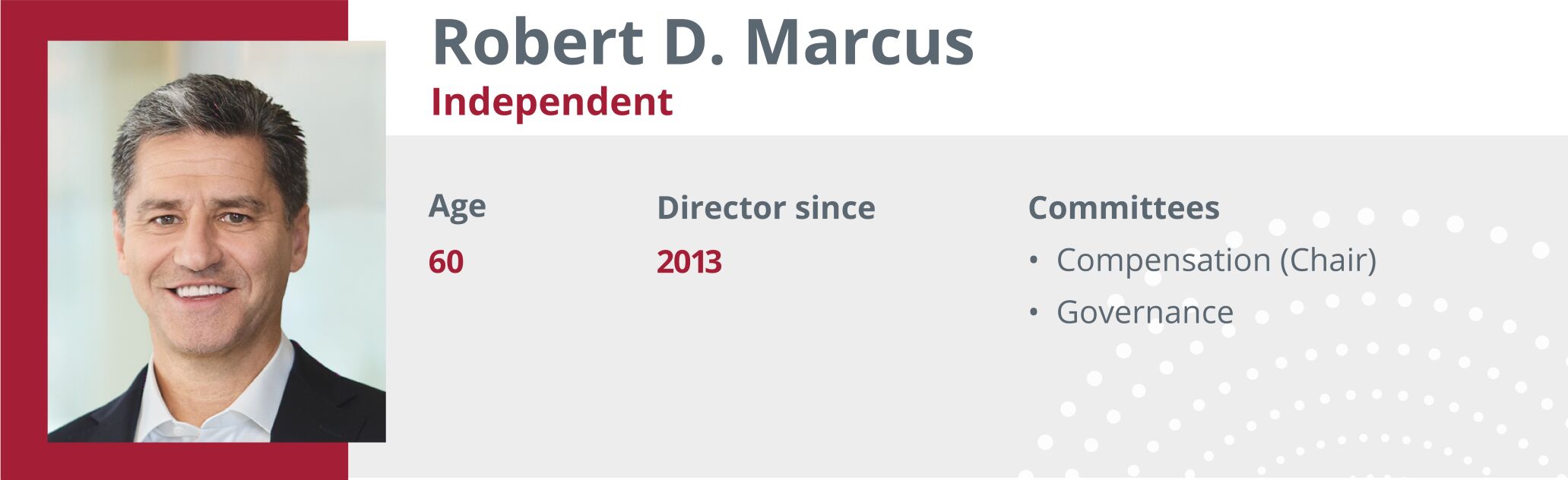
Robert D. Marcus | 60 Former Chairman and Chief Executive Officer, Director Since: 2013 Committees: Compensation, Governance | |
|
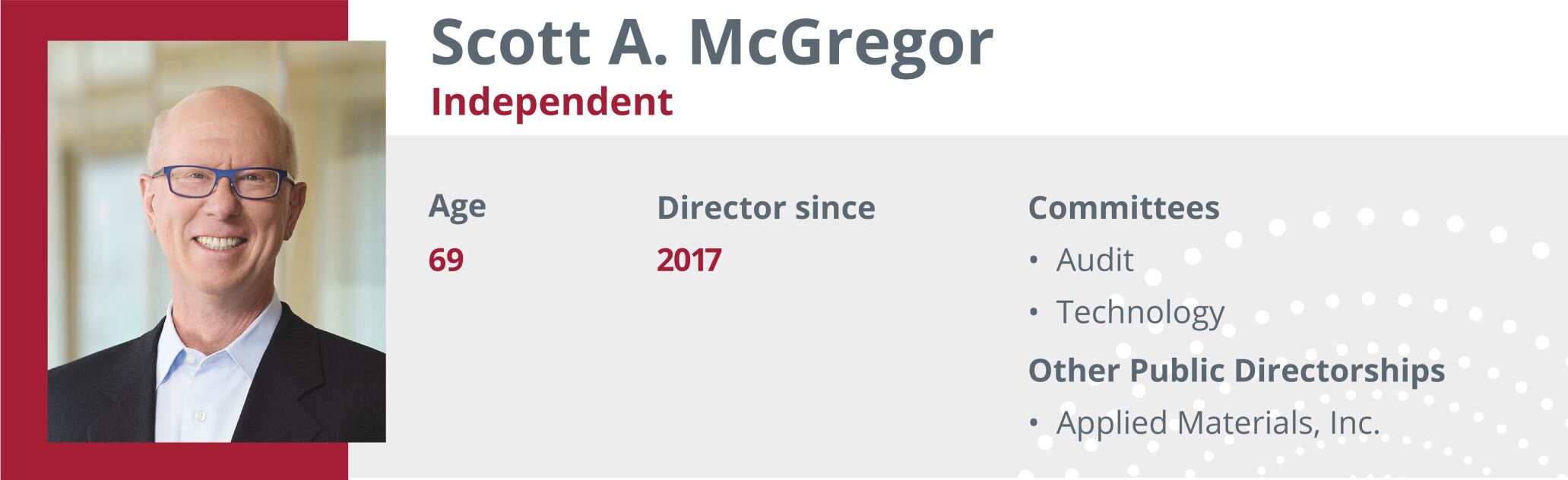
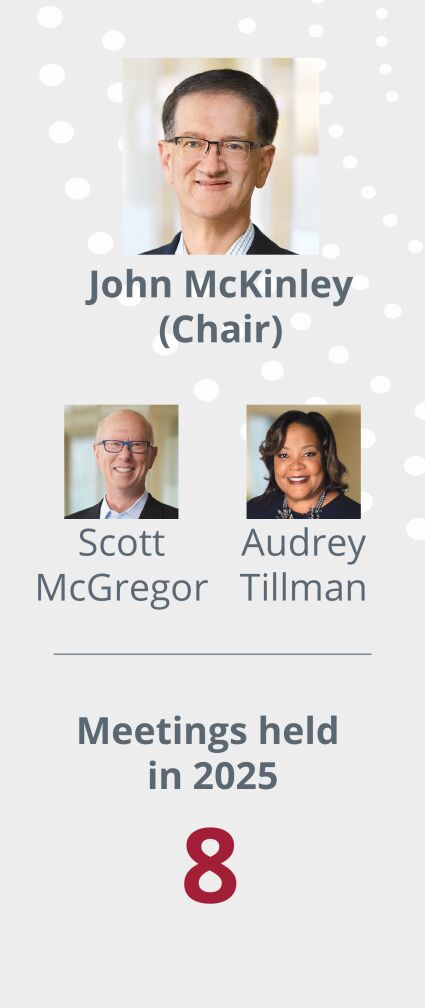
Scott A. McGregor | 69 Former President and Chief Executive Officer, Director Since: 2017 Committees: Audit, Technology | |
|
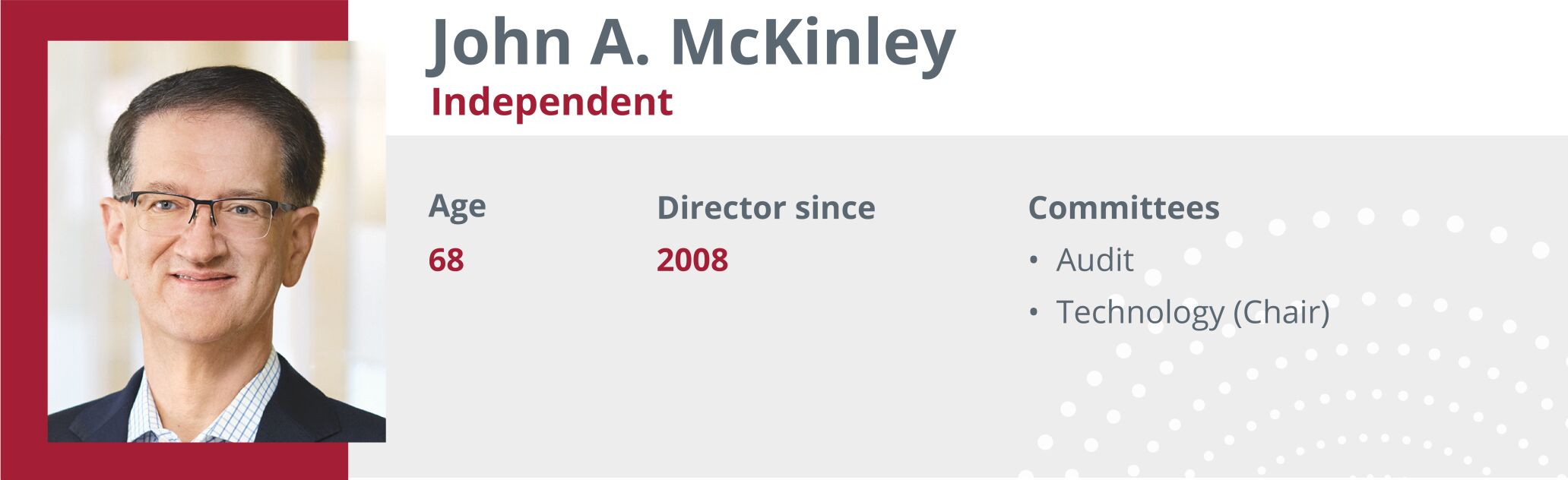
John A. McKinley | 68 Founder, Great Falls Ventures Director Since: 2008 Committees: Audit, Technology | |
|
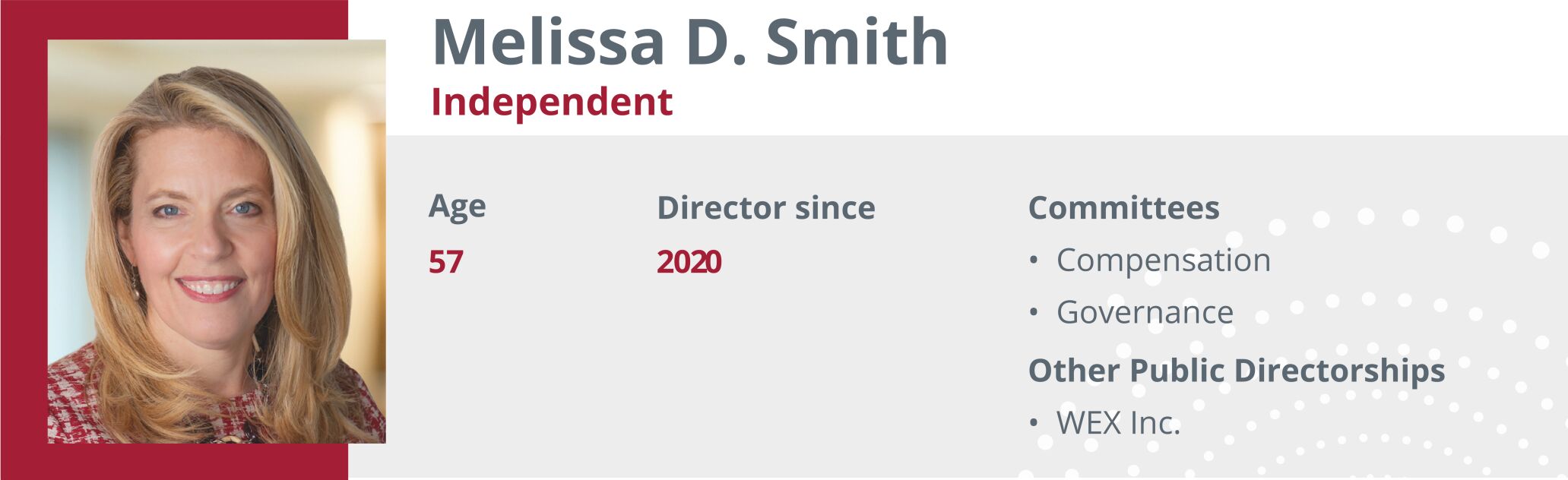
Melissa D. Smith | 57 Chair and Chief Executive Officer, WEX Inc. Director Since: 2020 Committees: Compensation, Governance | |
|
Audrey Boone Tillman | 61 Senior Executive Vice President and General Director Since: 2021 Committees: Governance, Technology |
|
|
23 |
Compensation Program Highlights
2025 Compensation Decisions
For the 2025 fiscal year, the Committee thoughtfully evaluated the compensation program structure in light of the ongoing evolution of our business strategy and shareholder feedback, when making decisions regarding the program. After evaluation, the Compensation Committee took certain actions with respect to our short- and long-term incentive programs for 2025, as summarized below and described in further detail under “Analysis of 2025 Compensation Decisions” beginning on page 68:
| We provide competitive
(see pages 65–68) |
• Attracting, retaining and motivating the right talent is a high priority for us as we focus on executing the business initiatives that underpin our strategy
• In support of this priority, the Compensation Committee annually reviews our executive compensation program to ensure that it provides competitive pay opportunities, establishes appropriate performance targets based on our strategic and operating plans, and reflects evolving market trends and shareholder feedback consistent with best practices
• The Committee retains an independent compensation consultant to assist in aligning our program with our shareholders’ interests and current market practices, and to guard against inappropriate or excessive risk that could have a material adverse effect on the Company | |
| Our compensation
(see pages 62, 75–80 and 85) |
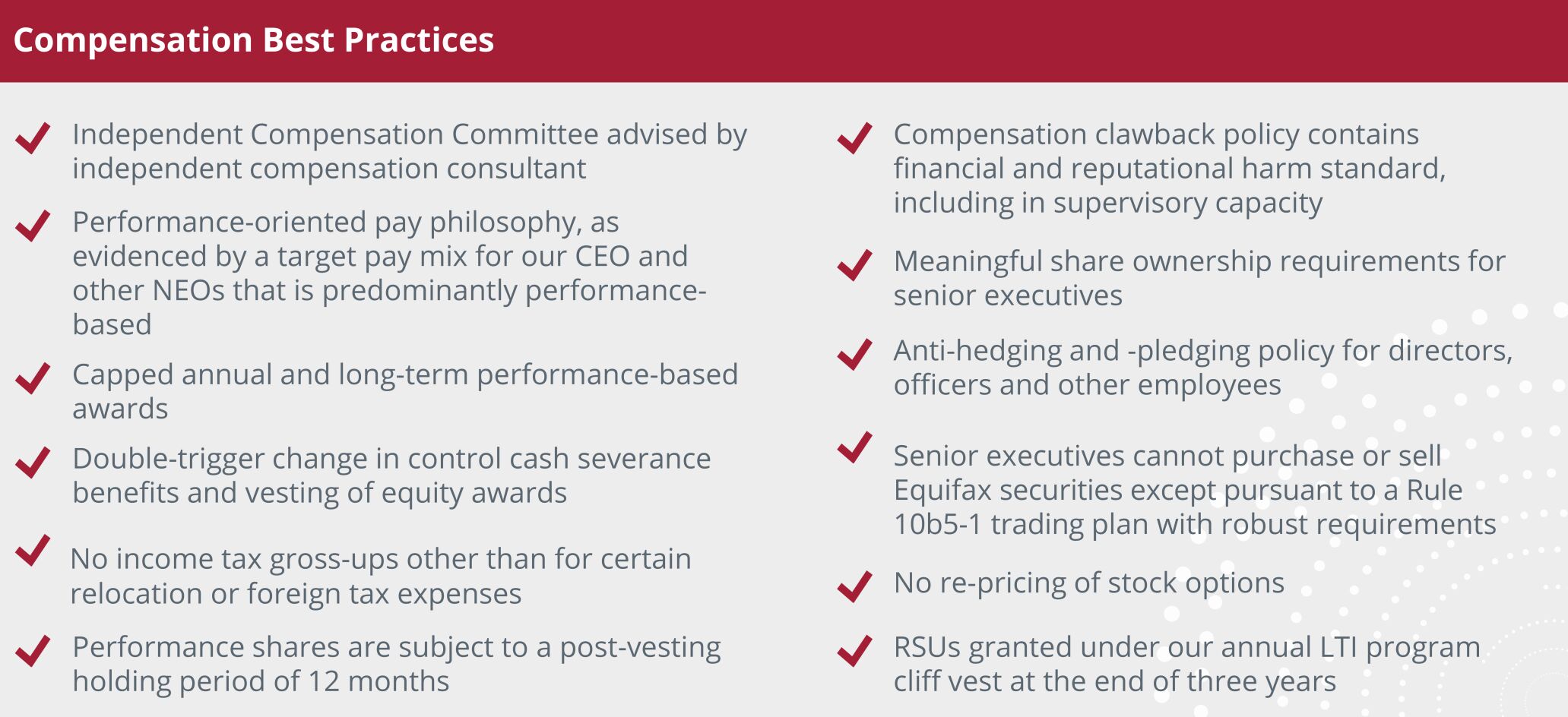
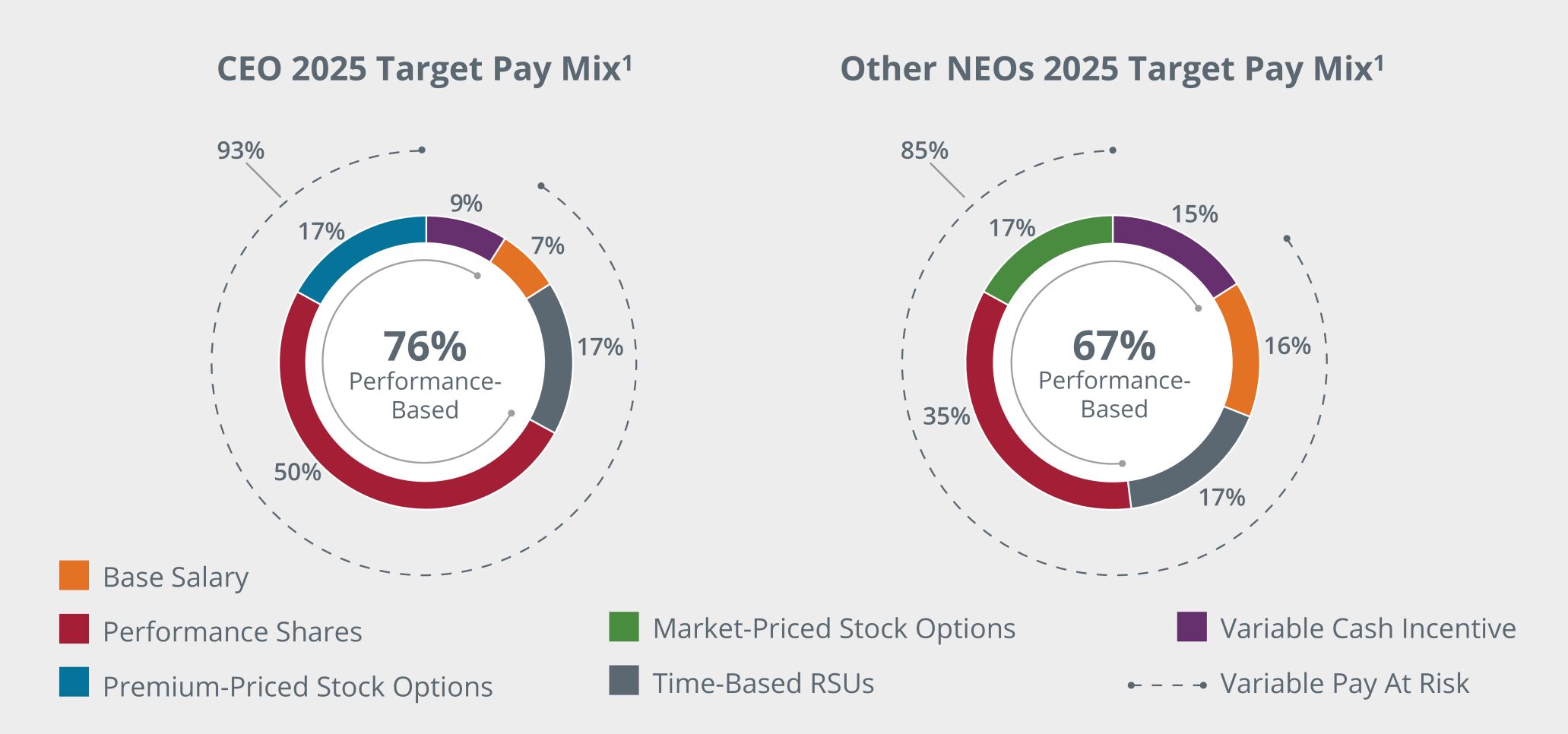
• Our compensation program emphasizes long-term equity awards and annual performance-based cash incentives so that a majority of each executive’s total compensation opportunity is linked directly to the Company’s stock price or otherwise tied to performance
– For 2025, 93% of target total direct compensation for our CEO and an average of 85% for the other NEOs was delivered in the form of variable, at-risk pay
• Our annual and long-term compensation plans, including our 2025 compensation program, are designed to align CEO pay with our financial performance:
– AIP Payouts Align with Performance:
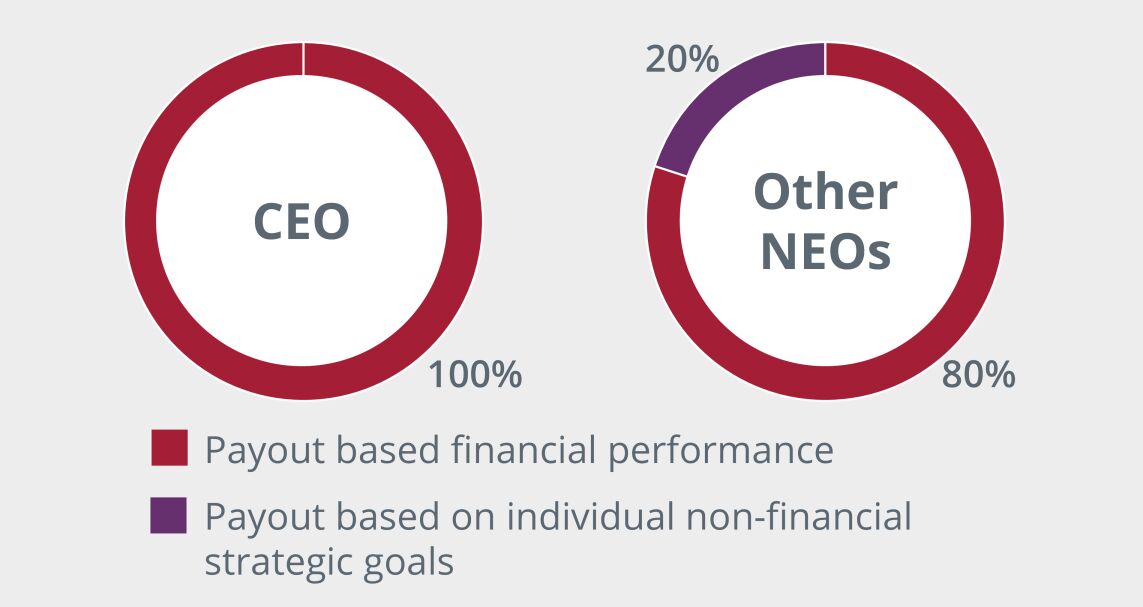
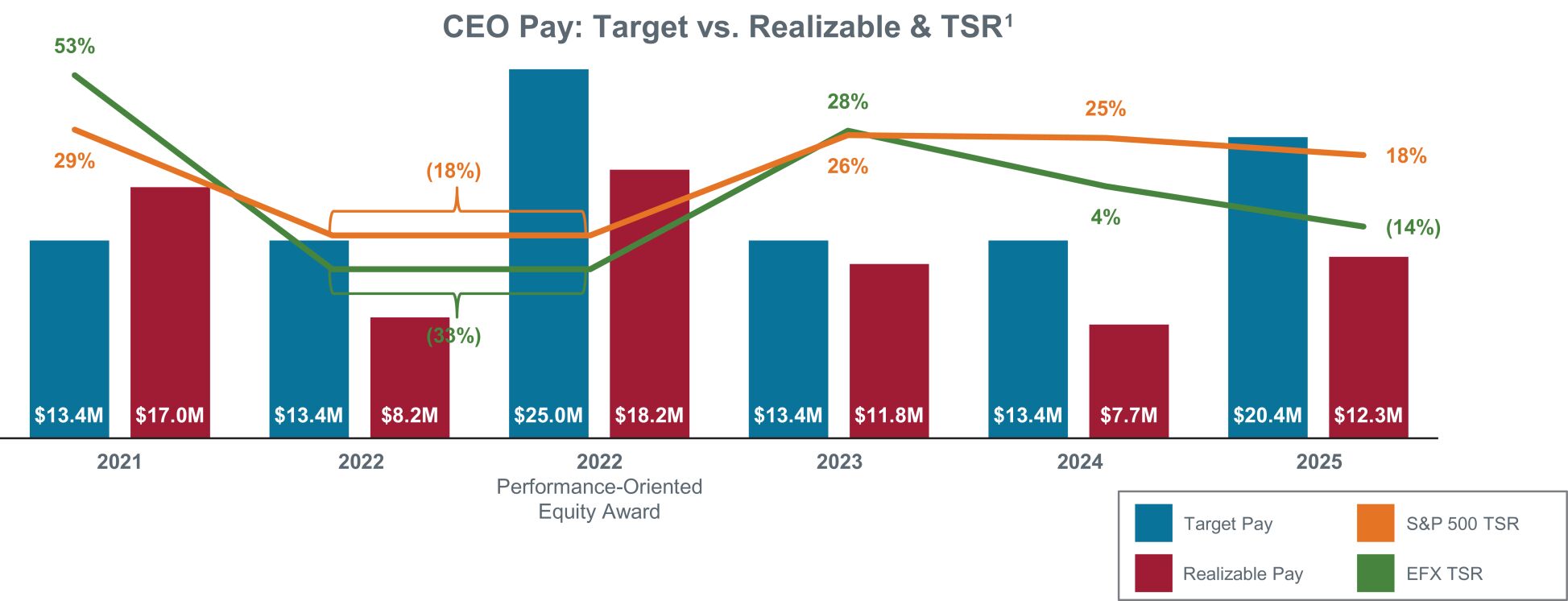
• In 2022-2024, although we achieved record revenues, our financial performance fell short of our enterprise targets due to unprecedented declines in the U.S. mortgage market and a challenging U.S. macroeconomic environment; as a result, the AIP payout to our CEO, whose award is tied 100% to enterprise financial results, was below target in each of 2022, 2023 and 2024
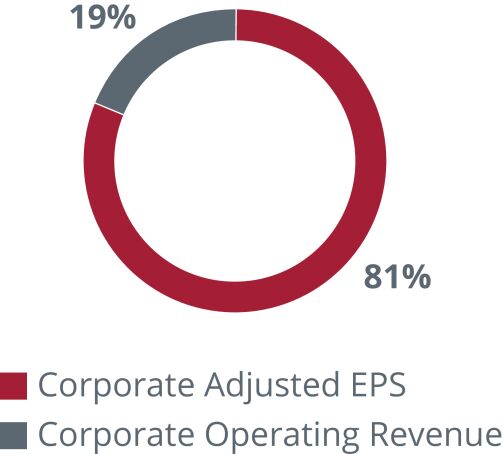
• In 2025, despite continued weakness in the U.S. mortgage and hiring markets, we generated record revenue of $6.075 billion, up 7% over 2024, and within our long-term 7-10% organic revenue growth target. In addition, our adjusted EPS of $7.65 was up 5% compared to 2024. As a result of this strong performance, the payout to our CEO was 152.1% of target and payouts to our other NEOs were 154.5% of target, on average
– LTI Payouts Align with Performance:
• The 2022-2024 cycle TSR and Adjusted EBITDA performance shares (which vested in February 2025) both paid out below target, reflecting the prolonged challenges to our business presented by U.S. macroeconomic factors
• Conversely, the 2023-2025 cycle TSR and Adjusted EBITDA performance shares (which vested in February 2026) both paid out above target, reflecting our stronger performance despite the prolonged challenges to our business presented by U.S. macroeconomic factors (see page 85)
|
| 24 |
2026 Proxy Statement |
| Our compensation
(see pages 68–72 and 85-87) |
• In designing our 2025 compensation program, the Compensation Committee conducted a comprehensive review of our program and practices, benchmarked against peers, and considered the ongoing transformation of our business, the competitive market for executive talent and feedback gathered from our shareholders
• During its deliberations, the Committee noted broad shareholder support for the structure and design of our core 2024 compensation program, including the use of performance-based annual equity award structures to drive alignment of the interests of our executives and shareholders, as well as strong support for Mr. Begor continuing as our CEO
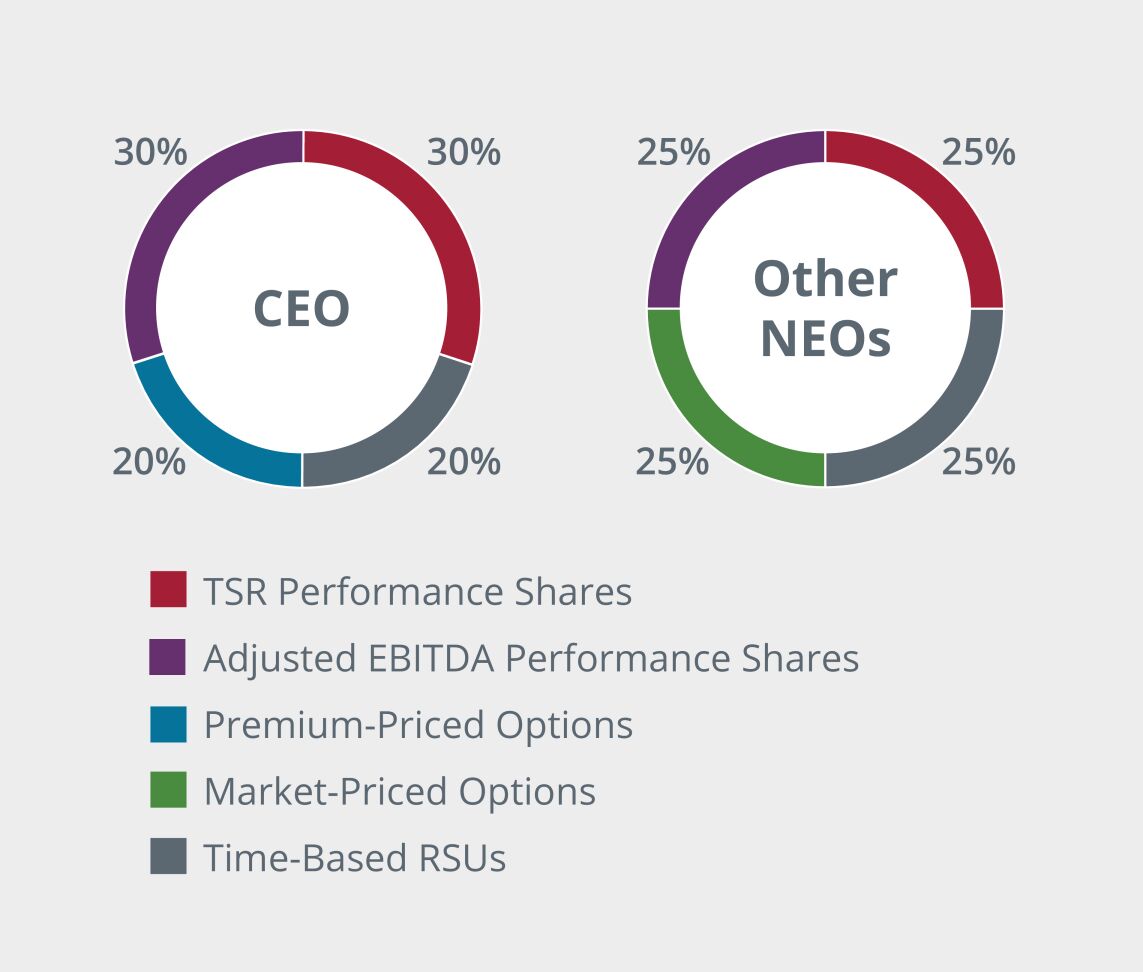
• Following consideration of shareholder feedback, the continuing transformation of our business and the competitive environment for executive talent, the Committee approved a new 2025 compensation arrangement for our CEO that pairs enhanced retentive elements (including a new definition of retirement and the elimination of cash severance upon a termination without cause) with an increase to his target long-term incentive opportunity (see pages 68-72)
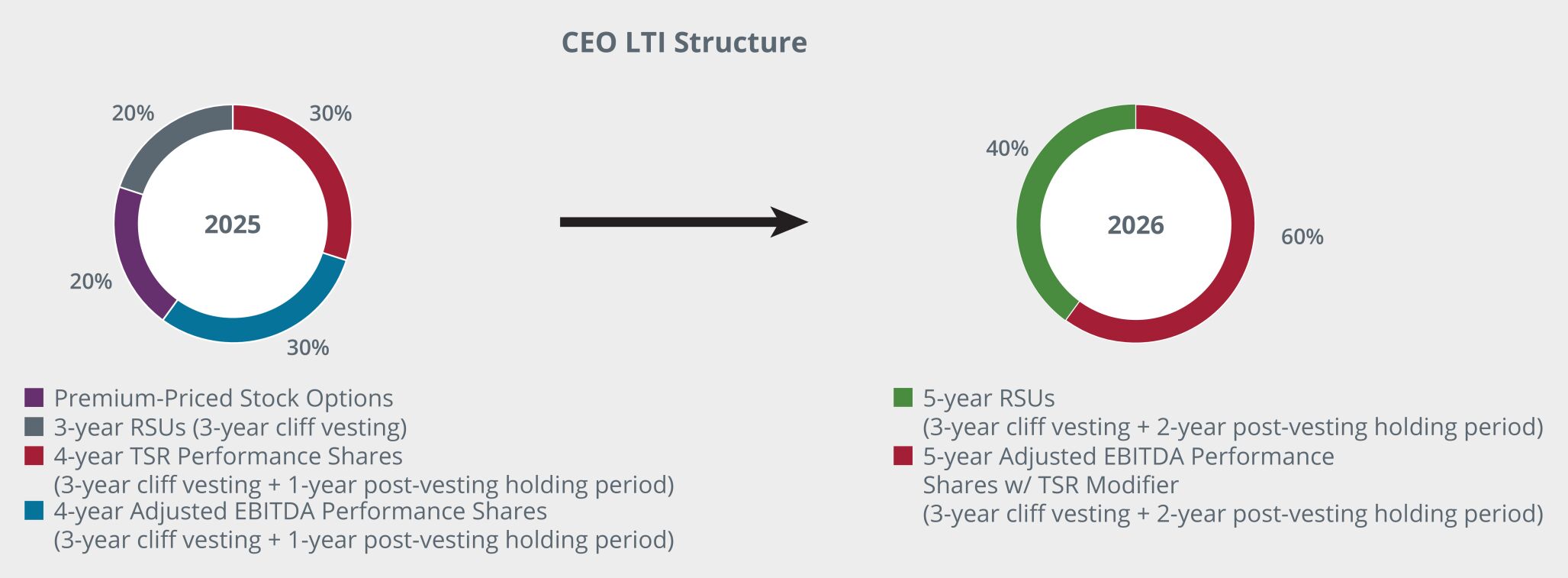
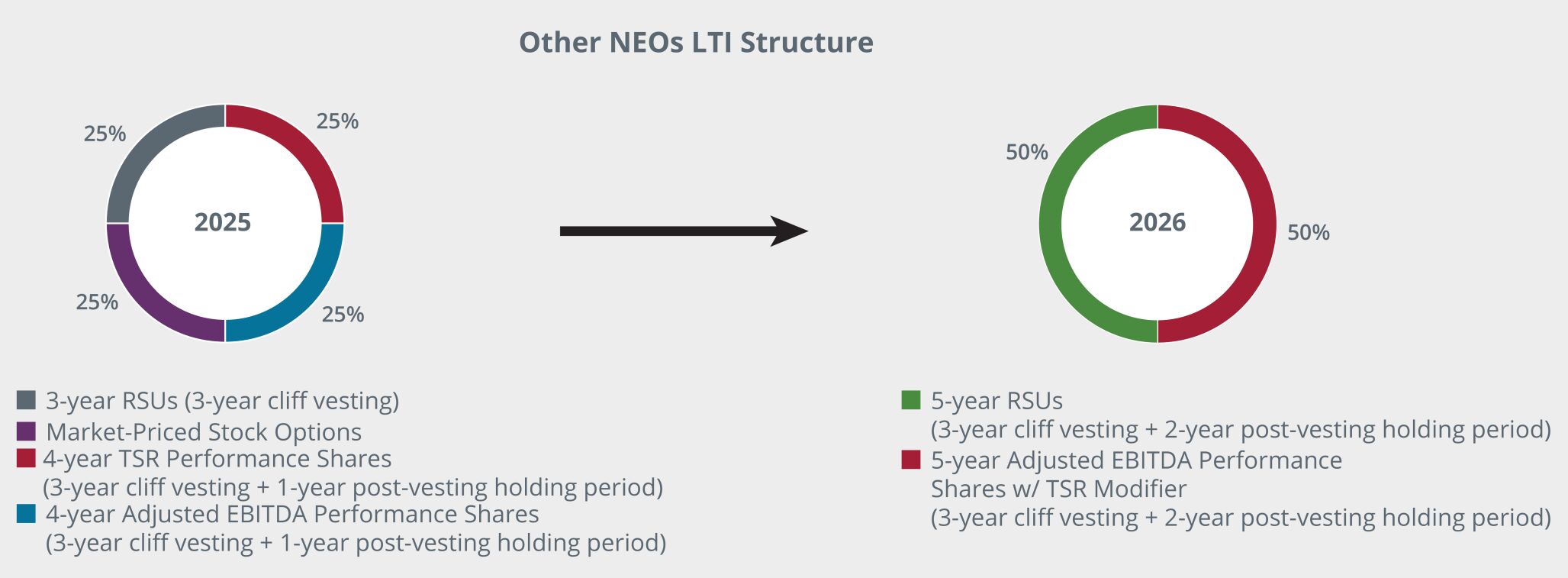
• For 2026, the Committee made changes to further align our compensation program with shareholder interests, including shifting all 2026 LTI awards to a 5-year time horizon (3-year vesting period and 2-year post-vesting holding period) and maintaining our CEO’s compensation level flat for 2026 (see pages 85-87) |
|
|
25 |
Corporate Governance Highlights
| Independent Board |
• 9 of our 10 director nominees are independent | |
| Board Refreshment and |
• The Governance Committee has implemented a succession plan to identify highly-qualified director candidates taking into account scheduled retirements, including committee leadership roles
• Since 2020, we have refreshed our Board with four new directors who bring valuable perspective and expertise | |
| Annual Evaluation of |
• The Board annually reviews our Company leadership structure to determine whether a combined Chair and CEO role or separate roles is in the best interests of shareholders | |
| Independent Board |
• We have separated the roles of CEO and Chairman | |
| Board Oversight of CEO |
• The Board annually evaluates the CEO’s performance and conducts a rigorous review and assessment of the succession planning process for the CEO and other top officers
• The Compensation Committee assists the Board with candidate development and succession planning for the CEO, in coordination with the Governance Committee | |
| Limits on Outside Board |
• Outside directors are limited to service on three other public company boards
• Our CEO is limited to two other public company boards (and serves on one outside board) | |
| Director and Executive |
• Each independent director is required to own Equifax common stock with a market value of at least 5x his/her annual cash retainer
• Our CEO and our other senior executive officers are required to own Equifax common stock with a market value of at least 6x and 3x base salary, respectively | |
| Rigorous Trading Policy |
• Our insider trading policy prohibits our CEO and other senior executives from purchasing or selling Equifax securities except pursuant to an approved Rule 10b5-1 trading plan
• Our trading policy and security incident escalation procedures are designed to ensure that those with decision-making authority on trading restrictions and approvals have notice of any potential security incident | |
| No Supermajority Voting |
• In 2025, our Board adopted an amendment to our Articles of Incorporation to eliminate supermajority voting requirements on actions requiring a shareholder vote | |
| No “Poison Pill” |
• We do not have a stockholder rights plan, or “poison pill,” in place | |
| Management Proposal to |
• At the 2026 annual meeting, we are asking shareholders to vote (on a non-binding, advisory basis) on a management proposal to lower the ownership threshold to call a special meeting of shareholder (see Proposal 4 on page 127 of this proxy statement)
• We recommend that shareholders vote “FOR” Proposal 4 | |
| Board Oversight of Risk |
• Our Board oversees risk management at the Company and exercises direct oversight of strategic risks to the Company and other risk areas not delegated to one of its committees • Our Governance Committee oversees our strategy with respect to our responsible business priorities
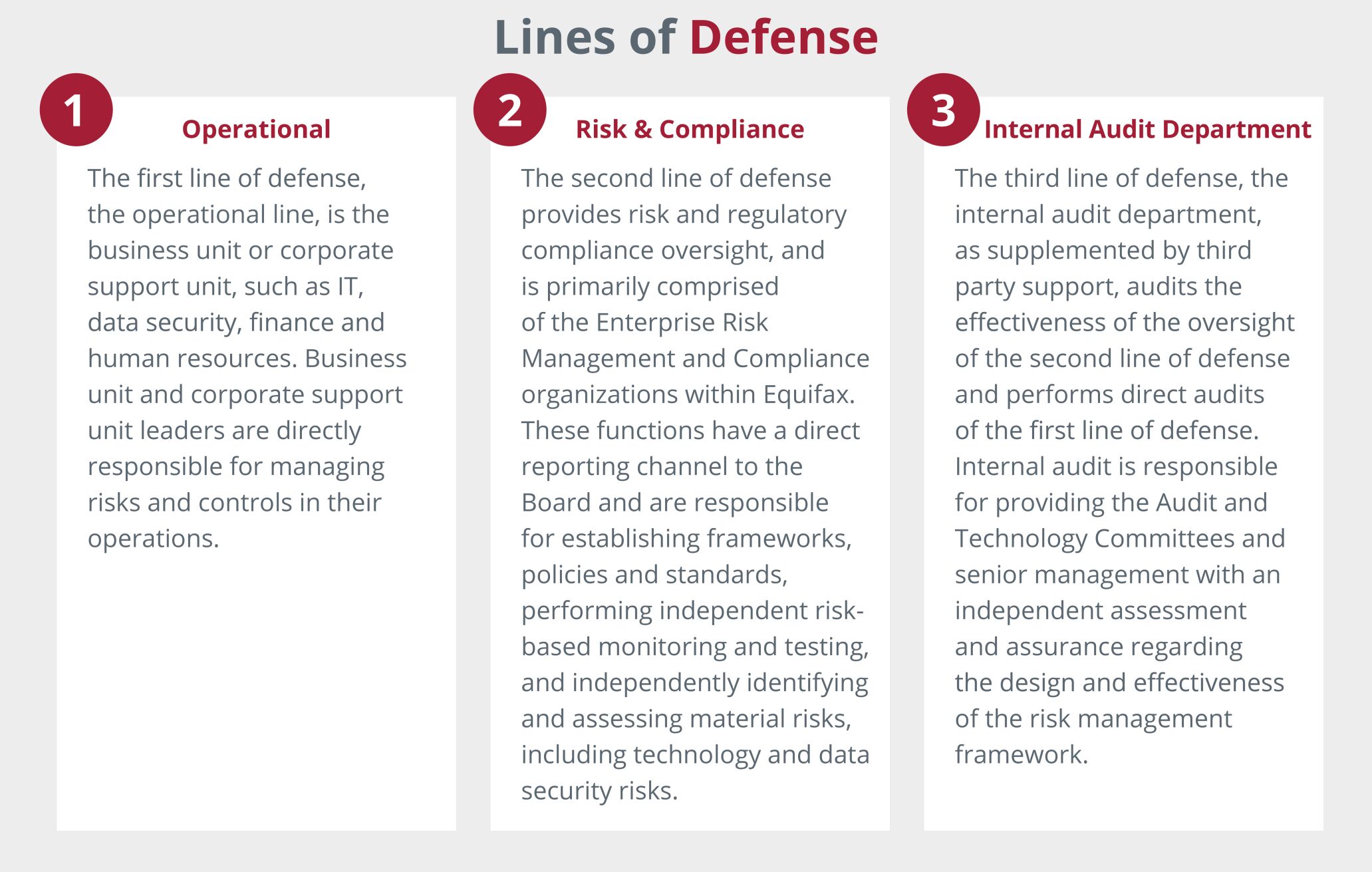
• Our Audit Committee reviews our policies related to enterprise risk assessment and risk management
• Our Audit Committee and Technology Committee jointly oversee risk management with respect to cybersecurity |
| 26 |
2026 Proxy Statement |
| Board Oversight of |
• Our Governance Committee has oversight authority regarding Company political activity (including corporate political expenditures) pursuant to our political engagement policy
• Our political engagement policy prohibits using corporate funds to make political contributions | |
| Annual Board Self- |
• We have an annual Board and committee self-evaluation process, which presents the opportunity to examine the Board’s effectiveness and identify areas for improvement
• The Board periodically engages a third party consultant to facilitate its annual Board and committee self-evaluation process
• The Board solicits feedback from management as part of its annual self-evaluation process | |
| Director Orientation and |
• Upon joining our Board, directors participate in an orientation program regarding our Company, including business operations, strategy, regulatory compliance, cybersecurity and governance
• The Board also conducts periodic visits to our key facilities and Board members annually review management’s crisis management planning |
|
|
27 |
Proposal 1
Election of Director Nominees
All members of our Board are elected to serve until the next annual meeting of shareholders and until their successors have been elected and qualified. The ten nominees for election listed in Proposal 1 have consented to being named in this Proxy Statement and to serve if elected. All director nominees attended 75% or more of the aggregate of the meetings of the Board and of the committees of the Board on which such directors served during 2025. The Company does not have a policy about directors’ attendance at the annual meeting of shareholders, but directors are encouraged to attend. All of the directors then serving attended the 2025 Annual Meeting.
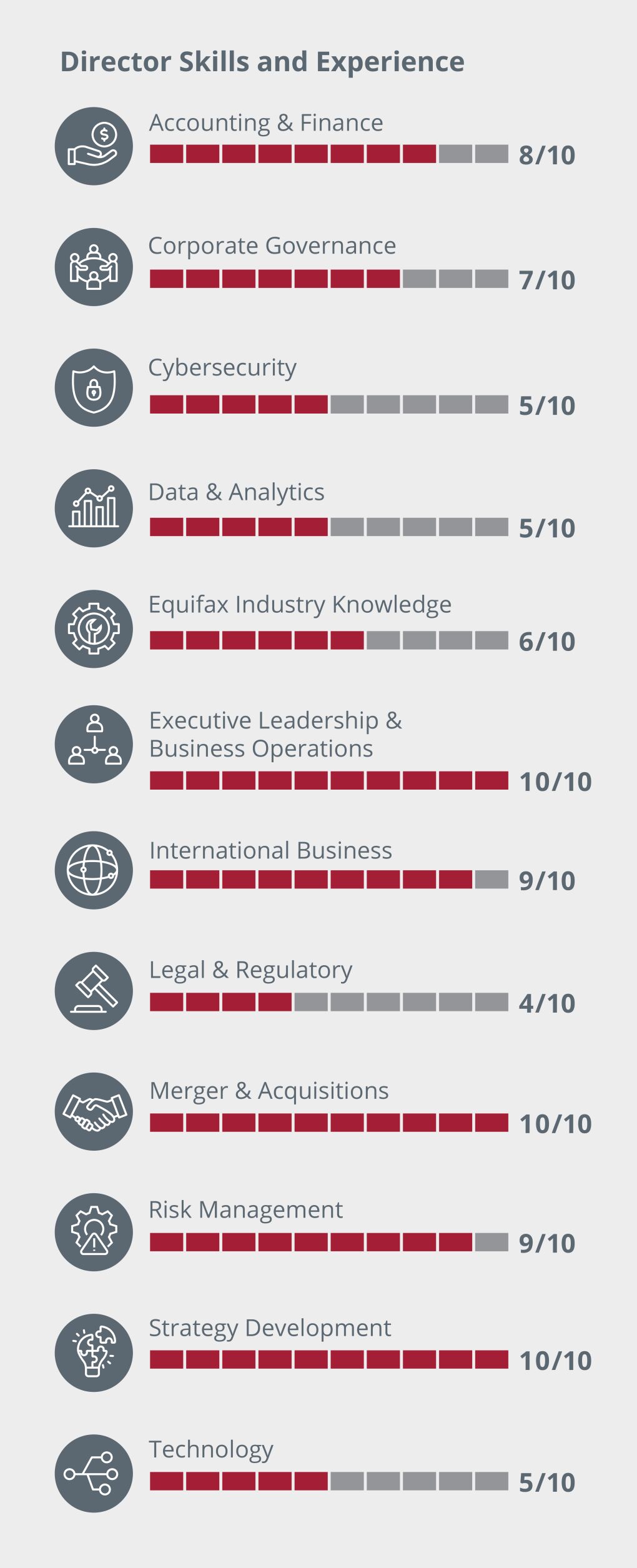
Our director nominees have a variety of backgrounds, which reflects the Board’s continuing objective to achieve a diversity of perspective and experience. As more fully discussed in “Process for Identifying Director Nominees” on page XX, director nominees are considered on the basis of a range of criteria, including their business knowledge and background, reputation and global business perspective. They must also have demonstrated experience and ability that is relevant to the Board’s oversight role with respect to Company business and affairs. Biographical information for each of the nominees is set forth on pages 30–39 and a Board matrix is set forth on page 40.
| Board Recommendation | ||
|
|
THE BOARD RECOMMENDS A VOTE “FOR” THE ELECTION OF EACH OF OUR DIRECTOR NOMINEES.
| |
| 28 |
2026 Proxy Statement |
Our Director Nominees
Mr. Begor has served as our Chief Executive Officer and as a director since April 2018. Prior to joining Equifax, Mr. Begor was a Managing Director in the Industrial and Business Services group at Warburg Pincus, a global private equity investment firm, since June 2016. Prior to Warburg Pincus, Mr. Begor spent 35 years at General Electric Company (“GE”), a global industrial and financial services company, in a variety of operating and financial roles. During his career at GE, Mr. Begor served in a variety of roles leading multibillion dollar business units of the company, including President and CEO of GE Energy Management from 2014 to 2016, President and CEO of GE Capital Real Estate from 2011 to 2014, and President and CEO of GE Capital Retail Finance (Synchrony Financial) from 2002 to 2011. Mr. Begor served on the board of directors of Fair Isaac Corporation (FICO) from 2016 to 2018 and the board of directors of NCR Atleos Corporation from 2023 to 2025.
Key Skills and Experience
|
Executive Leadership & Business Operations. When he joined Equifax as CEO in 2018, Mr. Begor brought over 35 years of operating and leadership experience as an executive in senior roles at GE. During his tenure, Equifax has grown from $3.4 billion of annual revenue in 2018 to record annual revenue of $6.1 billion in 2025, a compound growth rate of approximately 9%. This strong financial performance has enabled us to complete $4.8 billion of bolt-on acquisitions since 2018 to broaden our capabilities well beyond a traditional credit bureau, while making investments to expand data, analytics, product and technology capabilities. In addition, under Mr. Begor’s leadership, we returned $1.2 billion to shareholders in 2025 via dividends and share repurchases. | |
|
Strategy Development. During over three decades at GE, Mr. Begor gained immense experience setting strategy for multibillion dollar business units of the company. As our CEO and a member of our Board, Mr. Begor plays a crucial role in setting the strategic direction of our company. Since 2018, we have developed and executed on our strategic priorities – investing approximately $3 billion in our Equifax Cloud data and technology transformation, becoming an industry leader in security and accelerating innovation, new products, EFX.AI capabilities and growth. | |
|
Equifax Industry Knowledge. During his tenure at GE, Mr. Begor served as chief executive of GE Capital Retail Finance (Synchrony Financial), a consumer finance lender. This experience provided him the perspective of being a credit bureau customer, which helps us execute on our strategic priority to put customers and consumers first. In addition, prior to joining Equifax, Mr. Begor served for two years as a director at FICO, a public data and analytics company focused on credit scoring services and an Equifax industry peer. Mr. Begor’s unparalleled knowledge of our industry and our business make him uniquely qualified to lead the Company and serve as a director as we pivot from building the Equifax Cloud to leveraging our Equifax Cloud capabilities to accelerate innovation and new products powered by EFX.AI. | |
|
|
29 |
Founding Partner of MSouth Equity Partners, a private equity firm based in Atlanta, since February 2007. Mr. Feidler was President and Chief Operating Officer and a director of BellSouth Corporation (“BellSouth”), a major regional telecommunications company, from 2005 until January 2007. Mr. Feidler served as its Chief Staff Officer during 2004. From 2001 through 2003, Mr. Feidler was Chief Operating Officer of Cingular Wireless and served on the Board of Directors of Cingular from 2005 until January 2007. From 1991 to 2000, he served as the head of corporate development for BellSouth and as president of various operating subsidiaries. From 1986 to 1990, he worked in the investment banking department of The Robinson-Humphrey Company (predecessor to SunTrust Robinson Humphrey). From 1981 to 1986, Mr. Feidler was an attorney in the corporate law section of King & Spalding LLP.
Key Skills and Experience
|
Executive Leadership & Business Operations. Mr. Feidler has extensive operating, financial, legal and regulatory experience through his prior position with a major regional telecommunications company, as well as expertise in private equity investing and acquisitions. He also has broad based leadership experience, including experience with CEO succession planning, through his nearly 20 years of service on the board of directors of New York Life Insurance Company. His many years of experience in business operations and executive leadership is especially relevant to us given his role as independent Chair of the Equifax Board. | |
|
Strategy Development. Mr. Feidler co-founded MSouth, an Atlanta-based private equity firm, in 2007. Prior to MSouth, Mr. Feidler amassed over 25 years of M&A and transactional experience through his roles at BellSouth, Cingular Wireless, The Robinson-Humphrey Company and King & Spalding. Mr. Feidler’s extensive experience in acquiring and successfully growing businesses helps our Board oversee the core elements of our business strategy, including new product development, strategic partnerships and acquisition strategies. | |
|
Equifax Industry Knowledge. Equifax has exclusive rights to operate and manage the NCTUE database of more than 430 million telecommunications, pay TV, internet, home security and utility account records. Mr. Feidler’s deep understanding of the value of this data, gained through his years of experience with BellSouth and Cingular Wireless, is valuable as we seek to layer insights from these records on top of traditional credit data to help maximize consumer approval rates, help customers identify potential risks, reduce manual intervention costs and improve customer experience. | |
| 30 |
2026 Proxy Statement |
Former Chief Executive Officer of Randstad North America, a unit of Randstad N.V., the world’s largest human resources services provider, from 2019 until 2023. Prior to joining Randstad North America, Ms. Fichuk spent more than 25 years with Nielsen Holdings PLC (“Nielsen”), a global information services leader, where she held various positions, including President, Developed Markets, President North America and Global Managing Director for Kraft and Mondelez, among other positions.
Ms. Fichuk is an advisor and investor in startup technology and AI companies and has completed Northwestern University’s AI Applications for Growth certification. Ms. Fichuk also has significant nonprofit experience, including serving as a trustee for the United States Council for International Business and as a member of the CEO Council for the Global Business Alliance and sitting on the Global Leadership Council of the Colorado State University College of Business.
Key Skills and Experience
|
Data & Analytics. Ms. Fichuk gained extensive global data and analytics expertise during her 25 years at Nielsen, where she most recently served as President, Developed Markets. In this role, she led 4,000 employees across North America and Western Europe transforming the business model from client service to a product sales organization while providing global consumer intelligence to the world’s largest retailer and manufacturing companies. During her time as CEO of Randstad North America, she drew upon her experience at Nielsen to help the company make more sophisticated use of data. As a global data, analytics and technology company, Ms. Fichuk’s experience will help us execute on our strategic priority to expand our portfolio of differentiated data assets and drive market-leading D&A to help our customers. | |
|
International Business. Ms. Fichuk has decades of experience working for businesses with large global operations. Most recently, she ran the North American business of Randstad, which is headquartered in the Netherlands, where she led Randstad’s core business brands in the U.S. and Canada. She also served as a member of the company’s Executive Board, overseeing global strategy, operations and compliance. During her career at Nielsen, her roles included President of Developed Markets and Strategic Initiatives, with responsibility for North America, Western Europe and Australia/New Zealand. This experience benefits our Board’s oversight of our global operations, including continued growth within our International business unit. | |
|
Equifax Industry Knowledge. Ms. Fichuk served most recently as CEO of the North American business unit of Randstad, a global human resources services company. Ms. Fichuk’s experience in human resources services and the labor market is important to the Board as we seek to continue growing our portfolio of human resources business process automation and outsourcing services for employers. | |
|
|
31 |
Retired Americas Vice Chair of Ernst & Young LLP (“EY”), an international public accounting firm. He was Vice Chair of Assurance Services of EY Americas from 2009 to July 2014, and Americas Vice Chair until his retirement in September 2014. Mr. Hough joined EY in 1978 and became a partner in 1987. During his career, he led various teams across the firm, including serving as Vice Chair and Southeast Area Managing Partner from 2000 to 2009 and Vice Chair of Human Resources from 1996 to 2000.
Key Skills and Experience
|
Accounting & Finance. Mr. Hough was trained as an accountant, with over 36 years of experience as a certified public accountant with EY. As a senior leader for more than two decades who interfaced with many of EY’s most significant clients across diverse industries, he regularly engaged with members of issuer company management, boards and audit committees on audit, financial accounting, financial reporting, risk management and governance matters. Mr. Hough’s deep expertise in these areas makes him exceptionally qualified to serve as chair of our Audit Committee. | |
|
Risk Management. Mr. Hough currently serves as chairman of the Federated Hermes Fund Family (“Federated Hermes”) and as lead director and audit committee member of Haverty Furniture Companies, Inc. (“Havertys”). He previously served as audit committee chair at both Federated Hermes and Publix Super Markets, Inc. (“Publix”). Through these board positions and his 27 years as a partner at EY, Mr. Hough has acquired in-depth knowledge related to risk policies and processes and overall enterprise risk management. Mr. Hough is able to apply this experience in his role as our chair of our Audit Committee and co-chair of our joint Audit and Technology Committees. | |
|
Executive Leadership & Business Operations. Mr. Hough is a seasoned public company director with broad experience in executive leadership roles at a major international accounting firm. In his roles as Vice Chair of EY Americas Assurance Services and EY Americas Vice Chair, he oversaw services provided by 1,550 partners and 17,150 professionals throughout the Americas. Through his membership on the EY Executive Board and EY Global Assurance Executive Committee, he helped provide strategic and operational direction for the global firm. He has extensive experience as a board member, including current service with Federated Hermes and Havertys and prior experience with Publix. Mr. Hough’s broad and varied leadership experience benefits Equifax as our Board oversees management’s execution against our business strategy. | |
| 32 |
2026 Proxy Statement |
Chief Financial Officer of Workiva Inc. (“Workiva”), a leader in cloud-based reporting solutions, since January 2026. Prior thereto, she served as Chief Financial Officer of SentinelOne, Inc. (“SentinelOne”), a global leader in AI-powered cybersecurity, from September 2024 to January 2026. Prior to that, from February 2022 to June 2023, she served as Executive Vice President and Chief Financial Officer at Workday, Inc. (“Workday”), a leading AI enterprise platform that helps organizations manage their people and money. From 2014 to 2022, she held positions of increasing significance at Workday. Prior to joining Workday, she held various leadership roles in corporate finance spanning more than 20 years at VMWare, TIBCO and Symantec.
Key Skills and Experience
|
Accounting & Finance. Ms. Larson is a seasoned finance professional who currently serves as chief financial officer of Workiva. She previously served as chief financial officer of both SentinelOne and Workday. During her nearly decade-long tenure with Workday, Ms. Larson held several leadership positions across the company’s finance and product organizations, including serving as chief financial officer, where she was responsible for the company’s overall finance and accounting functions, internal audit and investor relations. Ms. Larson has a background as a certified public accountant with an undergraduate degree in finance and accounting. Her deep public company finance and accounting leadership experience benefits our Audit Committee in its oversight of our financial performance and financial reporting. | |
|
Equifax Industry Knowledge. Ms. Larson served in several leadership roles across the finance and product organizations during her ten years at Workday, a company that offers a suite of AI-powered, cloud-based enterprise software solutions primarily focused on human capital management (HCM), financial management, enterprise resource planning (ERP) and analytics. Her experience in both human capital management and enterprise technology is a tremendous asset to our Board as we continue to expand the portfolio of employer services offered under our Workforce Solutions business unit. | |
|
Cybersecurity; Technology. Ms. Larson has acquired experience with cybersecurity, cloud technology and AI through her roles at SentinelOne and Workday. This experience enhances her skill sets in relation to the Equifax Board, as we maintain our leadership in cybersecurity and leverage our Equifax Cloud capabilities to accelerate innovation and new products powered by EFX.AI. | |
|
|
33 |
Former Chairman and Chief Executive Officer of Time Warner Cable Inc. (“Time Warner Cable”), a provider of video, high-speed data and voice services, from January 2014 until the company was acquired by Charter Communications in May 2016. He was named a director of Time Warner Cable in July 2013 and served as President and Chief Operating Officer from 2010 to 2013. Prior thereto, he was Senior Executive Vice President and Chief Financial Officer from January 2008 and Senior Executive Vice President from August 2005. Mr. Marcus joined Time Warner Cable from Time Warner Inc. where he held various senior positions from 1998. From 1990 to 1997, he practiced law at Paul, Weiss, Rifkind, Wharton & Garrison LLP (“Paul Weiss”), a premier law firm based in New York.
Mr. Marcus is an Executive Partner at XN LP, a New York-based investment firm. He serves on the Board of Directors of Newhouse Broadcasting Co. as well as the boards of several non-profit organizations, including New Alternatives for Children, Uncommon Schools, Cooperman Barnabas Medical Center and OpenDor Media.
Key Skills and Experience
|
Executive Leadership & Business Operations. Mr. Marcus served as chairman and chief executive officer of Time Warner Cable from 2014 until the completion of the company’s merger with Charter Communications in 2016. During the course of a decade, he served in other senior roles of increasing responsibility at Time Warner Cable, including president and chief operating officer and chief financial officer. His public company operating and finance experience, which includes a background in executive compensation, is invaluable to the Board as we execute on our long-term strategic priorities and to the Compensation Committee as we design compensation programs that attract, retain and motivate executive talent. | |
|
Mergers & Acquisitions. Mr. Marcus has deep mergers and acquisitions experience. He served as chairman and chief executive officer of Time Warner Cable during the company’s merger with Charter Communications. Prior to that, he served over nearly a decade in roles at Time Warner Cable that involved significant mergers and acquisitions activity, including president and chief operating officer, chief financial officer and the senior executive vice president overseeing corporate groups including mergers and acquisitions. Before joining Time Warner Cable, he held roles at Time Warner Inc. that included senior vice president of mergers and acquisitions. Mr. Marcus’s experience is relevant to Equifax, as the execution of bolt-on M&A is a core pillar of our growth strategy. | |
|
Legal & Regulatory. Mr. Marcus has significant legal and regulatory experience, gained through his years of practice at Paul Weiss and his experience as chief executive officer of Time Warner Cable, where the legal and regulatory functions reported into him. This experience navigating public company legal and regulatory issues facilitates Mr. Marcus’s significant insights and contributions as a member of the Board and the Governance Committee, in particular. | |
| 34 |
2026 Proxy Statement |
Former President, Chief Executive Officer and Director of Broadcom Corporation (“Broadcom”), a world leader in wireless connectivity, broadband, automotive and networking infrastructure. Mr. McGregor served in those positions from 2005 until the company was acquired by Avago in 2016. From 2016 to 2017, Mr. McGregor served on the board of directors of Xactly Corporation (“Xactly”), an AI-powered provider of intelligent revenue solutions. From 2010 to 2016, he served on the board of directors of Ingram Micro, Inc. (“Ingram Micro”), a U.S. distributor of information technology products and services. From 2001 to 2005, Mr. McGregor served as President and Chief Executive Officer of the Philips Semiconductors division of Royal Philips Electronics. Prior thereto, Mr. McGregor was head of Philips Semiconductors’ Emerging Business unit from 1998. He previously served in a range of senior management positions at Santa Cruz Operation Inc., Digital Equipment Corporation (now part of HP), Xerox PARC and Microsoft, where he was the architect and development team leader for Windows 1.0. Mr. McGregor received a B.A. in Psychology and an M.S. in Computer Science and Computer Engineering from Stanford University.
Mr. McGregor currently serves on the board of directors of Applied Materials, Inc. (“Applied Materials”), a U.S. company that provides materials engineering solutions used to produce new chip and advanced displays. Prior to that, he served on the board of directors of Alorica Inc. (“Alorica”), an industry leader at leveraging data-driven insights to design and deploy digitally engineered, tech-enabled customer experiences at scale, and at Luminar Technologies (“Luminar”), a U.S. technology company that develops vision-based lidar and machine perception technologies, primarily for self-driving cars.
Key Skills and Experience
|
Cybersecurity. Mr. McGregor has decades of experience running and overseeing technology companies with sophisticated cybersecurity programs. In particular, he served as chief executive officer of Broadcom for over ten years, during which time he oversaw the development of networking semiconductors that are the foundation for a large part of the world’s cybersecurity hardware and acquired extensive cybersecurity expertise. Mr. McGregor’s cybersecurity experience is particularly important to us as we seek to maintain our intense focus on data security as we accelerate innovation and new products powered by EFX.AI. | |
|
Technology. Mr. McGregor has spent his career at the forefront of technology and innovation. An industry leader in information technology, he began his career as a computer engineer, helping to design the first personal computers and the first version of Microsoft Windows. He later served in executive roles within the Philips Semiconductors division of Royal Philips Electronics and as the chief executive officer of Broadcom. His executive management experience is supplemented by his current and prior experience as a member of the board of directors of several cutting-edge technology companies, including Applied Materials, Xactly, Ingram Micro, Alorica and Luminar. He also has decades of experience focusing on AI issues, including experience gained through service as an executive and/or board member at technology companies and his position as an investor and advisor for multiple AI companies. Mr. McGregor’s expertise in innovation and technology is invaluable to our Board as we leverage our Equifax Cloud technology and EFX.AI capabilities to accelerate innovation and new products and optimize our internal operations and team effectiveness. | |
|
Data & Analytics. Mr. McGregor currently chairs strategy and investment committee of the board at Applied Materials, a company for which AI and data analytics is fundamental to the business. In addition, he previously served on the board of directors of Alorica, a business driven by data-driven insights. Our Board believes this experience benefits Equifax as we execute on our strategic priorities of accelerating innovation and new products powered by EFX.AI and driving market-leading D&A and expanded data assets. | |
|
|
35 |
Founder of Great Falls Ventures, a venture capital firm based in Washington, D.C., since April 2007. He was Chief Technology Officer of News Corporation from July 2010 to September 2012. He was President, AOL Technologies and Chief Technology Officer from 2003 to 2005 and President, AOL Digital Services from 2004 to 2006. Prior thereto, he served as Executive President, Head of Global Technology and Services and Chief Technology Officer for Merrill Lynch & Co., Inc., from 1998 to 2003; Chief Information and Technology Officer for GE Capital Corporation from 1995 to 1998; and Partner, Financial Services Technology Practice, for Ernst & Young International from 1982 to 1995.
Key Skills and Experience
|
Technology. Mr. McKinley has a background in managing complex global technology operations as chief technology officer at a number of leading global companies, which is important for Equifax as we leverage our Equifax Cloud technology to accelerate innovation and new products using EFX.AI. Mr. McKinley also has extensive experience in the areas of artificial intelligence (AI) and natural language processing. He and his team delivered the first robo-advisor solution for Merrill Lynch in 2002. He is also currently an advisor to AI-centric firms in the investment and security sectors. This experience with AI enhances our Board’s effective oversight of our responsible AI innovation. | |
|
Cybersecurity. Mr. McKinley has cybersecurity experience that has facilitated the enhancement of our security program maturity to a level that has outperformed all major industry benchmarks for the last six years. He gained this experience through, among other things, serving on the board of cloud-based security company MessageLabs, which was acquired by Symantec. He started his career at EY, where he helped establish the computer security practice in the United States. | |
|
Accounting & Finance. Mr. McKinley began his career with EY, eventually becoming a partner in the Financial Services Technology Practice. In this role, he assisted in multiple IT control reviews. Later, during his tenure as President of Digital Services at AOL, he had full P&L responsibilities for the division. Prior to joining the Equifax Board, he served on the audit committee of Proxicom. Mr. McKinley received an undergraduate degree in economics from the Wharton School at the University of Pennsylvania. Mr. McKinley’s varied finance and accounting expertise, combined with his background in technology, is highly relevant to his role as a member of our Audit Committee and co-chair of our joint Audit and Technology Committees. | |
| 36 |
2026 Proxy Statement |
Chair and Chief Executive Officer of WEX Inc. (“WEX”), a global leader in financial technology solutions. Ms. Smith has served as Chief Executive Officer since 2014 and Board Chair since 2019. She joined WEX in 1997 and held several senior leadership positions across different aspects of the business prior to her appointment as Chief Executive Officer, including serving as Chief Financial Officer for ten years. Before joining WEX, Ms. Smith started her career at Ernst & Young LLP.
Key Skills and Experience
|
Executive Leadership & Business Operations. Ms. Smith has served as CEO and board chair of WEX for eleven years and six years, respectively. In these broad-based leadership roles, she has gained significant experience in overseeing business operations and driving business growth, as evidenced by the fact that WEX’s annual revenue has increased from $800 million to $2.66 billion during her tenure as CEO. The Board views this experience as particularly valuable as we leverage our Equifax Cloud capabilities to accelerate innovation and new products powered by EFX.AI. | |
|
Strategy Development; Data & Analytics. During over two decades at WEX, Ms. Smith has been instrumental in the company’s strategic growth, overseeing major acquisitions, technology investments and international expansion. The Board believes Ms. Smith’s strategic vision and leadership experience in a business driven by data and analytics benefit Equifax as we develop and execute on our corporate strategy. | |
|
Accounting & Finance. Among other roles at WEX, Ms. Smith served as chief financial officer for ten years, during which time she spearheaded the company’s initial public offering. She began her career as an auditor at Ernst & Young LLP. This deep financial expertise facilitates the Board’s oversight of our annual operating budget and financial performance and our Compensation Committee’s design of incentive programs that align with our financial performance. | |
|
|
37 |
Senior Executive Vice President and General Counsel of Aflac Incorporated (“Aflac”), the largest U.S. provider of supplemental insurance, since 2014. Ms. Tillman joined Aflac in 1996 and has held positions of increasing significance, including serving as Senior Vice President of Human Resources. Prior to joining Aflac, she was an associate with Smith, Helms, Mulliss and Moore and an associate professor at the North Carolina Central University School of Law.
Ms. Tillman has received numerous awards and accolades during her career. Most recently, she was named to Black Enterprise magazine’s Most Powerful Women in Business list for the third consecutive year and Women’s Inc.’s Top Corporate Counsel list in 2019. In 2020, she was awarded the Meritorious Public Service Medal by the Department of the United States Army.
Key Skills and Experience
|
Legal & Regulatory. Ms. Tillman has extensive legal and regulatory experience, having served as the general counsel of Aflac for more than a decade. She directs Aflac’s legal division and functions related to compliance, as well as the office of the corporate secretary, including oversight functions of the legal and compliance offices at Aflac Japan, where the company earns more than half of its revenue. Prior to Aflac, she acquired additional legal expertise as an attorney at Smith, Helms, Mulliss and Moore and an associate professor at the North Carolina Central University School of Law. The Board values Ms. Tillman’s experience in these areas, given that Equifax is subject to a number of U.S. federal, state, local and foreign laws and regulations that involve matters central to our business. | |
|
Risk Management. As general counsel of Aflac, Ms. Tillman has legal and compliance oversight responsibilities that give her significant experience with enterprise risk management and governance frameworks. This experience benefits our Board’s ability to oversee Equifax’s various risk management and governance frameworks, including our enterprise risk management program. | |
|
Corporate Governance. Ms. Tillman brings deep knowledge in corporate governance, gained over decades of experience in the insurance industry and legal and human resources fields. In her position as general counsel of Aflac, a U.S. public company, she is exposed to many of the same corporate governance issues we encounter at Equifax. In particular, she is able to leverage these insights as a member of our Board’s Governance Committee. | |
| 38 |
2026 Proxy Statement |
Board Matrix
The Board matrix below summarizes certain of the key skills, experience, qualifications and attributes that our director nominees bring to the Board to enable the effective oversight of our Company and execution of our business strategy. This matrix highlights the depth and breadth of the skills and experience of our director nominees. Additional details regarding each director nominee’s skills, experience and background are set forth in the individual biographies on pages 29-38.
|
|
|
|
|
|
|
|
|
| |||||||||||
| Skills and Experience | Begor | Feidler | Fichuk | Hough | Larson | Marcus | McGregor | McKinley | Smith | Tillman | ||||||||||
| Accounting & Finance |
● | ● | ● | ● | ● | ● | ● | ● | ||||||||||||
| Corporate Governance |
● | ● | ● | ● | ● | ● | ● | |||||||||||||
| Cybersecurity |
● | ● | ● | ● | ● | |||||||||||||||
| Data & Analytics |
● | ● | ● | ● | ● | |||||||||||||||
| Equifax Industry Knowledge |
● | ● | ● | ● | ● | ● | ||||||||||||||
| Executive Leadership & Business Operations |
● | ● | ● | ● | ● | ● | ● | ● | ● | ● | ||||||||||
| CEO Experience |
● | ● | ● | ● | ● | ● | ||||||||||||||
| CFO Experience |
● | ● | ● | ● | ||||||||||||||||
| International Business |
● | ● | ● | ● | ● | ● | ● | ● | ● | |||||||||||
| Legal & Regulatory |
● | ● | ● | ● | ||||||||||||||||
| Mergers & Acquisitions |
● | ● | ● | ● | ● | ● | ● | ● | ● | ● | ||||||||||
| Risk Management |
● | ● | ● | ● | ● | ● | ● | ● | ● | |||||||||||
| Strategy Development |
● | ● | ● | ● | ● | ● | ● | ● | ● | ● | ||||||||||
| Technology |
● | ● | ● | ● | ● | |||||||||||||||
| Background |
||||||||||||||||||||
| Tenure/Age/Gender |
||||||||||||||||||||
| Tenure (years) |
8 | 19 | 3 | 9 | 2 | 12 | 8 | 17 | 5 | 5 | ||||||||||
| Age |
67 | 69 | 60 | 71 | 55 | 60 | 69 | 68 | 57 | 61 | ||||||||||
| Gender (Male or Female) |
M | M | F | M | F | M | M | M | F | F | ||||||||||
| Race and Ethnicity |
||||||||||||||||||||
| Hispanic or Latino |
||||||||||||||||||||
| Black or African American |
● | |||||||||||||||||||
| White |
● | ● | ● | ● | ● | ● | ● | ● | ● | |||||||||||
| Asian |
||||||||||||||||||||
| American Indian or Alaska Native |
||||||||||||||||||||
| Native Hawaiian or Pacific Islander |
||||||||||||||||||||
|
|
39 |
Process for Identifying Director Nominees
When the need to fill a new Board seat or vacancy arises, the Governance Committee proceeds in the manner it deems appropriate to identify a qualified candidate or candidates. Candidates may be identified through the engagement of an outside search firm, recommendations from independent directors, the Chairman of the Board, management or other advisors to the Company, and recommendations by shareholders. The Governance Committee Chair and Chairman of the Board are provided with copies of the resumes for any potential candidates so identified and review them as appropriate with the Governance Committee, our CEO and the full Board.
Our Governance Committee determines the selection criteria and qualifications for director nominees. As set forth in our Governance Guidelines, these criteria include, among other things, a director candidate’s integrity and ethical standards, independence from management, an ability to provide sound and informed judgment, a history of achievement that reflects superior standards and willingness to commit sufficient time. Cybersecurity is one of the skills that the Governance Committee specifically considers in its assessment of Board membership criteria. With respect to the most recent additions to the Board, the Governance Committee was also focused on expertise in accounting and finance, corporate governance, data and analytics, Equifax industry knowledge, international business, legal and regulatory, risk management, technology and strategy development.
Although the Committee does not have a formal diversity policy for Board membership, it considers whether a director nominee contributes or will contribute to the Board in a way that can enhance the perspective and experience of the Board as a whole through, among other things, diversity in professional background, education, gender, age, race and ethnicity. When current Board members are considered for nomination for re-election, the Committee also takes into consideration their prior Board contributions, performance and meeting attendance records. The effectiveness of the Board’s skills and expertise is also considered as part of the Board’s annual self-assessment.
Directors are limited to service on three other public company boards, not including our Board. Audit Committee members may not serve on the audit committee of more than three public companies absent a Board determination that such service will not impair the ability of such member to serve effectively on our Audit Committee. In addition, when our CEO is a member of our Board, he or she may not serve on more than two other public company boards. These policies – and our directors’ compliance with these policies – are reviewed at least annually and all directors currently comply with these limitations.
See “Questions and Answers about the Annual Meeting” beginning on page 134 for information on the procedures for shareholders to recommend director nominees for consideration by the Governance Committee.
| 40 |
2026 Proxy Statement |
Board Leadership & Corporate Governance
Corporate Governance Overview
Our Board of Directors and management team are committed to achieving and maintaining high standards of corporate governance, ethics and integrity. We conduct our business in a manner that is socially responsible, values-based and in compliance with the law. We periodically review our governance policies and practices against evolving standards and make changes as appropriate. We also value the perspectives of our shareholders and other stakeholders, including our employees and the communities in which we operate.
The following sections summarize our corporate governance policies and practices including our Board leadership structure, our criteria for director selection and the responsibilities and activities of our Board and its committees. Our corporate governance documents, including our Corporate Governance Guidelines (“Governance Guidelines”), our Board committee charters and our Code of Ethics and Business Conduct applicable to directors, officers and employees, are available at www.equifax.com/about-equifax/corporate-governance, or in print upon request to Equifax Inc., Attn: Office of Corporate Secretary, P.O. Box 4081, Atlanta, Georgia 30302, telephone (404) 885-8000. The Code of Ethics and Business Conduct provides our policies and expectations on a number of topics, including our commitment to good citizenship, providing transparency in our public disclosures, prohibiting insider trading, avoiding conflicts of interest, honoring the confidentiality of sensitive information, preservation and use of Company assets, compliance with all laws and operating with integrity.
See “Corporate Governance Highlights” on pages 26-27 for a summary of our key governance practices.
Shareholder Engagement Program
Program Overview
Our Board of Directors and management team value the constructive feedback received from shareholders through our proactive and regular engagement. Investor engagement continues to prompt review of and changes to our governance practices, and our Board remains committed to seeking out and responding to investor feedback. Our integrated outreach team, led by our Office of Corporate Secretary and Investor Relations personnel, and joined by members of our Board for certain conversations, discusses a wide variety of issues with our shareholders.
2025 Outreach and Engagement
This past year, we continued our extensive outreach efforts, which follow an annual cycle centered around our annual meeting of shareholders.
|
|
41 |
Following our 2025 Annual Meeting, we reached out to shareholders holding approximately 70% of our outstanding common shares (“O/S”) and engaged with shareholders holding approximately 55% of our outstanding shares. We thoughtfully considered shareholder input on a range of topics, including executive compensation, Board governance and oversight (including oversight of artificial intelligence innovation), shareholder rights, initiatives related to consumers and more. Our Independent Board Chair and our Compensation Committee Chair led several of these engagement meetings.
Board Actions in Response to Shareholder Feedback
Our Board conducted an in-depth review of the shareholder feedback provided in 2025 to develop an appropriate response to topics raised by investors, evaluating actions both in terms of potential changes to practices and disclosure, as described below.
| Key Themes Discussed | Equifax Actions | |
| Board Oversight of |
• Published new proxy statement disclosure to describe how the Board oversees AI-related risks and opportunities (see “Responsible AI at Equifax” on pages 54-56)
• Enhanced our proxy statement disclosure to describe the evolution of our AI governance program, including AI risk management, controls and Board oversight (see pages 52-56) | |
| Executive Compensation |
• Approved a new compensation arrangement for our CEO, in consideration of shareholder feedback and the competitive environment (see “2025 CEO Compensation Arrangement” on pages 70-72)
• Evaluated the design of our long-term incentive program for 2026 to strengthen retention and reinforce long-term equity ownership aligned with shareholder interests and feedback (see “Actions Taken With Respect to 2026 Compensation” on pages 85-87) | |
| Shareholder Rights |
• At the 2026 Annual Meeting, we are asking shareholders to approve a non-binding, advisory resolution calling on the Board to lower the ownership threshold to call a special meeting of shareholders from 100% to 25% (see Proposal 4 on page 127)
• We recommend that shareholders vote “FOR” Proposal 4 | |
| Initiatives Related to |
• Published new proxy statement disclosure to explain how we are leveraging AI to responsibly expand access to credit (see “Responsible AI at Equifax” on pages 54-56)
• Published a reimagined U.S. consumer credit report with easy-to-read graphics to make it even easier for U.S. consumers to understand their credit history and monitor their financial health
• Further supported the needs of our 30.3 million myEquifax™ users in the U.S. with the launch of a new myEquifax mobile application that gives people a convenient way to monitor their financial health from mobile devices |
| 42 |
2026 Proxy Statement |
Board Leadership Structure
The Board annually reviews its leadership structure and our governance documents provide the Board with the flexibility to select the appropriate leadership structure for us at any given time. In 2017, the Board decided to adjust its leadership structure to separate the roles of Chairman and CEO. Mark Feidler, who had previously served as a leader for the independent directors in his role as Presiding Director, was elected to the role of Independent Chairman. In selecting Mr. Feidler to serve as Independent Chairman, the then-serving independent directors considered, among other things, his effective leadership when serving in the role of Presiding Director and his ability to commit sufficient time to the additional workload and increased meeting attendance as important qualifications.
The Board has determined that having separate Chairman and CEO roles is in the best interest of the Company and its shareholders at this time. This structure provides for direct independent oversight of management and clearly delineates the role of the Board as a source of insight and oversight for management. The Board believes this leadership structure, which also includes a majority independent Board and fully independent Board committees, best serves the objectives of the Board’s independent oversight of the Company’s business and affairs.
|
Mark L. Feidler
Independent Chairman of the Board
|
|
The role and responsibilities of Independent Chairman include:
| • | Calling meetings of the full Board or of the non-management directors |
| • | Establishing the agenda for each Board meeting, in coordination with the CEO |
| • | Presiding at all meetings of the Board |
| • | Advising the CEO of decisions reached and suggestions made at the executive sessions of the non-management directors |
| • | Facilitating communication between the directors and with the CEO |
| • | Meeting directly with management and other employees of the Company |
| • | Presiding at meetings of shareholders and calling special meetings of shareholders |
| • | Being available for consultation and direct communication with shareholders |
|
|
43 |
Annual Board Self-Evaluations
Our Board continually seeks to improve its performance. We have a robust and constructive annual Board and committee self-evaluation process, which presents the opportunity to examine the Board’s effectiveness and practices and identify areas for improvement. Our Governance Committee annually reviews and recommends the specific format to use for that year’s Board evaluation.
| Questionnaire | One-On-One Discussion With Independent Chairman |
Committee/ Full Board Sessions |
Periodic Engagement of Outside Consultant | |||||||||
| On an annual basis, each director completes written Board and committee evaluation questionnaires The questionnaire responses are then aggregated without individual attribution |
Our Independent Chairman references the response summaries and conducts a one-on-one discussion with each director regarding Board and committee effectiveness and engagement |
Following these individual discussions, each committee and the full Board conducts a self-evaluation discussion in non-management executive sessions |
Periodically, the Board engages an outside consultant to facilitate the Board and committee self- evaluation process |
Board Self-Evaluation Process for 2025-2026
Based upon the recommendation of the Governance Committee, the Board determined it was appropriate to implement its standard process for the 2025-2026 self-evaluation cycle. Under the standard process, each director completed written Board and committee self-evaluation questionnaires, which were aggregated by the Office of Corporate Secretary without individual attribution. The Independent Chairman then participated in one-on-one discussions with each of the other directors, during which they discussed the Board and committee response summaries.
As a part of its annual self-evaluation process, the Board also solicited and considered feedback from the senior leadership team regarding management’s engagement with the Board. The Chairman reviewed the results of the self-evaluation process with the full Board in February 2026. In addition to the Board self-evaluation, each standing committee conducted its own self-evaluation and charter review.
|
|
Feedback Incorporated
Each year, the self-evaluation process has highlighted opportunities to strengthen the effectiveness of the Board’s practices, structures, competencies and communications.
Key themes for this year’s evaluation included:
• Areas of strategic focus and Board composition in support of long-term strategy
• Balance and scope of topics and materials covered in Board and committee meetings
• Management succession planning |
| 44 |
2026 Proxy Statement |
Committees of the Board of Directors
The Board has four standing committees, each of which is comprised entirely of independent directors as defined in the New York Stock Exchange (“NYSE”) rules. The Board appoints committees to help carry out its duties and work on key issues in greater detail than is generally possible at Board meetings. Committees regularly review the results of their meetings with the Board. In 2025, the full Board held 4 meetings and the standing committees held a total of 25 meetings (including 4 joint meetings of the Audit and Technology Committees).
| Committee Memberships | ||||||||||||||||||||
| Name | Independent | Audit | Compensation | Governance | Technology | |||||||||||||||
| Mark W. Begor |
||||||||||||||||||||
| Mark L. Feidler
|
|
|
|
|||||||||||||||||
| Karen L. Fichuk |
|
|
||||||||||||||||||
| G. Thomas Hough |
|
|
|
|||||||||||||||||
| Barbara A. Larson |
|
|
||||||||||||||||||
| Robert D. Marcus |
|
|
|
|||||||||||||||||
| Scott A. McGregor |
|
|
|
|||||||||||||||||
| John A. McKinley |
|
|
|
|||||||||||||||||
| Melissa D. Smith |
|
|
|
|||||||||||||||||
| Audrey Boone Tillman |
|
|
|
|||||||||||||||||
= Independent Chairman
= Audit Committee Financial Expert
= Committee Chair
= Committee Member
|
|
45 |
Committee Responsibilities
Each committee operates pursuant to a written charter which is available on our website at www.equifax.com/about-equifax/corporate-governance. The oversight responsibilities of each committee are summarized below.
|
|
Audit Committee |
| ||
• Direct authority to appoint, oversee, compensate and discharge our independent auditors
• Reviews and pre-approves the services provided by our independent auditors and reviews the independence of that firm
• Reviews our financial statements, earnings press releases and financial information and discusses the same with our independent auditors and management
• Reviews the integrity of our financial reporting process and the adequacy and effectiveness of our financial and information technology controls
• Oversees our regulatory compliance program and administers our Code of Ethics and Business Conduct
• Reviews our policies related to enterprise risk assessment and risk management
• In coordination with the Technology Committee, oversees risk management with respect to cybersecurity
• Oversees our internal audit function
• Meets separately with our internal and external auditors to ensure full and frank communications
| ||||
|
|
Compensation Committee |
| ||
• Approves and oversees our executive compensation plans, programs and policies
• Evaluates the performance and determines the compensation for our CEO; oversees the performance evaluations for our other executive officers and makes compensation determinations
• Approves equity compensation awards made to Section 16 officers
• Reviews the CD&A and other proxy statement disclosures related to executive compensation; recommends the inclusion of the CD&A in the proxy statement
• Considers the results of shareholder advisory votes on executive compensation and determines any appropriate responsive actions
• Oversees an annual risk assessment of our compensation programs
• Monitors the effectiveness and funded status of our retirement and 401(k) plans
• Assist the Board with candidate development and succession planning for the CEO, in coordination with the Governance Committee
• Review with the CEO management development and succession planning for other executive officers
• Advise and consult with management on other significant human resources matters
| ||||
| 46 |
2026 Proxy Statement |
|
|
Governance Committee |
| ||
• Oversees an annual review of the performance and effectiveness of the Board and its committees
• Makes recommendations regarding the independence and qualifications of individual directors, as well the composition of the Board and its committees
• Makes recommendations regarding the election of new directors and re-election of incumbent directors
• Oversees an annual review of the Committee charters
• Makes recommendations on matters related to Board policies and practices, including the Corporate Governance Guidelines
• Oversees an annual review of the director compensation program
• Oversees our shareholder engagement program and our responses to shareholder proposals
• Oversees our strategy with respect to responsible business priorities
• Oversees the new director orientation program and the continuing education activities of the Board
• Annually reviews our political activities, including lobbying activities
| ||||
|
|
Technology Committee |
| ||
• Oversees our technology strategy, including new product development programs and new technology investments
• Reviews our technology investments and infrastructure associated with risk management, including policies relating to information security, disaster recovery and business continuity
• In coordination with the Audit Committee, oversees risk management with respect to cybersecurity
• Oversees engagement of outside advisors to review our cybersecurity program and annually reviews the effectiveness of our cybersecurity program
• Receives reports directly from our Chief Information Security Officer, Chief Technology Officer and the internal audit department, including in executive session
| ||||
|
|
47 |
Director Independence
Our Governance Guidelines provide that a substantial majority of our Board should be independent. Our Guidelines for Determining the Independence of Directors, which is an appendix to our Governance Guidelines and may be accessed on our website at www.equifax.com/about-equifax/corporate-governance, meet or exceed the requirements of SEC rules and regulations and the NYSE listing standards.
The Board has affirmatively determined that all director nominees (other than our CEO, Mark Begor) are independent under the applicable NYSE listing standards, SEC rules and our Guidelines for Determining the Independence of Directors. In making these determinations, the Board considered the types and amounts of the commercial dealings between the Company and the companies and organizations with which the directors are affiliated. The Board views the independence analysis as an ongoing consideration and will continue to monitor these relationships.
Each director is an equal participant in decisions made by the full Board. All of our standing Committees are comprised solely of independent directors.
Board Refreshment and Succession Planning
Board Refreshment
The Governance Committee regularly assesses the requirements of the Board and makes recommendations regarding its size, composition and structure. The Governance Committee is focused on how the experience and skill set of each individual director complements those of fellow directors to create a balanced Board that reflects a mix of viewpoints, skills and expertise through members with a diversity of professional experience, education, gender, age, race and ethnicity. As part of its ongoing strategic review regarding Board refreshment, the Governance Committee seeks to anticipate future needs for expertise in key areas, such as cybersecurity, technology, data and analytics and international business operations. Among other things, the Governance Committee considers committee composition and chair rotation as part of its overall succession planning process.
The Governance Committee and the Board actively seek new director candidates that can provide valuable guidance as we focus on executing our strategic priorities by fully leveraging the Equifax Cloud and our EFX.AI advanced analytics and machine learning capabilities to drive innovation, new products and growth. The Board believes that the additions of Melissa Smith in 2020, Audrey Tillman in 2021, Karen Fichuk in 2023 and Barbara Larson in 2024 have provided our Board with additional broad-based executive leadership experience, as well as enhanced expertise in accounting and finance, corporate governance, cybersecurity, data and analytics, Equifax industry knowledge, international business, legal and regulatory, risk management, technology and strategy development.
The Board will continue to seek out highly-qualified director candidates as part of the Board succession plan to enhance the composition of our Board to align with our overall strategy.
| 48 |
2026 Proxy Statement |
Board Tenure and Succession Planning
Pursuant to our Bylaws and Governance Guidelines, we have a mandatory retirement age of 72, after which a director will not be elected or re-elected unless the Governance Committee and Board determine that the continued service of the director on the Board would be of benefit to the Company. The following chart shows the individual and average tenure of our director nominees, which is well distributed to create a balanced Board. Since 2020, we have refreshed our Board with four new directors who bring valuable perspective and expertise.
Committee Tenure and Refreshment
The Governance Committee is responsible for reviewing the composition of the committees of the Board. In its review of committee composition, the Governance Committee considers the responses collected during the Board and committee annual self-evaluations, as well as the past experience and relevant skills of each director. The Governance Committee and the Board annually consider the composition of the committees of the Board to ensure each committee has the appropriate relevant mix of skills and experience.
Director Orientation and Continuing Education
Upon joining our Board, our directors participate in an orientation program regarding our Company, including business operations, strategy, regulatory compliance, cybersecurity, governance and company policies. In addition to the onboarding process, our Board receives regular updates from management regarding the Company’s operating plan and strategy, including updates specific to each business unit and the enterprise as a whole. In addition to these regular reports, the Board receives periodic updates from management and third parties, as appropriate, regarding regulatory compliance, government relations, investor perspectives, artificial intelligence, shareholder activism and other Board governance topics. The Board also conducts periodic visits to our key facilities. Our directors participate in annual cybersecurity training and receive annual updates on our crisis management program in order to ensure enterprise preparedness. Board members also may attend outside director continuing education programs at Company expense to assist them in keeping pace with developments in corporate governance and other critical issues relating to the operations of public company boards.
Management Succession Planning and Talent Development Process
Our Board is accountable for the development, implementation and continual review of a succession plan for the CEO and other executive officers. The Compensation Committee assists the Board with candidate development and succession planning for the CEO in coordination with the Governance Committee, as the Compensation Committee deems appropriate. The Compensation Committee reviews with the CEO management development and succession planning for other executive officers.
The Compensation Committee monitors each of the CEO’s direct reports for high potential internal CEO succession candidates, all of whom have ongoing exposure to the Board and are reviewed annually with the Board by the CEO and the Chief Human Resources Officer. The Compensation Committee and the Board also review the foregoing in executive session on a regular basis. The Board’s process ensures that critical business capabilities are safeguarded, executive development is prioritized and strategic talent is leveraged to focus on current and new business imperatives.
|
|
49 |
Related Person Transaction Policy
The Board has adopted a written policy for approval of transactions between the Company and its directors, director nominees, executive officers, greater than 5% beneficial owners and their respective immediate family members (each, a “Related Person”), where the amount of the transaction is expected to exceed $120,000 in a single calendar year.
The policy provides that the Audit Committee will review transactions subject to the policy and decide whether or not to approve those transactions. In doing so, the Audit Committee will determine whether the transaction is in the best interests of the Company. In making that determination, the Audit Committee will take into account the following, along with other factors it deems appropriate:
| • | the extent of the Related Person’s interest in the transaction; |
| • | whether the transaction is on terms generally available to an unaffiliated third-party under the same or similar circumstances; |
| • | the benefits to the Company; |
| • | the availability of other sources for comparable products or services; and |
| • | the terms of the transaction. |
The Governance Committee will also determine the impact or potential impact on a director’s independence in the event the Related Person is a director, an immediate family member of a director, or an entity in which a director is a partner, shareholder or executive officer.
Certain Relationships and Related Person Transactions of Directors, Executive Officers and 5% Shareholders
During 2025, the Company was not a participant in any transaction or series of transactions in which the amount involved did or may exceed $120,000 in which any Related Person had or will have a direct or indirect material interest, other than the compensation arrangements (including with respect to equity compensation) described in “Executive Compensation” beginning on page 59 and “Director Compensation” beginning on page 118.
| 50 |
2026 Proxy Statement |
Workforce Talent Development and Engagement
Our People
At Equifax, we leverage unique data, analytics and technology to create insights that power decisions and enable people to live their financial best. This is brought to life by our approximately 15,000 employees in 22 countries around the world who are passionately focused on our customers and consumers. We believe our greatest competitive advantage and asset is our people. Nurturing a team environment that fosters cross-functional collaboration and innovation and working as One Equifax is core to our success. In 2025, we hired approximately 2,700 new employees and promoted approximately 1,800 employees as we continue to grow and transform our businesses around the world.
Our Culture and Values
We are focused on nurturing our people through meaningful opportunities for career advancement, learning and development, supporting our next generation of leaders, an inclusive work environment, sustainable employee engagement and ongoing recognition.
Our team shares a culture that informs how we see ourselves and our view of the world. Our work is guided by our purpose and our shared values. Our values express who we are, how we work and the behaviors that support our company. Combined with our purpose, our values guide how we work together every day and form our relationships with customers, partners and shareholders.
| Our Values
| ||||||
| Our values express who we are, how we work and the behaviors that support our company, our vision and our purpose. They serve as guiding principles for our global team. They are:
| ||||||
|
|
• Be leaders in security and trusted data stewards
• Lead with integrity and be personally accountable
• Hold high standards in all our markets around the world |
|
• Exceed our customers’ expectations every day
• Deliver value and quality to our customers so we grow together
• Aspire to be our customers’ first call | |||
|
|
• Deliver results and play to win
• Drive excellent execution
• Have a sense of urgency, agility, and grit |
|
• Work together as one aligned global team
• Assume best intentions from each other
• Foster optimism and have fun together | |||
|
|
• Be intellectually curious and insights driven
• Optimize our data and technology to sustain market and product leadership
• Drive scalable, profitable growth |
|
• Take initiative to develop ourselves and help others grow
• Value diversity of experience and thought
• Proudly show our Equifax spirit at work and in our communities | |||
Employee Engagement
We focus on generating sustained employee engagement by shaping meaningful experiences that result in increased productivity, loyalty and belonging. For a description of our strategy and initiatives related to our workforce talent development and engagement, see our 2025 SASB Report available at Equifax.com/about-equifax/responsible-business-priorities.
|
|
51 |
Board Oversight of Risk
Our Board oversees risk management at the Company. The Board exercises direct oversight of strategic risks to the Company and other risk areas not delegated to one of its committees. The risk management roles and responsibilities of the Board and its committees are:
| Board of Directors
|
|
• Monitors our “tone at the top” and risk culture and oversees principal risks facing the Company
• On an annual basis, reviews an enterprise risk assessment prepared by management that describes the principal risks and monitors the steps management is taking to map and mitigate these risks
– The Board then sets the general level of risk appropriate for the Company through business strategy reviews
– Risks are assessed throughout the business, focusing on (i) financial, operational and strategic risks, and (ii) ethical, legal, privacy, data security (including cybersecurity), data quality, regulatory and other compliance risks |
|
Audit Committee
• Reviews risks related to financial reporting; reviews material violations, if any, of our ethics, legal, regulatory and other compliance policies
• Considers our annual audit risk assessment which identifies internal control risks and drives the internal and external audit plan for the ensuing year
• Considers the impact of risk on our financial position and the adequacy of our risk-related internal controls
• Reviews and discusses with management our risk management policies and procedures
• In coordination with the Technology Committee, oversees risk management with respect to cybersecurity
|
Governance Committee
• Focuses on corporate governance risks, including evaluation of our leadership and risk oversight structure to ensure that it remains the optimal structure for our Company and shareholders
• Oversees our political engagement policy and reviews our political expenditures on an annual basis
• Oversees our strategy with respect to our responsible business priorities | |||
|
Technology Committee
• Reviews our technology investments and infrastructure associated with risk management
• In coordination with the Audit Committee, oversees risk management with respect to cybersecurity
• Reviews our technology strategy and monitors new technology product development programs and technology investments
|
Compensation Committee
• Reviews compensation, human resource and management succession risks, as summarized under “Management of Compensation-Related Risk” on page 91
|
|
Audit and |
As described above, the Audit Committee and Technology Committee coordinate on risk management oversight with respect to cybersecurity, including through quarterly joint committee meetings that cover the following topics:
• Regular reports from the internal audit department regarding the security and technology portions of the internal audit plan
• Regular reports from the compliance department regarding the security and technology portions of its second line assurance plan
• Regular reports from our Chief Information Security Officer and Chief Technology Officer regarding the cybersecurity control environment, including remediation updates, compensating controls analyses and other recurring items
| |
| 52 |
2026 Proxy Statement |
How We Manage Risk
We have a comprehensive enterprise risk management (“ERM”) program focused on the application of controls over the following primary risk types:
• Compliance
• Cybersecurity
• Data and Privacy |
• Financial
• Legal
• Operational |
• Reputational
• Strategic
• Technology |
In addition to the categories set forth above, we have a process under our ERM program for identifying other risks that could adversely affect our business, including risks related to artificial intelligence and responsible business-related matters. Our Audit Committee annually reviews our policies and processes with respect to risk assessment and risk management. See “Responsible AI at Equifax” on pages 54-56 for more information on how we manage AI-related risk.
We have implemented an ERM framework based on the “three lines of defense” model for establishing effective checks and balances, which is used by leading financial institutions.
The execution of our ERM program is supervised by our Compliance organization, with each business unit and corporate support unit having primary responsibility for assessing and mitigating risks within its respective areas of responsibility. Our Chief Risk, Privacy and Compliance Officer leads the ERM organization and function and meets regularly with the Board, the Audit Committee and the Joint Audit and Technology Committees. A Risk Program Governance team develops, enhances, deploys and manages risk program elements.
|
|
53 |
Responsible AI at Equifax
Equifax has been driving responsible artificial intelligence (“AI”) innovation for more than a decade and we are committed to using AI systems in a transparent, trustworthy, fair, explainable and secure manner. As we continue to accelerate our use of AI to innovate for future growth and efficiency, we are focused on maintaining a strong governance program in order to ensure we operationalize responsible AI.
AI Governance Program
Since 2018, we have invested approximately $3 billion in building the Equifax Cloud, our cloud-native security and technology infrastructure. We are now leveraging the foundation of the Equifax Cloud to accelerate our use of AI across the enterprise. In order to ensure we operationalize responsible AI at this accelerated pace, we have refined our AI governance approach so it is fully integrated into our “business-as-usual” operations and incorporated into our overall ERM program.
Risk Management
AI Integrated into ERM Framework
As described under “How We Manage Risk” on page 53, we have implemented an ERM program that is based on the “three lines of defense” model for establishing effective checks and balances. Under our ERM program, we conduct an annual enterprise risk assessment and produce an enterprise risk scorecard that is reviewed with management and the Board of Directors.
Under our AI governance approach, we manage AI-related risks in the same way we manage other enterprise risks. We have integrated AI risk management directly into our ERM framework and AI-related risks are assessed as an element of the nine primary enterprise risk categories within our annual enterprise risk scorecard. The integration of AI into our ERM framework helps ensure that AI-related risks are considered and managed by the first line of defense.
AI Controls Framework
Similar to how we manage cybersecurity and privacy risk, we have implemented an AI controls framework as the primary mechanism to comply with regulatory requirements and manage AI risk. Establishing controls and technical requirements allows us to define prescriptive requirements for using AI securely and measure our progress through regular controls testing. Our AI controls framework is based on the National Institute of Standards and Technology (NIST) AI Risk Management Framework and is integrated with our existing NIST-aligned cybersecurity and privacy controls framework. This integration enables us to manage and control AI risk across the Company.
To operationalize our controls, we have documented governance guardrails to drive consistent risk management through a risk rating scheme, standardize our approach to managing appropriate data use, and help ensure we have robust processes to monitor and evaluate AI inputs and outputs for accuracy, relevance and fairness.
| 54 |
2026 Proxy Statement |
| Board Oversight of AI-Related Risks & Opportunities |
| Our Board of Directors monitors our “tone at the top” and risk culture and oversees principal risks facing the Company. We take a “whole Board” approach to oversight of AI governance, meaning that our full Board of Directors exercises direct oversight of AI-related risks and opportunities.
In order to fulfill its oversight responsibility, our Board believes that all directors should have a practical understanding of AI technology and governance, both generally speaking and as applied to Equifax. In support of this commitment, our Board has undertaken several actions:
• AI Updates Presented to Full Board of Directors. We have been driving responsible AI innovation for more than a decade under the oversight of our Board of Directors and our Technology Committee. As our use of AI technology has accelerated, our Board has shifted AI-related updates to become a recurring topic at quarterly meetings of the full Board, instead of presenting these updates only to the Technology Committee.
• Continuing Board Education. We periodically bring in internal subject matter experts and outside experts to speak to our directors about AI issues and topics, including developments in AI technology and AI governance.
• AI Integrated into Annual Strategy Review. Our full Board reviews our AI strategy as part of our annual strategic review with management.
As we continue to innovate, our Board is focused on ensuring that our AI initiatives deliver tangible benefits – for customers, consumers, our employees and our shareholders – while at the same time abiding by established governance processes that mitigate risk. |
Responsible AI Innovation
We are powering our future growth by using the foundation of the Equifax Cloud™ and amplifying the strength of our proprietary data by leveraging our patented EFX.AI technology. In 2025, 100% of our new models and scores were powered by EFX.AI. In addition, in 2025 we began leveraging our cloud-native technology to improve the quality of our engagement with consumers and drive operational efficiencies through a new workforce optimization initiative.
Balancing AI Innovation and Risk Mitigation
We are building on a strong history of driving responsible and explainable AI innovation to deliver higher-performing scores, models and products to our customers. The successful use of AI requires accurate and high-quality data, and proprietary, unique data at scale is at the heart of EFX.AI. In addition, our infrastructure is tailored to manage highly regulated, non-public data. After years of investing in our technology and security infrastructure, the Equifax Cloud and our custom data fabric are enabling us to accelerate AI innovation and maximize our EFX.AI capabilities to provide benefits to our customers and consumers.
In 2025, our AI-driven models provided a nearly 30% performance lift over legacy models, demonstrating that our AI strategy provides predictive value, increased accuracy and high-quality outputs for our customers. When evaluating the business drivers behind our AI initiatives and the value that AI-assisted decisioning and agentic AI models bring to our customers, we also evaluate and undertake actions to mitigate the associated risks. To mitigate risk, we leverage our AI controls framework and enforce model guardrails, data usage checks and fairness evaluations. We have a comprehensive model risk management program pursuant to which Equifax experts review model development, testing and implementation.
|
|
55 |
Using AI to Help Move People Forward
| AI 4 EFX Workforce Optimization Initiative
We have undertaken an enterprise-wide “AI 4 EFX” initiative to fundamentally change the way people work, optimizing our operations and team effectiveness. Core to AI 4 EFX is “E3,” our three-year strategic operations plan focused on excellence, effectiveness and efficiency. By empowering our employees to leverage AI for data entry, workflow automation and routine inquiries, we are freeing them to focus on the most strategic and creative parts of their jobs. As we deploy our new agentic AI platform and conversational AI assistants to reimagine labor-intensive workflows, we anticipate these efficiencies will optimize our operations, reduce our reliance on manual headcount and drive towards significant cost savings over the next three years, while delivering meaningful improvements in quality. |
Leveraging AI to Responsibly Expand Access to Credit
We are committed to developing products that leverage EFX.AI and proprietary alternative data to generate predictive insights for financially inclusive lending. One example is our OneScore, a multi-data credit risk score that leverages Equifax Amplify AI and draws on both traditional consumer credit attributes and alternative data sources. Many consumers with limited traditional credit history may have lengthy histories of reliable payments in other areas, such as telco, utilities, pay TV and short-term loans. By leveraging the alternative data and AI-driven insights provided by OneScore, our customers can broaden the lending pool to include underserved populations with thin credit files or no credit history. Our data shows that 21% more applicants could be made scoreable with OneScore compared to a traditional credit score alone, and 15.5% more applicants could be approved when OneScore is used in combination with a traditional risk score without additional risk. |
| 56 |
2026 Proxy Statement |
Proposal 2
Advisory Vote to Approve Named
Executive Officer Compensation
Summary
As we do each year, and as required by Section 14A of the Securities Exchange Act, we are seeking advisory shareholder approval of the compensation of our named executive officers (“NEOs”) as disclosed in the section of this Proxy Statement titled “Executive Compensation” beginning on page 59. This vote is commonly referred to as “Say-on-Pay.” Shareholders are being asked to vote on the following advisory resolution:
“RESOLVED, that the shareholders approve, on an advisory basis, the compensation of Equifax’s named executive officers, as disclosed pursuant to the compensation disclosure rules of the Securities and Exchange Commission (which disclosure shall include the Compensation Discussion and Analysis, the compensation tables, and any related material).”
Our executive compensation program aligns closely with our performance and shareholder interests.
| We provide competitive
(see pages 65–68) |
• Attracting, retaining and motivating the right talent is a high priority for us as we focus on executing the business initiatives that underpin our strategy
• In support of this priority, the Compensation Committee annually reviews our executive compensation program to ensure that it provides competitive pay opportunities, establishes appropriate performance targets based on our strategic and operating plans, and reflects evolving market trends and shareholder feedback consistent with best practices
• The Committee retains an independent compensation consultant to assist in aligning our program with our shareholders’ interests and current market practices, and to guard against inappropriate or excessive risk that could have a material adverse effect on the Company | |
| Our compensation
(see pages 62, 75–80 and 85) |
• Our compensation program emphasizes long-term equity awards and annual performance-based cash incentives so that a majority of each executive’s total compensation opportunity is linked directly to the Company’s stock price or otherwise tied to performance
– For 2025, 93% of target total direct compensation for our CEO and an average of 85% for the other NEOs was delivered in the form of variable, at-risk pay
• Our annual and long-term compensation plans, including our 2025 compensation program, are designed to align CEO pay with our financial performance:
– AIP Payouts Align with Performance:
• In 2022-2024, although we achieved record revenues, our financial performance fell short of our enterprise targets due to unprecedented declines in the U.S. mortgage market and a challenging U.S. macroeconomic environment; as a result, the AIP payout to our CEO, whose award is tied 100% to enterprise financial results, was below target in each of 2022, 2023 and 2024
• In 2025, despite continued weakness in the U.S. mortgage and hiring markets, we generated record revenue of $6.075 billion, up 7% over 2024, and within our long-term 7-10% organic revenue growth target. In addition, our adjusted EPS of $7.65 was up 5% compared to 2024. As a result of this strong performance, the payout to our CEO was 152.1% of target and payouts to our other NEOs were 154.5% of target, on average
|
|
|
57 |
|
– LTI Payouts Align with Performance:
• The 2022-2024 cycle TSR and Adjusted EBITDA performance shares (which vested in February 2025) both paid out below target, reflecting the prolonged challenges to our business presented by U.S. macroeconomic factors
• Conversely, the 2023-2025 cycle TSR and Adjusted EBITDA performance shares (which vested in February 2026) both paid out above target, reflecting our stronger performance despite the prolonged challenges to our business presented by U.S. macroeconomic factors (see page 85)
| ||
| Our compensation
(see pages 70–74 and 85–87) |
• In designing our 2025 compensation program, the Compensation Committee conducted a comprehensive review of our program and practices, benchmarked against peers, and considered the ongoing transformation of our business, the competitive market for executive talent and feedback gathered from our shareholders
• During its deliberations, the Committee noted broad shareholder support for the structure and design of our core 2024 compensation program, including the use of performance-based annual equity award structures to drive alignment of the interests of our executives and shareholders, as well as strong support for Mr. Begor continuing as our CEO
• Following consideration of shareholder feedback, the continuing transformation of our business and the competitive environment for executive talent, the Committee approved a new 2025 compensation arrangement for our CEO that pairs enhanced retentive elements (including a new definition of retirement and the elimination of cash severance upon a termination without cause) with an increase to his target long-term incentive opportunity (see pages 70–74)
• For 2026, the Committee made changes to further align our compensation program with shareholder interests, including shifting all 2026 LTI awards to a 5-year time horizon (3-year vesting period and 2-year post-vesting holding period) and maintaining our CEO’s compensation level flat for 2026 (see pages 85–87) |
| Board Recommendation | ||
| Our Board believes that the information provided above and within the “Executive Compensation” section of this Proxy Statement demonstrates that our executive compensation program is designed appropriately and is working to ensure that management’s interests are aligned with those of our shareholders.
Although the vote is non-binding, the Board of Directors and the Compensation Committee will review the voting results in connection with their ongoing evaluation of Equifax’s executive compensation program. | ||
|
|
THE BOARD RECOMMENDS A VOTE “FOR” PROPOSAL 2. | |
| 58 |
2026 Proxy Statement |
Executive Compensation
Compensation Discussion and Analysis
To assist shareholders in finding important information, this Compensation Discussion and Analysis (CD&A) section is organized as follows:
Quick Reference
|
|
Page | |||
| 60 | ||||
| 63 | ||||
| 65 | ||||
| 66 | ||||
| 68 | ||||
| 72 | ||||
| 80 | ||||
| 85 | ||||
| 85 | ||||
| 88 | ||||
This CD&A discusses the compensation decisions for the NEOs listed in the Summary Compensation Table on page 93 of this Proxy Statement. The NEOs for fiscal year 2025 were:
| NEO1 |
Position in 2025 | Years at Equifax at End of 2025 (rounded) | ||||||||
|
Mark W. Begor |
Chief Executive Officer | 8 | |||||||
|
John W. Gamble, Jr. |
Executive Vice President, Chief Financial Officer and Chief Operations Officer | 12 | |||||||
|
Chad M. Borton |
Executive Vice President, President, Workforce Solutions | 2 | |||||||
|
Jamil Farshchi |
Executive Vice President, Chief Technology Officer | 8 | |||||||
|
Julia A. Houston |
Executive Vice President, Chief Legal Officer | 12 |
| 1 | Our other NEOs for fiscal year 2025 were Todd Horvath, our former Executive Vice President, President, U.S. Information Solutions, and John J. Kelley III, our former Executive Vice President, Chief Legal Officer. Mr. Horvath’s employment with Equifax ended on June 1, 2025. Mr. Kelley stepped down from his role as Chief Legal Officer on April 1, 2025 and retired from Equifax on January 1, 2026. |
|
|
59 |
Executive Summary
2025 Performance Highlights
| 1 | Adjusted EPS and Adjusted EBITDA are non-GAAP financial measures. Reconciliation of the Company’s non-GAAP financial measures to the corresponding GAAP financial measures can be found in Annex A to this Proxy Statement. |
| 2 | We define “Vitality Index” as the percentage of revenue from new products introduced in the last three years. |
| 3 | As of December 31, 2025. |
2025 Progress Against Our Strategic Priorities
During 2025, we were guided by our strategic imperatives, which align with our pivot from building, investing and transforming to fully leveraging the Equifax Cloud and our EFX.AI capabilities to drive new product innovation and growth. A summary of our significant 2025 accomplishments against our EFX2027 strategic priorities is set forth below.
|
|
Accelerate Innovation and New Products • Launched over 180 new products; 3rd consecutive year above 120 • Vitality Index of 15%, the 4th consecutive year above our Long-Term Financial Framework goal of 10% | |
|
|
Leverage Equifax Cloud Capabilities • More than 90% of revenue in the Equifax Cloud • Decommissioned 10 data centers, for a total of 46 since the start of our transformation | |
|
Expand Differentiated Data Assets • Continued to grow The Work Number database, ending 2025 with 813 million employment records and 4.8 million employers • Entered into new partnership with Dun & Bradstreet in Australia/New Zealand • Ranked as a leader in U.S. alternative credit scoring by CB Insights | |
|
Drive AI Innovation • Built 100% of our new models and scores with EFX.AI as of year end • Launched AI 4 EFX initiative to integrate AI solutions into our core business operations to drive tangible efficiencies • Refined our AI Governance Program so it is fully integrated into our enterprise risk management program | |
| 60 |
2026 Proxy Statement |
|
Put Customers and Consumers First • Introduced MyEquifax mobile app, designed to make it easier for consumers to monitor their financial health directly from their smartphones • Rolled out reimagined U.S. consumer credit report design with easy to read graphics to make it even easier for consumers to understand their credit history and monitor their financial health | |
|
Execute Bolt-on M&A • Acquired Vault Verify, complementing The Work Number with new employment records with a concentration in the healthcare sector • 2-year anniversary of our Boa Vista Serviços acquisition, with continued strong progress in integration | |
|
Continue Leadership in Security • Security maturity rating outperformed all major industry benchmarks for 6th consecutive year • Modernized our defenses with robust threat detection and response capabilities | |
|
Act as One Team, One Equifax • Attained an engagement score of 81% in our 2025 employee engagement survey, up 3% from our last global survey and surpassing technology and financial services industry benchmarks • Rated one of America’s Best Companies by TIME Magazine for the 2nd year in a row • Our BEST credit education program delivered nearly 8,000 hours of consumer credit training to 5,000+ people in communities where we live and work in 10 countries across the globe • Continued developing our people, completing nearly 150,000 hours of training (including 33,000 hours of AI training) and professional development
|
|
|
61 |
Our Incentive Programs Align Payouts with Financial Performance and Non-Financial Goals
Our 2025 compensation program metrics, established in the first quarter of 2025, were:
| Annual Incentive Plan (AIP) Opportunity
| ||
|
Payouts are based on the attainment of financial goals and
|
Financial Goals • Corporate Operating Revenue measures our top line business growth1,2 • Corporate Adjusted EPS measures our profitability1,2
Individual Non-Financial Strategic Goals Individual goals aligned with our EFX2027 strategic priorities (see pages 74–75): • Accelerate Innovation and New Products • Leverage Equifax Cloud Capabilities • Expand Differentiated Data Assets • Drive AI Innovation • Put Customers and Consumers First • Execute Bolt-on M&A • Continue Leadership in Security • Act as One Team, One Equifax
Payouts Align With Performance Our NEOs’ 2025 AIP awards paid out between 140%-162% of target in alignment with our performance against financial goals (see page 76) | |
| Long Term Incentive (LTI) Plan Opportunity
| ||
|
Designed to strike a balance between stock market-based
|
Financial Performance Metrics • Performance shares tied to three-year cumulative TSR measuring our stock performance relative to companies in the S&P 500, providing a broad index for comparison and alignment with shareholder investment choices – If our cumulative three-year TSR is negative, the payout is capped at target (100%), regardless of our relative TSR percentile ranking • Performance shares tied to Adjusted EBITDA are earned based on our Adjusted EBITDA performance over a three-year period3 – If we fail to meet our threshold Adjusted EBITDA goals for any year during the three-year performance period, the payout for that year will be $0
Payouts Align With Performance TSR and Adjusted EBITDA performance shares granted in 2023 vested in 2026 at 112% and 111% of target, respectively (see page 85) | |
| 1 | Corporate Operating Revenue and Corporate Adjusted EPS, as used for corporate-level financial goals under the AIP, are non-GAAP measures. Corporate Operating Revenue is Operating Revenue adjusted to be stated in constant dollars at our budgeted 2025 foreign exchange rates. Corporate Adjusted EPS is Adjusted EPS as shown in Annex A to this Proxy Statement, and then further adjusted to be stated in constant dollars at our budgeted 2025 foreign exchange rates. Because of these adjustments to Operating Revenue and Adjusted EPS, the actual Corporate Operating Revenue and Corporate Adjusted EPS used for incentive management purposes are not the same as Operating Revenue and Adjusted EPS reported under our “2025 Performance Highlights” on page 60. |
| 2 | Certain of our NEOs had roles for 2025 for which their AIP outcome was tied to specific business unit-level financial goals, as described in further detail under “Analysis of 2025 Compensation Decisions” beginning on page 68. |
| 3 | Adjusted EBITDA is a non-GAAP measure, as shown in Annex A to this Proxy Statement. |
| 62 |
2026 Proxy Statement |
Say-on-Pay Voting Results in 2025
In evaluating our executive compensation program, one factor our Compensation Committee considers is the results of the most recent annual shareholder advisory vote on executive compensation, or “say-on-pay”, vote. At our 2025 Annual Meeting, approximately 92% of the votes cast approved our executive compensation program. Following our 2025 Annual Meeting, the Committee continued to review our compensation program and practices and how they align with our core compensation philosophy, market best practices and our strategic priorities. The Committee continues to take steps to ensure that pay opportunities are performance-based, with a mix of fixed and at-risk variable pay that ensures alignment between management and shareholder interests.
Shareholder Engagement on Executive Compensation
As part of our Board-directed shareholder engagement program, feedback received from shareholders on our executive compensation program is shared with the Compensation Committee and the full Board. The Compensation Committee considers this feedback, as well as the compensation plan and benchmarking advice from its independent compensation consultant, in its review of our compensation program.
Following the 2025 Annual Meeting where 92% of shareholders expressed support for our compensation program, members of our management team, together with our Compensation Committee Chair or our Independent Board Chair for certain conversations, conducted investor outreach meetings with investors representing approximately 55% of our shares. During these meetings, our shareholders:
| • | expressed support for our core compensation program, including our use of performance-based equity award structures to drive alignment of the interests of our NEOs and shareholders; and |
| • | described their priorities and provided constructive feedback regarding various topics. |
This feedback informed the Committee’s decisions with respect to the design of our 2026 compensation program, as more fully described under “Actions Taken with Respect to 2026 Compensation” on page 85.
Taking account of shareholder feedback, we continue to improve our proxy disclosures regarding the structure of our executive compensation program. We will continue to evaluate and integrate this feedback into the Committee’s discussions, including topics such as metrics that are used to determine the NEOs’ short- and long-term incentive compensation.
Compensation Program Highlights
Executive Compensation Philosophy
| • | The Compensation Committee is responsible for the Company’s executive compensation policies and plans. |
| • | The Committee works to ensure that incentives are performance-based and aligned with shareholders’ interests, while guarding against metrics or goals that create inappropriate or excessive risk reasonably likely to have a material adverse effect on the Company. |
| • | The Committee has designed and regularly reviews our compensation program to ensure we are providing competitive pay opportunities to attract and retain executive talent and to incentivize achievement of strategic and financial goals. |
|
|
63 |
2025 Target Pay Mix
As illustrated in the charts below, the Company emphasizes long-term equity awards and annual performance-based cash incentives so that a majority of each executive’s total compensation opportunity is linked directly to the Company’s stock price or otherwise tied to performance. For 2025, 93% of target total direct compensation for our CEO and an average of 85% for the other NEOs was in the form of variable, at-risk pay. Moreover, 80% of long-term incentive awards for our CEO and 75% of long-term incentive awards for our other NEOs was in the form of performance-based compensation (performance shares and stock options).
| 1 | Percentages calculated based upon actual base salary, target annual incentive and the target grant date value of annual long-term incentive awards, excluding special awards. Percentages may not total 100% due to rounding. |
| 64 |
2026 Proxy Statement |
How We Determine the Total Amount of Compensation
Compensation Elements and Objectives
| Element |
Objectives | |
| Base Salary |
• Provides competitive pay to attract and retain experienced and successful executives | |
| Annual Incentive Plan (AIP) |
• Encourages and rewards valuable contributions to our annual financial and operational performance objectives, which align with our strategic priorities | |
• Designed to reward high performance and achievement of financial goals and individual non-financial strategic goals by key employees, including our NEOs | ||
| Long-Term Incentive (LTI) Program |
• Designed to align the interests of key employees with those of shareholders, while striking a balance between stock market-based and operational performance | |
| – TSR performance shares align the interests of key employees with those of shareholders by linking pay to our share price performance (inclusive of dividends) relative to other companies in which shareholders could invest | ||
| – Adjusted EBITDA performance shares tie our executive compensation payouts to a key internal operational performance metric that measures management’s ability to drive profitable growth over time | ||
| – Market-priced stock options (granted to our NEOs other than the CEO) provide a strong incentive for the creation of long-term shareholder value because the options may be exercised for a profit only to the extent our stock price appreciates following the grant date | ||
| – Premium-priced stock options (granted to our CEO) provide an even stronger link between our LTI compensation and creation of shareholder value by ensuring that our CEO receives gains only after a premium return is delivered to investors | ||
| – RSUs cliff vest at the end of three years and primarily encourage retention and alignment with long-term shareholder interests |
Compensation Design Process
Role of the Compensation Committee and Management in Determining Executive Compensation
The Compensation Committee reviews and makes decisions about executive compensation, including the amount of base salary, short-term incentives and long-term incentives awarded to our NEOs. Our CEO and other executives may assist the Committee from time to time in its evaluation of compensation elements or program design or by providing mathematical calculations, historical information, year-over-year comparisons and assessments of performance and potential. For the 2025 AIP and 2025 LTI program, the Committee considered recommendations from members of management regarding the performance measures and targets, including the individual non-financial strategic goals under the AIP. The Compensation Committee also considers recommendations from its independent compensation consultant and competitive data and makes decisions on executive compensation based on its assessment of individual performance and achievement of goals by both the individual and the Company.
The CEO’s performance is reviewed by the Compensation Committee with input from the other non-employee members of the Board. The CEO annually reviews the performance of each executive officer who reports to him, including the NEOs. The conclusions reached and recommendations made based on these reviews, including with respect to salary adjustments and annual award amounts, are presented to the Compensation Committee for approval and to the Board for review. Members of management play various additional roles in this process:
| • | The CEO makes recommendations to the Committee regarding the design of performance measures for our AIP and the design of our LTI program, as well as compensation packages for the executive officers (other than himself), based on his review of pay practices among our peer group, relevant industry data, market competition, internal pay equity and his evaluation of the performance, experience, long-term potential and leadership of the executives who report to him. |
|
|
65 |
| • | The Chief Human Resources Officer provides the Committee with details regarding the operation of our compensation plans, including the design of performance measures for our AIP and the design of our LTI program. The CHRO also facilitates a robust performance evaluation process and succession planning discussions. |
| • | The Chief Financial Officer provides information and analysis relevant to the establishment of financial performance targets for our performance-based annual and long-term incentive awards and presents information regarding the attainment of corporate and business unit financial goals for the preceding year. |
| • | The Chief Legal Officer attends meetings of the Committee to provide input on legal issues, to communicate investor perspectives on our pay program based on shareholder engagement efforts and to respond to questions about corporate governance and executive compensation. |
Although members of management participate in the executive compensation process, the Compensation Committee makes the final determination regarding our overall compensation program design and the compensation provided to each of our NEOs.
Compensation Consultant Services and Independence
The Compensation Committee has the authority to engage advisors to assist it in fulfilling its responsibilities. The Committee retained Frederic W. Cook & Co., Inc. (“FW Cook”), a nationally-recognized executive compensation consulting firm, to provide advice with respect to 2025 compensation for our CEO and other executive officers. FW Cook performs services solely on behalf of the Committee and does not provide any other services to the Company. Management had no role in selecting the Committee’s compensation consultant and has no separate relationship with FW Cook. The Committee has assessed the independence of FW Cook pursuant to SEC and NYSE rules and concluded that no conflict of interest exists that would prevent FW Cook from independently representing the Committee. In 2025, FW Cook assisted the Committee in determining appropriate levels of compensation for the CEO and other executive officers for 2025, advising on the structure of variable incentives and assisting the Committee in evaluating performance goals.
Benchmarking Use of a Peer Group
Compensation Peer Group
Robust Annual Review Process
We are a global data, analytics and technology company. We provide information solutions for businesses, governments and consumers, and we provide human resources business process automation and outsourcing services for employers. The market for our products and services is highly competitive and is subject to change. Our direct competitors vary widely in size and in the nature of the products and services they offer.
The Committee regularly evaluates whether the compensation opportunities for our executives are appropriate and competitive by comparing each NEO’s target compensation opportunity to the compensation opportunities for executives in comparable positions at peer companies. The Committee considers the pay practices of our peer companies as a primary factor when setting target pay opportunities for our executives. However, the Committee also believes that compensation decisions are multi-dimensional and require consideration of other factors, including relevant industry data, market competition, internal pay equity and each individual executive’s performance, experience, long-term potential and leadership contributions.
The Committee conducts an annual review of our peer group, with the assistance of FW Cook, to ensure the selected companies continue to reflect our business strategy and the evolving market in which we compete for business. Most importantly, the Committee seeks to ensure that the peer group also includes competitors for talent, as our labor market for executive leadership extends across the highly competitive technology and technology-enabled industries. The peer group selection process further refines these business and labor market competitors to only include companies that are similar to us in scale and business complexity.
| 66 |
2026 Proxy Statement |
Business Evolution and Impact on Peer Group
Since 2018, our market capitalization has increased by 2.3x and we have transformed into a faster growing, diversified data, analytics and technology company that has expanded well beyond a traditional consumer credit bureau. Our peer group has evolved along with our business. From time to time (and most recently in 2022), the Committee has made changes to our peer group to align with our size, growth orientation and business strategy and to more closely reflect companies we consider competitors for executive talent.
In particular, the Committee has sought to ensure that our peer group continues to reflect the significance of Workforce Solutions, our largest and fastest-growing business segment. We have added peers over time to reflect our Workforce Solutions services offerings (including peers that provide global cloud based financial and human capital management software and application services and related outsourcing solutions). We have also added peers we consider competitors for executive talent (including peers that provide credit ratings, data analytics and workflow solutions, and mortgage technology data and analytics).
2025 Peer Group
Although the Committee reviews the compensation peer group annually, the Committee does not change the peer group annually. We last made changes to our peer group in May 2022.
In May 2024, following annual review and based on the recommendations of FW Cook, the Committee determined it would be appropriate to retain the same 15-company peer group for 2025 that has been utilized since 2022. The Committee utilized this peer group in February 2025 when setting NEO pay levels under the 2025 compensation program.
The companies comprising our 2025 compensation peer group were as follows:
| Automatic Data Processing, Inc. | Gartner, Inc. | Paychex, Inc. | ||
| Broadridge Financial Solutions, Inc. | Global Payments, Inc. | S&P Global Inc. | ||
| Fidelity National Information Services | Intercontinental Exchange, Inc. | TransUnion | ||
| Fair Isaac Corporation (FICO) | Intuit Inc. | Verisk Analytics, Inc. | ||
| Fiserv, Inc. | Moody’s Corporation | Workday, Inc. |
2026 Peer Group
Following annual review in May 2025, the Committee determined to retain the same 15-company peer group described above for purposes of setting 2026 compensation levels.
Peer Group for Performance Shares
The peer group described above was deemed appropriate for compensation purposes, although the stock performance of those companies is not necessarily impacted by the same economic factors as ours. Moreover, investors are likely to compare Equifax to other companies in the S&P 500 Index (of which we are a member). For that reason, the Compensation Committee believes that a broader peer group is more appropriate for evaluating TSR performance for performance shares issued under our LTI program, as the broader group is also not prone to outsized impact by a few outliers in terms of TSR performance in the same way our 15-company compensation group may be. Therefore, the Committee uses the companies in the S&P 500 Index as the comparative group for that purpose.
Use of “Tally Sheets”
On a regular basis, the Compensation Committee reviews “tally sheets” relating to compensation of the NEOs. For each executive, the tally sheets quantify the executive’s total compensation package, the impact of stock price changes on the value of unvested long-term equity incentives, the wealth created from prior equity grants and
|
|
67 |
amounts payable upon hypothetical employment change events. These summaries allow the Committee to assess the cumulative impact of its past compensation decisions and to evaluate retention risk. Although tally sheet review (including review of unvested equity values) did not lead to any specific compensation program changes in 2025, it did impact the Committee’s decision to adjust the LTI structure for 2026 (as described on pages 85-87).
Other Factors Considered in Setting Pay Opportunities for NEOs
The CEO and the Compensation Committee consider a number of factors in addition to the market data in determining individual pay amounts. Such factors include an individual’s level of performance, the individual’s demonstrated success in meeting or exceeding business objectives and creating shareholder value, job market conditions, our operating environment and business challenges, the individual’s importance to our business, succession planning considerations and the individual’s pay in the context of others at the Company. The application of discretion based on such factors may result in pay opportunities that are different from market. Overall compensation opportunities reflect our executives’ positions, responsibilities, performance, leadership and tenure. In the case of our CEO, the terms of his employment agreement are also relevant.
Analysis of 2025 Compensation Decisions
Context for 2025 Compensation Decisions
At our 2024 Annual Meeting, approximately 91% of the votes cast approved our executive compensation program. During our subsequent off-season engagement (September 2024 to December 2024), shareholders representing approximately 65% of our outstanding shares described their priorities and provided constructive feedback to our management team regarding our executive compensation program.
During these discussions, our shareholders expressed support for our core compensation program, including the use of performance-based equity award structures to drive alignment of the interests of our executives and shareholders. During these conversations, our shareholders also expressed strong support for Mr. Begor continuing as CEO.
In designing the 2025 compensation structures and target pay levels, the Committee sought to ensure that the compensation program reflected our strategic business priorities, while also ensuring that the Company could attract and retain key employees in order to create value for shareholders and provide appropriate incentives for executives managing those efforts.
Relationship Between Realizable and Target CEO Pay
Pay-for-Performance Compensation Philosophy
Our Compensation Committee carefully evaluates the structure, competitiveness and outcomes of the compensation program for our CEO, and also considers feedback received from shareholders during our regular engagements. In reviewing and designing the overall program, the Committee reinforced our pay-for-performance philosophy by maintaining a significant emphasis on at-risk, long-term incentive opportunities tied to rigorous goals. Informed by shareholder feedback and the Committee’s assessment of realizable pay outcomes, the program continues to help ensure that actual compensation payouts move in line with Company performance and shareholder returns. This compensation design aligns the CEO’s incentives with long-term Company performance and shareholder interests, supporting sustainable value creation.
Our compensation structure and pay-for-performance philosophy has enabled us to both retain executives and incentivize them to deliver. We believe that linking the significant majority of our CEO’s pay to the performance of our Company aligns him to the long-term interests of our shareholders by providing appropriate incentives to drive the successful execution of our business objectives and creation of shareholder value. As an example, during the past five years, on average, 74% of our CEO’s target annual compensation was determined by performance-based cash and equity incentives that tied directly to our enterprise financial performance, stock price performance and/or relative TSR positioning. This structure aligns pay with long-term performance.
| 68 |
2026 Proxy Statement |
Overview of CEO Realizable Pay vs. Target Pay
Target pay reflects the target opportunity of incentive awards granted to our CEO as of the grant date. By contrast, realizable pay reflects: (i) the payouts for annual cash incentive awards based on our financial performance; and (ii) the approximate market value of previously-granted equity awards as of year-end. Each year we disclose the target grant value of annual cash incentives and equity incentive awards issued to our CEO in accordance with SEC disclosure rules. The vast majority of our CEO’s compensation is performance based and subject to increase or decrease based on our financial performance and/or stock performance. As a result, our Compensation Committee believes it is important to consider realizable pay when evaluating our CEO’s compensation program.
Realizable pay is used to evaluate our CEO’s equity compensation, which comprised 84% of his annual compensation in 2025. The value of an equity award granted to our CEO moves above or below its grant date (i.e., target) value based on movements in our stock price and achievement of any relevant underlying performance metrics. Likewise, shifts in the value of realizable pay are closely linked with our shareholders’ experience. Our Compensation Committee monitors our CEO’s realizable pay (which looks at the year-end value of previously-granted equity awards) to help ensure there is a direct link between our CEO’s compensation program and our shareholders’ actual experience.
CEO Realizable Pay Demonstrates Pay-for-Performance Alignment
The Compensation Committee’s pay-for-performance approach is demonstrated by the alignment between CEO pay and shareholder outcomes. Historically, our annual and long-term incentive plans have operated by design to align CEO realizable pay with our enterprise financial performance, stock price performance and relative TSR positioning. Our Compensation Committee believes that this correlation between performance and actual pay delivery provides meaningful incentives for our CEO to drive strong shareholder returns over the long-term.
As shown in the graphic below, our CEO’s realizable compensation has varied appropriately with our company performance, mirroring our shareholders’ experience and reflecting the performance-based structures of our incentive programs.
Over the last five years, our CEO’s realizable pay is 24% lower than disclosed target opportunities, reflecting alignment with shareholder experience over the same period.
| 1 | Target pay reflects the sum of the annual base salary, target annual incentive amount and target equity award value for our CEO in each of the years presented. |
| Realizable pay reflects base salary and annual incentives actually paid to our CEO for each of the years presented. For 2021-2023, realizable pay reflects the value of vested equity awards based on our stock price as of December 31, 2025. For 2024-2025, realizable pay reflects the estimated value of unvested equity based on our stock price as of December 31, 2025, as well as our adjusted EBITDA and relative TSR performance as of December 31, 2025. |
|
|
69 |
2025 CEO Compensation Arrangement
Background Context; Annual Review of CEO Pay and Performance
The Compensation Committee conducts an annual review of our CEO’s performance, including evaluation of our enterprise financial performance, progress on strategic priorities and shareholder feedback. During the Committee’s annual evaluation of Mark Begor’s performance in 2024, the Board noted that Mr. Begor has proven his ability to successfully lead the Company and deliver on his strategic vision. Under Mr. Begor’s leadership, our business has grown through successful execution on several major strategic priorities, including record-breaking annual revenues, $4.8 billion of bolt-on acquisitions, a $3 billion investment in our security and cloud technology infrastructure and recent advancements in our AI capabilities.
The Board also considered several key initiatives currently underway that Mr. Begor is leading, including: our EFX.AI and AI 4 EFX initiatives designed to accelerate the use of AI technologies in our products and maximize the efficiency of our operations, our initiative to convert mortgage customers from the use of FICO score to VantageScore, our joint USIS and Workforce Solutions One Equifax initiative focused on launching industry-leading products that combine USIS credit and alternative data with The Work Number-based income and employment data, our strategy to grow the government vertical within our Workforce Solutions business and the completion of our cloud technology transformation.
In consideration of these past accomplishments and pending strategic initiatives, along with the strong support shareholders have voiced for Mr. Begor continuing as CEO, the Board announced in November 2024 that Mr. Begor would continue in his role as CEO beyond the end of 2025 to complete the business transformation he started.
In conjunction with its annual review of CEO performance, the Committee reviews our CEO’s compensation to ensure it is market-competitive, provides rigorous performance targets based on our strategic and operating plans, and aligns pay with the long-term performance of the Company. As part of this annual review in 2024, the Committee undertook an in-depth market review and benchmarking analysis of Mr. Begor’s compensation relative to peers. The Committee’s outside compensation consultant provided relevant market data. The peer group utilized by the Committee for this CEO pay benchmarking analysis was the same 15-company peer group used for setting 2024 and 2025 annual compensation and described on page 67.
At the time of this peer pay benchmarking analysis in 2024, Mr. Begor’s core compensation structure had not been updated since 2021. The research demonstrated that peer median CEO pay had increased meaningfully since Mr. Begor’s core compensation was last negotiated and that his annual target compensation opportunity of $13.4 million was meaningfully below the peer median. At the same time, 100% of Mr. Begor’s then-outstanding equity was eligible to vest upon a retirement event occurring after December 31, 2025.
In view of the Board’s decision to have Mr. Begor continue in his role as CEO beyond the end of 2025, the Board determined that it would be in the best interests of the Company and shareholders to develop a new 2025 compensation arrangement for him with updated retentive elements.
| 70 |
2026 Proxy Statement |
| Consideration of Shareholder Feedback
|
Objectives of New Compensation Arrangement
| |||||
| As part of the Committee’s deliberative process in determining Mr. Begor’s go-forward compensation structure, the Committee considered key elements of prior shareholder feedback related to CEO compensation. Each year we conduct comprehensive shareholder engagement, which provides the opportunity to speak with investors about our leadership team and executive compensation practices, among other topics. In these conversations, shareholders expressed strong support for Mr. Begor continuing as our CEO. We also heard broad support for the core structure of our compensation program, which is heavily weighted toward long-term incentives and performance-based awards. A majority of our shareholders have also expressed a preference for no additional one-time awards to our CEO and, instead, prefer that we integrate any forward-looking compensation adjustments into the annual LTI program.
As the Board finalized these decisions, we reached out to investors representing 70% of our outstanding shares and engaged with investors representing 55% to discuss and preview Mr. Begor’s 2025 compensation arrangement. The feedback we received throughout these conversations helped to inform the disclosures in this proxy statement. |
Following its deliberations during the course of 2024, the Board concluded it would be in the best interests of the Company and shareholders for: (1) Mr. Begor to remain in his role as CEO beyond the end of 2025 and (2) the Committee to develop a new compensation arrangement for 2025 with updated retentive elements.
In designing the structure of our CEO’s 2025 compensation arrangement, the Committee sought to accomplish several objectives. Through its market review and peer benchmarking analysis, the Committee sought to close the gap between Mr. Begor’s compensation and peer median to ensure Mr. Begor’s continued leadership beyond the end of 2025.
The Committee also determined that it was important for the new compensation arrangement to align with the Board’s ongoing CEO succession planning process. The Governance and Compensation Committees jointly oversee the succession planning process for the CEO, with participation from the full Board. During 2024, the Board was continuing its succession planning activities, including through the engagement of a third party advisor to assist with the process. Given the complex, multi-year nature of CEO succession planning activities, the Board wanted to ensure that its new arrangement with Mr. Begor would allow the Board to retain flexibility to conduct our CEO succession process on a timeline that is in the best interests of the Company and its shareholders.
The Committee also considered prior shareholder feedback to avoid a one-time award and instead incorporate any pay increase in the form of long-term, performance-based equity delivered in connection with the annual LTI program. |
| Actions Taken with respect to 2025 CEO Compensation |
Increase in 2025 Annual LTI Award
Ultimately, following a careful review of compensation practices within our peer group and the broader market, and in consideration of shareholder feedback, the Committee decided to increase Mr. Begor’s target annual LTI value from $10.1 million in 2024 to $17.1 million in 2025. The mix of equity awards remained the same, consisting of 60% performance shares, 20% premium-priced stock options and 20% time-based RSUs. This structure is consistent with prior investor feedback that emphasized a preference for long-term performance-based equity awards delivered in connection with the annual LTI program (rather than an off-cycle grant).
|
|
71 |
As a result of this adjustment, Mr. Begor’s 2025 pay will reflect an increase year-over-year in the Summary Compensation Table. His target pay package for 2025 was valued at $20.4 million when granted, which aligned his annual target compensation more competitively with market practices.
Our LTI program has been deliberately designed and operated to align CEO pay with our enterprise financial performance, stock price performance and relative TSR positioning. The historic payouts under our LTI program demonstrate the rigor of our targets. The 2025 LTI awards granted to Mr. Begor demonstrate the same amount of rigor. (For more information, see “Relationship Between CEO Realizable and Target Pay” on pages 68-69.)
The Committee viewed the 2025 LTI increase as necessary in order to retain Mr. Begor past 2025 because his existing core pay package was below peer median. However, following its annual review of CEO pay in February 2026, the Committee decided to maintain Mr. Begor’s base salary, AIP target incentive and LTI target grant date value for 2026 at levels consistent with 2025. This decision reflects the Committee’s emphasis on maintaining stable, market-aligned pay opportunities and its continued commitment to a disciplined, pay-for-performance philosophy. (See pages XX-XX for more details.) The Committee will continue to annually review CEO pay and performance, and ensure that our strategic priorities are aligned with shareholder value creation.
New Retirement Definition; Elimination of Cash Severance
As part of his new compensation package, Mr. Begor agreed to certain changes to his prior arrangement that are favorable to the Company and its shareholders.
Under Mr. Begor’s prior arrangement (in place before November 2024), all of his outstanding equity was scheduled to cliff vest or be eligible for favorable retirement vesting as of December 31, 2025. The Board wanted to adjust future equity grants to (1) incentivize Mr. Begor to stay past 2025 and (2) give the Board control over the timing of the CEO succession process.
For Mr. Begor’s 2025 equity grants and future equity awards, the Board changed the definition of “Retirement” to mean voluntary resignation on or after December 31, 2027 (or termination without cause or resignation for good reason). Additionally, under his employment agreement, Mr. Begor is no longer eligible to receive cash severance in the event of a termination without cause.
Taken together, the Board believes these changes provide appropriate incentives to Mr. Begor to stay past 2025 and also allow the Board to ensure a successful and thoughtful CEO succession process. We believe the decisions made by the Committee create appropriate incentives that are aligned with shareholder interests as we enter the next chapter of The New Equifax.
| CEO Equity Deferrals
While our compensation program is structured to focus all of our executives on creating long-term value, Mr. Begor took that long-term commitment a step further by choosing to defer 100% of his earned long-term incentives granted in the form of RSUs and PSUs between 2021-2024, totaling over $48 million of equity, for a 10 to 15-year period following his retirement from Equifax. As a result of his voluntary, irrevocable deferral elections, our CEO will continue to be invested in Equifax for more than ten years following his tenure at the Company. (See page 83 for additional details on our CEO’s voluntary equity deferrals.) |
2025 Annual Cash Incentive Structures and Outcomes
Summary
Annual cash incentive awards are designed to reward the achievement of near-term business goals in alignment with our strategic business priorities. Moreover, these awards are structured to ensure that payouts are aligned to performance and shareholder experience. In addition to financial metrics, annual incentive awards are based on an assessment of individual contributions toward the achievement of business and strategic goals.
The 2025 corporate financial performance goals for the NEOs with Company-wide responsibilities were based on Corporate Operating Revenue (used to measure top line business growth) and Corporate Adjusted EPS (used to
| 72 |
2026 Proxy Statement |
measure profitability). We refer to this as the Corporate Plan. The financial goals for business unit leaders were focused primarily on relevant business unit revenue and operating income performance (used to measure business unit growth and profitability), as well as Corporate Adjusted EPS (to emphasize profitability of the Company as a whole). We refer to these as Business Unit Plans.
When setting the range of performance goals for the Corporate Plan and the Business Unit Plans at the outset of the fiscal year, the Compensation Committee considers our financial results from the prior year and our annual operating budget for the coming year. The Committee also considers the history of goal attainment in prior years, economic and industry conditions, industry sector performance and the views of our shareholders.
Establishment of Corporate-Level Financial Goals
2025 AIP
The Compensation Committee established corporate-level financial goals required to earn a cash incentive award for 2025 in a manner that was designed, within reasonable limits, to encourage achievement that exceeds target goals and penalizes underachievement. The financial goals under our compensation program are established with reference to our annual operating budget, which is approved by the Board. We set challenging but achievable goals to avoid excessive risk-taking by executives, including maximum payout opportunities requiring exceptional performance for the Company and our executives in order to drive the achievement of our short-and long-term objectives.
The 2025 target and maximum goals for Corporate Operating Revenue were set above 2024 goal levels and above 2024 actual results. The 2025 threshold goal for Corporate Operating Revenue was set above the 2024 goal level but slightly below 2024 actual results, due to the unprecedented declines in the U.S. mortgage market that began in 2022 and have continued through present, including February 2025 when 2025 AIP goals were set.
The 2025 target and maximum goals for Corporate Adjusted EPS were set above 2024 goal levels and above 2024 actual results. The 2025 threshold goal for Corporate Adjusted EPS was set above the 2024 threshold level, but slightly below 2024 actual results, due to the unprecedented declines in the U.S. mortgage market that began in 2022 and have continued through present, including February 2025 when 2025 AIP goals were set.
In setting the corporate-level financial goals under the 2025 AIP, the Compensation Committee considered (i) our 2025 operating budget, (ii) our 2025 financial outlook as of February 2025 (including assumptions related to global macroeconomic factors, U.S. mortgage market conditions and business unit growth trends for 2025) and (iii) our strategic priorities, taking into account the initiatives to be implemented during 2025. The Compensation Committee was mindful of these external, macroeconomic factors when setting the 2025 AIP goals. In designing the 2025 compensation structures and target pay levels, the Committee sought to ensure that the compensation program reflected our financial and strategic business priorities, while also ensuring that the Company could attract and retain talented employees in order to create value for shareholders and provide appropriate incentives for executives managing those efforts.
The 2025 corporate-level financial goals under the AIP were as follows:
| Performance Measure1 |
Weight (%)2 |
Threshold (25% payout) |
Target (100% payout) |
Maximum (200% payout) | ||||||||||||||||
| Corporate Adjusted EPS |
65 | $6.70 | $7.45 | $7.72 | ||||||||||||||||
|
|
|
|
|
|
|
|
(11.2% above Threshold) | (15.2% above Threshold) | ||||||||||||
| Corporate Operating Revenue |
15 | $5.613 billion | $5.950 billion | $6.159 billion | ||||||||||||||||
|
|
|
|
|
|
|
|
(6.0% above Threshold) | (9.7% above Threshold) | ||||||||||||
| 1 | Corporate Operating Revenue and Corporate Adjusted EPS, as used for the corporate-level financial goals under the AIP, are non-GAAP measures. Corporate Operating Revenue is Operating Revenue adjusted to be stated in constant dollars at our budgeted 2025 foreign exchange rates and further adjusted. Corporate Adjusted EPS is Adjusted EPS as shown in Annex A to this Proxy Statement and then further adjusted to be stated in constant dollars at our budgeted 2025 foreign exchange rates. Because of these adjustments to Operating Revenue and Adjusted EPS, the actual Corporate Operating Revenue and Corporate Adjusted EPS used for incentive management purposes are not the same as Operating Revenue and Adjusted EPS reported under our 2025 Performance Highlights above. |
| 2 | Mr. Begor’s AIP awards are determined based exclusively on achievement measured against Company financial goals (rather than 80% financial goals and 20% individual objectives). As a result, his 2025 AIP payout was based upon our Corporate Adjusted EPS (81.25% weighting) and Corporate Operating Revenue (18.75% weighting). |
|
|
73 |
2026 AIP
In February 2026, the Committee set goals under the 2026 AIP. In setting the corporate-level financial goals under the 2026 AIP, the Compensation Committee considered our operating budget, financial outlook and strategic priorities for 2026, including our strategy to migrate customers to our VantageScore mortgage credit score offerings, which will have a positive impact on Adjusted EPS but a negative impact on operating revenue. In order to avoid penalizing our leaders for negative impacts on operating revenue growth, the Committee determined that, under the 2026 AIP, corporate operating revenue will be increased by an amount calculated based on the total number of VantageScore mortgage credit scores sold in 2026 multiplied by the difference between the average price charged by Equifax for a FICO mortgage credit score and a VantageScore mortgage credit score.
Establishment of Business Unit-Level Financial Goals
The Compensation Committee reviewed and approved a Business Unit Plan for each of our business units. The Compensation Committee established business unit-level financial goals required to earn a cash incentive award for 2025 in a manner designed, within reasonable limits, to encourage achievement that exceeds target goals and penalizes underachievement. Each Business Unit Plan included a corporate-level financial goal (Corporate Adjusted EPS) at a 30% weighting.
In 2025, Mr. Borton participated in the Business Unit Plan for the Workforce Solutions business unit and Mr. Horvath participated in the Business Unit Plan for the USIS business unit. The 2025 business unit objectives for Messrs. Borton and Horvath are set forth below.
Workforce Solutions Plan
The 2025 threshold, target and maximum goals for Workforce Solutions operating revenue were set above 2024 goal levels, with threshold equal to 2024 actual results. The 2025 target and maximum goals for Workforce Solutions operating income were set above 2024 goal levels and above 2024 actual results. The 2025 threshold goal for Workforce Solutions operating income was set above the 2024 threshold, but slightly below 2024 actual results, due to the unprecedented declines in the U.S. mortgage market that began in 2022 and have continued through present, including February 2025 when 2025 AIP goals were set.
| Workforce Solutions Plan – Performance Measures |
Weight (%) |
Threshold (25% payout) |
Target (100% payout) |
Maximum (200% payout) | ||||||||||||||||
| Corporate Adjusted EPS |
30 | $6.70 | $7.45 | $7.72 | ||||||||||||||||
|
|
|
|
|
|
|
|
(11.2% above Threshold) | (15.2% above Threshold) | ||||||||||||
| Workforce Solutions Operating Revenue |
30 | $2.434 billion | $2.582 billion | $2.672 billion | ||||||||||||||||
|
|
|
|
|
|
|
|
(6.1% above Threshold) | (9.8% above Threshold) | ||||||||||||
| Workforce Solutions Operating Income |
20 | $1.071 billion | $1.137 billion | $1.200 billion | ||||||||||||||||
|
|
|
|
|
|
|
|
(6.2% above Threshold) | (12.0% above Threshold) | ||||||||||||
USIS Plan
The 2025 threshold, target and maximum goals for USIS operating revenue were set above 2024 goal levels, with threshold equal to 2024 actual results. The 2025 target and maximum goals for USIS operating income were set above 2024 goal levels and above 2024 actual results. The 2025 threshold goal for USIS operating income was set above the 2024 goal level but below 2024 actual results due to the unprecedented declines in the U.S. mortgage market that began in 2022 and have continued through present, including February 2025 when the 2025 AIP goals were set.
| 74 |
2026 Proxy Statement |
| USIS Plan – Performance Measures |
Weight (%) |
Threshold (25% payout) |
Target (100% payout) |
Maximum (200% payout) | ||||||||||||||||
| Corporate Adjusted EPS |
30 | $6.70 | $7.45 | $7.72 | ||||||||||||||||
|
|
|
|
|
|
|
|
(11.2% above Threshold) | (15.2% above Threshold) | ||||||||||||
| USIS Operating Revenue |
30 | $1.893 billion | $2.004 billion | $2.074 billion | ||||||||||||||||
|
|
|
|
|
|
|
|
(5.9% above Threshold) | (9.6% above Threshold) | ||||||||||||
| USIS Operating Income |
20 | $406.7 million | $448.5 million | $492.6 million | ||||||||||||||||
|
|
|
|
|
|
|
|
(10.3% above Threshold) | (21.1% above Threshold) | ||||||||||||
Establishment of Individual Non-Financial Strategic Goals
Non-financial strategic goals have proven to be an effective tool for motivating our executives to execute on our key strategic initiatives. Through our conversations with shareholders, we understand the importance of clearly linking these non-financial goals to our business strategy and the creation of long-term shareholder value. Individual non-financial objectives for our NEOs are developed in the first quarter of each year in connection with the preparation of our business plan and overall strategy. These individual objectives are specific to each NEO but also intended to support our enterprise-wide initiatives. The 2025 non-financial performance objectives for our NEOs were developed in alignment with our enterprise-wide strategic priorities, tailored to each NEO’s individual role and responsibilities.
These individual non-financial strategic goals are considered management business objectives (MBOs) and evaluated along with an executive’s other MBOs to ultimately determine the 20% portion of that executive’s AIP opportunity based on non-financial individual goals. Consistent with investor feedback, our CEO’s 2025 AIP payout was based entirely on financial performance metrics, although he was still responsible for meeting individual strategic non-financial goals.
Approach to AIP Goals Related to Responsible Business Priorities
We have identified a set of responsible business priorities that are aligned with our corporate strategy. By aligning our responsible business practices with our corporate strategy, we remain focused on the areas that are most relevant to our business, which drives the creation of shareholder value while at the same time positioning the Company for long-term sustainability.
Since 2018, our AIP has incorporated non-financial goals that relate to our Equifax responsible business priorities. We began by adding a cybersecurity performance measure as an AIP metric in 2018, in order to promote a Company-wide focus on data security and reinforce our overall security program goals. Today, Equifax employees who participate in the AIP have a mandatory security-focused performance goal as part of their individual objectives, which is designed to support the highest level of performance under our global cybersecurity awareness program. Employees are required to identify one or more predetermined security goals, established by the Security Department, that are most appropriate to their role and scope of responsibility.
Over the past several years, we have continued to monitor the evolution of non-financial strategic goals in compensation programs. In recent years, we have expanded our use of non-financial goals in the AIP to include other responsible business practices tied to pre-determined individual performance objectives that align with our strategic priorities.
Evaluation of Individual NEO Performance
Following the end of each year, the CEO evaluates the performance of the other NEOs, taking into account performance for the just-completed year versus predefined commitments for such year, as well as any unforeseen financial, operational and strategic issues and any other relevant information. These performance evaluations are subject to the review of the Compensation Committee. For 2025, the payout levels for the non-financial MBO portion of the AIP (20% weighting) were set at 0% to 200% of target.
The Compensation Committee evaluates the performance of the CEO in a similar manner, with input from the full Board. In connection with the amendment of our CEO’s employment agreement in February 2021, the Compensation Committee determined that Mr. Begor’s future AIP awards would be determined based exclusively on achievement
|
|
75 |
measured against Company financial goals (rather than 80% financial goals and 20% individual objectives). The Committee set non-financial performance objectives for Mr. Begor for 2025; however, Mr. Begor’s performance against those objectives did not impact his 2025 incentive payout.
Summary of 2025 Annual Cash Incentive Awards
In February 2026, the Compensation Committee reviewed each NEO’s performance against the pre-established 2025 performance goals as approved by the Committee. Awards could range from 0% of the executive’s award goal (for performance below the threshold level) to 200% of the individual’s award target (for performance at or above the maximum level). The award paid to our CEO under the 2025 AIP was based exclusively on achievement measured against specified financial goals. Awards paid to our other NEOs under the 2025 AIP were determined based on achievement measured against specified financial goals (80% weighting) and non-financial MBOs (20% weighting). The target and maximum incentives, along with a summary of the actual 2025 awards earned by the NEOs, are set forth in the table that follows. A detailed description of how each NEO’s 2025 incentive award was achieved follows the table.
Our 2025 revenue of $6.075 billion was a record and up 7% over 2024, and our adjusted EPS of $7.65 was up 5% compared to 2024. These 2025 financial results are aligned to our EFX2027 strategic priorities and within the 7-10% organic revenue growth target reflected in our long-term financial framework, despite continued weak U.S. mortgage and hiring markets. As a result of this strong performance, the payout to our CEO, whose AIP award is tied 100% to enterprise financial results, was 152.1%. Payouts to our other NEOs under the 2025 AIP were 154.5% of target, on average.
| Named Executive Officer |
Base Salary ($) |
Target Incentive (as Percentage of Salary) (%) |
Target Incentive ($) |
Maximum Incentive ($)1 |
Earned 2025 Incentive as Percentage of Target (%) |
2025 Incentive Payout ($) | ||||||||||||||||||||||||
| M. Begor |
1,500,000 | 120 | % | 1,800,000 | 3,600,000 | 152.1 | 2,737,634 | |||||||||||||||||||||||
| J. Gamble |
800,000 | 120 | % | 960,000 | 1,920,000 | 161.7 | 1,552,058 | |||||||||||||||||||||||
| C. Borton |
769,231 | 115 | % | 884,616 | 1,769,231 | 140.0 | 1,238,295 | |||||||||||||||||||||||
| J. Farshchi |
722,116 | 100 | % | 722,116 | 1,444,232 | 161.7 | 1,167,463 | |||||||||||||||||||||||
| J. Houston |
647,692 | 80 | % | 518,154 | 1,036,307 | 161.7 | 837,713 | |||||||||||||||||||||||
| T. Horvath2 |
309,615 | 110 | % | 340,577 | 681,153 | 160.1 | 545,198 | |||||||||||||||||||||||
| J. Kelley |
650,000 | 80 | % | 520,000 | 1,040,000 | 141.7 | 736,698 | |||||||||||||||||||||||
| 1 | The maximum incentive for each was 200% of Target. |
| 2 | Mr. Horvath’s $700,000 base salary was prorated for 2025, reflecting his termination of employment on June 1, 2025; his annual incentive opportunity was calculated based on his prorated base salary. |
Determination of each NEO’s Performance and Annual Cash Incentive
Mark Begor | Chief Executive Officer |
||||||||||||||||||
|
|
Objectives | Target Level | Actual Results | Actual Payout as a % of Target |
2025 Incentive Payout |
|||||||||||||
| Corporate Adjusted EPS |
$ | 7.450 | $ | 7.602 | 156 | $ | 2,285,833 | |||||||||||
| Corporate Operating Revenue |
$ | 5.951 billion | $ | 6.021 billion | 134 | $ | 451,801 | |||||||||||
| Individual Objectives1 |
n/a |
|
|
|
n/a | n/a | ||||||||||||
|
|
|
|
|
|
|
|
|
|
|
|
|
| ||||||
| 1 | Mr. Begor’s AIP award payouts are determined based exclusively on achievement measured against Company financial goals (rather than 80% financial goals and 20% individual objectives). As a result, his 2025 AIP payout was based upon our Corporate Adjusted EPS (81.25% weighting) and Corporate Operating Revenue (18.75% weighting). The Committee also set non-financial performance objectives for Mr. Begor for 2025; however, his performance against those objectives did not impact his 2025 incentive payout. |
| 76 |
2026 Proxy Statement |
Mr. Begor’s achievements for 2025 included:
| • | Executed against our strategic priorities and led the Company to achieve record revenue of $6.075 billion, up 7% over 2024, and adjusted EPS of $7.65, up 5% compared to 2024, despite continued weakness in the U.S. mortgage and hiring markets. |
| • | Oversaw the launch of our new capital allocation program, consisting of a $3 billion share repurchase program and dividend growth plan. Returned $1.2 billion of cash to shareholders in 2025, including the repurchase of $927.5 million in Equifax shares and $232.8 million in dividends. |
| • | Led the Company to launch 188 new product innovations, resulting in a Vitality Index of 14.7%, which is well above our 10% long-term vitality index target for new products. |
| • | Reached a milestone of 90% of revenue derived from products delivered from an application running in the new Equifax Cloud, up from 85% in 2024. |
| • | Drove continued responsible AI innovation, with 100% of our new models and scores built using EFX.AI during 2025. |
| • | Oversaw the launch of our enterprise-wide AI 4 EFX initiative, which is designed to optimize our operations and team effectiveness in order to deliver cost savings, efficiencies, speed and accuracy. |
| • | Oversaw our 2025 employee engagement survey that yielded an engagement score of 81%, up 3% from our last global survey and surpassing technology and financial services industry benchmarks. |
John Gamble | Executive Vice President, Chief Financial Officer and Chief Operations Officer |
||||||||||||||||||
|
|
Objectives | Target Level | Actual Results | Actual Payout as a % of Target |
2025 Incentive Payout |
|||||||||||||
| Corporate Adjusted EPS |
$ | 7.450 | $ | 7.602 | 156 | $ | 975,289 | |||||||||||
| Corporate Operating Revenue |
$ | 5.951 billion | $ | 6.021 billion | 134 | $ | 192,768 | |||||||||||
| Individual Objectives |
$ | 192,000 |
|
|
|
200 | $ | 384,000 | ||||||||||
|
|
|
|
|
|
|
|
|
|
|
|
|
| ||||||
Mr. Gamble’s achievements for 2025 included:
| • | Supported achievement of the Company’s budget goals, despite the challenging U.S. macroeconomic environment, by proactively managing costs and capital spending across the enterprise. |
| • | Played a critical role in designing our new capital allocation program, consisting of a $3 billion share repurchase program and plan to grow dividend levels. Executed on the repurchase of over 4 million shares and the return of more than $1.2 billion to shareholders in the form of share repurchases and cash dividends. |
| • | Led the finance organization’s efforts to accelerate the use of AI to improve performance and operational efficiencies. |
| • | Oversaw active investor relations calendar, including execution of an Investor Day in the second quarter 2025. |
| • | Recruited, developed and retained talent for key roles on finance leadership team and across the broader finance organization, including through meaningful employee engagement initiatives, internal promotion opportunities and a rotational development program. |
|
|
77 |
|
|
||||||||||||||||||
|
|
Objectives | Target Level | Actual Results | Actual Payout as a % of Target |
2025 Incentive Payout |
|||||||||||||
| Corporate Adjusted EPS |
$ | 7.450 | $ | 7.602 | 156 | $ | 414,786 | |||||||||||
| WS Operating Revenue |
$ | 2.582 billion | $ | 2.582 billion | 101 | $ | 267,004 | |||||||||||
| WS Operating Income |
$ | 1.137 billion | $ | 1.146 billion | 115 | $ | 202,658 | |||||||||||
| Individual Objectives |
$ | 176,923 |
|
|
|
200 | $ | 353,846 | ||||||||||
|
|
|
|
|
|
|
|
|
|
|
|
|
| ||||||
Mr. Borton’s achievements for 2025 included:
| • | Led the Workforce Solutions business unit to deliver revenue of $2.6 billion, an increase of 6% compared to 2024, despite challenging U.S. mortgage and hiring markets, with Adjusted EBITDA margins of 51.5%. |
| • | Continued to drive growth in The Work Number database, increasing active records by 11% over 2024 and ending the year with 813 million total records. |
| • | Led Workforce Solutions to expand and accelerate new product innovation, attaining a Vitality Index of nearly 20% which is well above our 10% long-term goal. |
| • | Drove the successful acquisition of Vault Verify, a provider of human resources services, which complements The Work Number database and enhances the data we provide to verifiers. |
| • | Oversaw strategic initiatives and enhanced engagement efforts to drive continued growth in our government vertical, including new product innovation to support customers with verification requirements. |
| • | Expanded initiatives to support our customers first strategic priority, including expanded roundtables, customer advisory boards, increased customer visits and engagement and co-innovation projects. |
Jamil Farshchi | Executive Vice President, Chief Technology Officer |
||||||||||||||||||
|
|
Objectives | Target Level | Actual Results | Actual Payout as a % of Target |
2025 Incentive Payout |
|||||||||||||
| Corporate Adjusted EPS |
$ | 7.450 | $ | 7.602 | 156 | $ | 733,616 | |||||||||||
| Corporate Operating Revenue |
$ | 5.951 billion | $ | 6.021 billion | 134 | $ | 145,001 | |||||||||||
| Individual Objectives |
$ | 144,423 |
|
|
|
200 | $ | 288,846 | ||||||||||
|
|
|
|
|
|
|
|
|
|
|
|
|
| ||||||
Mr. Farshchi’s achievements for 2025 included:
| • | Led the technology organization to move our Cloud technology transformation toward completion, ending the year with approximately 90% of revenue generated from products delivered from an application running in the Equifax Cloud, up from 85% in 2024. |
| • | Drove efforts to decommission 9 additional data centers and retire 4 additional mainframes as part of our Cloud transformation, delivering spending reductions and margin improvement. |
| • | Led efforts to maximize internal efficiencies and drive AI deep into the organization with almost 90% of our global team leveraging Google Gemini AI. |
| 78 |
2026 Proxy Statement |
| • | Hired Jeremy Koppen as our new Chief Information Security Officer, ensuring strong security program stewardship and cyber resilience. |
| • | Continued our leadership in security, attaining a cybersecurity program maturity level that exceeded all major industry benchmarks for the sixth consecutive year. |
| • | Led significant improvements in our technology operations, including year-over-year improvements in network stability and cybersecurity incident response times. |
Julia Houston | Executive Vice President, Chief Legal Officer |
||||||||||||||||||
|
|
Objectives | Target Level | Actual Results | Actual Payout as a % of Target |
2025 Incentive Payout |
|||||||||||||
| Corporate Adjusted EPS |
$ | 7.450 | $ | 7.602 | 156 | $ | 526,406 | |||||||||||
| Corporate Operating Revenue |
$ | 5.951 billion | $ | 6.021 billion | 134 | $ | 104,045 | |||||||||||
| Individual Objectives |
$ | 103,631 |
|
|
|
200 | $ | 207,262 | ||||||||||
|
|
|
|
|
|
|
|
|
|
|
|
|
| ||||||
Ms. Houston’s achievements for 2025 included:
| • | Effectively managed legal, regulatory, risk and compliance matters across the enterprise, including engagement with key regulators and other stakeholders. |
| • | Developed and oversaw government relations engagement strategy to support key aspects of our business, including continued growth of the Government vertical within Workforce Solutions. |
| • | Oversaw our comprehensive shareholder engagement program, culminating in strong support for directors and say-on-pay support of 92% at our 2025 Annual Meeting. |
| • | Drove strong adoption of AI training and usage across the legal and compliance organization through the creation of specialized training and education. |
| • | Provided robust and strategic legal and compliance support to our business units and our corporate functions, including finance, communications, investor relations, executive compensation and human resources. |
| • | Developed and retained a high-performing team despite a highly-competitive labor market. |
| Todd Horvath | Former Executive Vice President, President, U.S. Information Solutions | ||||||||||||||||||
|
|
Objectives | Target Level | Actual Results | Actual Payout as a % of Target |
2025 Incentive Payout |
|||||||||||||
| Corporate Adjusted EPS |
$ | 7.450 | $ | 7.602 | 156 | $ | 159,693 | |||||||||||
| USIS Operating Revenue |
$ | 2.004 billion | $ | 2.079 billion | 200 | $ | 204,346 | |||||||||||
| USIS Operating Income |
$ | 448.5 million | $ | 477.6 million | 166 | $ | 113,044 | |||||||||||
| Individual Objectives |
$ | 68,115 |
|
|
|
100 | $ | 68,115 | ||||||||||
|
|
|
|
|
|
|
|
|
|
|
|
|
| ||||||
|
|
79 |
Mr. Horvath’s employment with Equifax ended on June 1, 2025. His achievements for the portion of 2025 he served as President, U.S. Information Solutions included:
| • | Led the USIS business unit to deliver revenue of $1 billion in the first half of 2025, up 8% year-over-year. |
| • | Drove USIS Adjusted EBITDA margins to 34.6% for the first half of 2025, up 160 basis points year-over-year. |
| John J. Kelley III | Former Executive Vice President, Chief Legal Officer and Corporate Secretary | ||||||||||||||||||
|
|
Objectives | Target Level | Actual Results | Actual Payout as a % of Target |
2025 Incentive Payout |
|||||||||||||
| Corporate Adjusted EPS |
$ | 7.450 | $ | 7.602 | 156 | $ | 528,281 | |||||||||||
| Corporate Operating Revenue |
$ | 5.951 billion | $ | 6.021 billion | 134 | $ | 104,416 | |||||||||||
| Individual Objectives |
$ | 104,000 |
|
|
|
100 | $ | 104,000 | ||||||||||
|
|
|
|
|
|
|
|
|
|
|
|
|
| ||||||
Mr. Kelley stepped down from his role as Executive Vice President, Chief Legal Officer and Corporate Secretary on April 1, 2025 and retired from Equifax on January 1, 2026. His achievements for the portion of 2025 he served as Chief Legal Officer included:
| • | Effectively managed legal and regulatory matters across the enterprise, including engagement with key regulators and other stakeholders. |
| • | Oversaw the Company’s settlement with the CFPB in the first quarter of 2025. |
| • | Provided strategic legal support to our business units and our corporate functions, including finance, communications, investor relations, executive compensation and human resources. |
| • | Oversaw our governance-focused shareholder engagement program, including direct participation in engagement meetings. |
2025 Long-Term Equity Incentive Compensation
Overview
For our CEO and other NEOs, LTI is the largest element of their total compensation package. In determining the value of long-term incentive awards to executive officers other than the CEO, the Committee considers numerous factors including the benchmarking data described on page 66, individual performance, internal equity, importance of role and share run rate (a measure of actual equity-grant activity in relation to the total number of shares outstanding at the Company).
The Committee approved a 2025 Annual LTI structure for our CEO that consists of TSR performance shares (weighted 30%), Adjusted EBITDA performance shares (weighted 30%), premium-priced stock options with an eight-year term (weighted 20%) and time-based RSUs (weighted 20%). The Committee approved a 2025 Annual LTI structure for NEOs other than the CEO that consists of TSR performance shares (weighted 25%), Adjusted EBITDA performance shares (weighted 25%), market-priced stock options with a ten-year term (weighted 25%) and time-based RSUs (weighted 25%).
| 80 |
2026 Proxy Statement |
| 2025 Annual LTI Structure | ||
|
|
∎ TSR Performance Shares: value based on the performance of our stock relative to companies in the S&P 500 Index over a three-year period; subject to post-vesting holding period of 12 months
∎ Adjusted EBITDA Performance Shares: value based on our Adjusted EBITDA performance during a three-year period; subject to post-vesting holding period of 12 months
∎ Premium-Priced Stock Options: granted to our CEO, cliff vest on the third anniversary of the grant date and have exercise prices set at a premium to the market value of our stock on the grant date
∎ Market-Priced Stock Options: granted to our other NEOs, vest ratably over three years and have an exercise price set at the market value of our stock on the grant date
∎ Time-Based RSUs: accomplish retention objectives through a three-year cliff vesting schedule while also augmenting the alignment of management and shareholder interests
| |
2025 LTIP Elements
Performance shares granted in 2025 are based on two different metrics: relative TSR and Adjusted EBITDA.
TSR Performance Shares
TSR performance shares align with shareholder interests, as higher relative TSR results in higher returns for shareholders compared to other investment options. TSR performance shares are earned, if at all, based on the percentile ranking of the Company’s cumulative TSR compared to the TSR of the companies in the S&P 500 Index (as constituted on the initial grant date, subject to certain adjustments) after a three-year performance period.
As described on pages 66–67, our compensation peer group is composed of companies with which we compete for business and talent. While the Committee recognizes this as a valuable peer group for evaluating compensation, the stock performance of the companies in our compensation peer group is not necessarily impacted by the same economic factors as ours. Moreover, investors are likely to compare Equifax to other companies in the S&P 500 Index (of which we are a member). For this reason, the Committee believes that the broader peer group of the S&P 500 Index is more appropriate for evaluating our relative TSR performance for purposes of performance shares issued under our LTI plan.
Payouts in February 2028 (if any) for the TSR performance shares awarded on February 10, 2025 will be based on the following scale, with straight-line interpolation between the threshold and maximum levels:
TSR Performance Shares: Performance/Payout Scale
| Company TSR Percentile |
Performance Share Payout as a % of Target | ||||
| 75th |
200 | % | |||
| 50th |
100 | % | |||
| 25th |
50 | % | |||
| Below 25th |
0 | % | |||
The number of TSR performance shares payable is the target award multiplied by a percentage (from 0% to 200%), calculated by taking an average of the payout percentages achieved for each of the last four quarters of the
|
|
81 |
performance period based on the Company’s cumulative TSR percentile ranking through the end of each such quarter. Basing the award payout on the average of the payout percentages for each of the last four quarters of the three-year performance period counterbalances potential late performance period volatility.
If our team does not deliver cumulative TSR that ranks at or above the 25th percentile, the value of the TSR performance shares will be $0. In addition, in the event our cumulative TSR is negative over the three-year performance period, the payout is capped at 100% of the target shares, irrespective of our TSR percentile rank versus the S&P 500.
TSR performance share awards accrue dividend equivalents on earned shares and require the recipient to hold the shares for a period of one year after vesting.
Adjusted EBITDA Performance Shares
Adjusted EBITDA performance shares tie our executive compensation payouts to a key internal operational performance metric that measures management’s ability to drive profitable growth.
Adjusted EBITDA performance shares granted in 2025 are earned, if at all, based on our Adjusted EBITDA for each of the three years of the performance period. In February 2025, the Committee set the threshold, target and maximum Adjusted EBITDA levels for 2025, and threshold, target and maximum Adjusted EBITDA growth rate goals for each of 2026 and 2027. The number of Adjusted EBITDA performance shares payable is the target award multiplied by a percentage (from 0% to 200%), calculated by taking an average of the payout percentages achieved for each of the three years of the performance period.
Adjusted EBITDA performance share awards accrue dividend equivalents on earned shares and require the recipient to hold the shares for a period of one year after vesting.
Market-Priced Stock Options
The Compensation Committee believes that market-priced stock options provide a strong incentive for the creation of long-term shareholder value, because stock options may be exercised for a profit only to the extent our stock price appreciates after the grant date. If our NEOs are not able to drive share price returns in excess of the exercise price before the expiration date, the realized value of their 2025 stock options will be $0.
The exercise price of stock options granted in 2025 for our NEOs other than the CEO were set at the market value of our stock on the grant date. The market-priced stock options granted on February 10, 2025 vest in equal installments on the first, second and third anniversaries of the grant date, assuming continued employment with the Company, and have a ten-year term.
Premium-Priced Stock Options
Premium-priced stock options granted to our CEO tighten the link between our long-term incentive compensation and the creation of shareholder value by ensuring that our CEO receives gains only after a premium return is delivered to investors.
The exercise prices of stock options granted in 2025 for our CEO were set above the market value of our stock in two equally weighted tranches, with exercise prices of 110% and 120% of the market value of our stock on the grant date. The premium-priced stock options granted on February 10, 2025 cliff-vest on the third anniversary of the grant date, assuming continued employment with the Company, and have an eight-year term.
RSUs
We use RSUs to encourage retention of our employees over the long-term and simultaneously inspire our team to focus on corporate performance. The RSUs issued to our NEOs on February 10, 2025 cliff vest on the third anniversary of the grant date, thereby maximizing the award’s long-term retention value. The value of RSUs varies directly with the market price of our common stock, which creates an added incentive to make decisions that will build shareholder value over the long term. RSUs accrue dividend equivalent units on earned shares.

| 82 |
2026 Proxy Statement |
Target Grant Value for 2025 Annual LTI Awards
The following table details the target grant value used by the Compensation Committee to determine the number of performance shares, stock options and RSUs granted to each NEO in 2025. Actual grant date values, computed in accordance with applicable accounting standards, are disclosed in the “2025 Grants of Plan-Based Awards” table on page 95. The actual value of equity awards that may be realized by the NEOs will depend on their continued service, our Adjusted EBITDA growth and our future stock price performance.
The Committee approved a 2025 Annual LTI structure for our CEO that consists of TSR performance shares (weighted 30%), Adjusted EBITDA performance shares (weighted 30%), premium-priced stock options with an eight-year term (weighted 20%) and time-based RSUs (weighted 20%). The Committee approved a 2025 Annual LTI structure for our NEOs other than the CEO that consists of TSR performance shares (weighted 25%), Adjusted EBITDA performance shares (weighted 25%), market-priced stock options with a ten-year term (weighted 25%) and time-based RSUs (weighted 25%).
| Name |
Target Grant Value ($)1,2 |
Target Number of Performance Shares (TSR) Granted3 |
Target Number of Performance Shares (Adj. EBITDA) Granted4 |
Number of Stock Options Granted5 |
Number of RSUs Granted6 | ||||||||||||||||||||
| M. Begor |
17,100,000 | 22,442 | 22,442 | 44,943 | 13,524 | ||||||||||||||||||||
| J. Gamble |
5,000,000 | 5,469 | 5,469 | 15,880 | 4,943 | ||||||||||||||||||||
| C. Borton |
4,500,000 | 4,922 | 4,922 | 14,292 | 4,449 | ||||||||||||||||||||
| J. Farshchi |
3,750,000 | 4,102 | 4,102 | 11,910 | 3,707 | ||||||||||||||||||||
| J. Houston7 |
2,850,000 | 3,093 | 3,093 | 8,982 | 2,796 | ||||||||||||||||||||
| T. Horvath |
0 | 0 | 0 | 0 | 0 | ||||||||||||||||||||
| J. Kelley |
3,250,000 | 3,555 | 3,555 | 10,322 | 3,213 | ||||||||||||||||||||
| 1 | Except as otherwise noted, the grant date for annual equity awards to each of the NEOs was February 10, 2025; the closing stock price on such date was $252.90. |
| 2 | The Compensation Committee determined the 2025 long-term incentive awards by establishing a dollar value for each NEO and then converting this dollar value to a number of performance shares, stock options (either market- or premium-priced) and RSUs. |
| 3 | The number of TSR performance shares granted is calculated by taking the target grant value divided by the closing price of our common stock on the grant date, then applying an illiquidity discount to reflect the one-year post-vesting holding period. |
| 4 | The number of Adjusted EBITDA performance shares granted is calculated by taking the target grant value divided by the closing price of our common stock on the grant date, then applying an illiquidity discount to reflect the one-year post-vesting holding period. |
| 5 | Premium-priced stock options were granted to our CEO in 2025 and market-priced stock options were granted to our other NEOs. The premium-priced stock options were granted in two equally-weighted tranches, with exercise prices of 110% and 120% of the grant date closing stock price. The number of premium-priced stock options granted is calculated using a Monte Carlo model, which is built on a lattice model framework. The number of market-priced stock options granted is calculated based on a binomial valuation model. |
| 6 | The number of RSUs granted is calculated by taking the target grant value divided by the closing price of our common stock on the grant date. |
| 7 | Ms. Houston received an annual equity award of $2,100,000 on February 10, 2025 in her capacity as Executive Vice President, Chief Strategy and Marketing Officer. She received an additional equity grant of $750,000 on May 1, 2025 in connection with her appointment as Executive Vice President, Chief Legal Officer on April 1, 2026 in recognition of her increased responsibilities and a review of competitive market rates for her new position; the closing stock price on May 1, 2026 was $260.61. |
CEO Equity Deferrals
As a result of his voluntary, irrevocable deferral elections, our CEO will continue to be invested in Equifax for more than ten years following his tenure at the Company.
| • | During 2021 through 2024, our CEO made proactive irrevocable elections under our deferred compensation program to defer 100% of his long-term incentives granted in the form of RSUs and performance shares. |
|
|
83 |
| • | These deferred equity awards had an aggregate value of more than $48 million as of March 9, 2026 (assuming payout at 100% of target for his outstanding awards), are payable only in Equifax common stock if earned and are not payable until after Mr. Begor leaves the Company. |
| • | Deferred awards granted in 2021 begin paying out in equal annual installments over a 10-year period, beginning five years following Mr. Begor’s departure from Equifax. |
| • | Deferred awards granted in 2022 through 2024 begin paying out in equal annual installments over a 10-year period, beginning seven months following Mr. Begor’s departure from Equifax. |
| • | These deferral decisions reflect our CEO’s belief in the shareholder value to be delivered by executing on our strategic priorities and building on the strong foundation of the Equifax Cloud to accelerate innovation and new products powered by EFX.AI for growth. |
| 84 |
2026 Proxy Statement |
Vesting Results of Previously-Granted Performance Shares
2023 TSR Performance Share Awards
In February 2026, the Compensation Committee approved the vesting and payment of the TSR performance shares granted in February 2023 at 112.23% of the target award level. The Committee’s determination was based on the Company’s achievement of total shareholder return relative to companies in the S&P 500 Index (as constituted on the initial grant date, subject to certain adjustments) over the three-year performance period ended December 31, 2025. The number of TSR performance shares payable was the target award multiplied by a percentage (from 0% to 200%) that was calculated by taking the average of the payout percentages achieved through each of the last four quarters of the performance period, based upon the Company’s cumulative TSR percentile ranking through the end of each such quarter, as shown in the table below:
| Period from January 1, 2023 through the end of: | ||||||||||||||||||||
|
|
Q1 2025 | Q2 2025 | Q3 2025 | Q4 2025 | Average | |||||||||||||||
| Equifax TSR |
27.2 | % | 35.7 | % | 34.5 | % | 14.0 | % |
|
|
| |||||||||
| Equifax Percentile vs. S&P 500 |
55 | th | 59 | th | 53 | rd | 41 | st |
|
|
| |||||||||
| Payout |
118.62 | % | 136.11 | % | 113.11 | % | 81.07 | % | 112.23 | % | ||||||||||
2023 Adjusted EBITDA Performance Share Awards
In February 2026, the Compensation Committee approved the vesting and payment of the Adjusted EBITDA performance shares granted in February 2023 at 110.73% of the target award level. The Committee’s determination was based on our Adjusted EBITDA for each of the three years of the performance period ended December 31, 2025. The number of Adjusted EBITDA performance shares payable was the target award multiplied by a percentage (from 0% to 200%) that was calculated by taking the average of the payout percentages achieved for each of the three years of the performance period, as shown in the table below:
| Performance Period |
Threshold (50%) | Target (100%) | Maximum (200%) | Actual Performance |
Actual Payout as a % of Target | |||||||||||||||||||||||||
| Year 1 |
2023 | $1.629 billion | $1.791 billion | $1.854 billion | $1.695 billion | 70.29% | ||||||||||||||||||||||||
| Year 2 |
2024 | |
$1.695 billion (prior year actual) |
|
|
$1.796 billion (+6.0% from prior year actual) |
|
|
$1.856 billion (+9.5% from prior year actual) |
|
$1.836 billion | 166.75% | ||||||||||||||||||
| Year 3 |
2025 | |
$1.836 billion (prior year actual) |
|
|
$1.946 billion (+6.0% from prior year actual) |
|
|
$2.010 billion (+9.5% from prior year actual) |
|
$1.935 billion | 95.14% | ||||||||||||||||||
| Final 3-Year Average Payout Percentage |
|
110.73% | ||||||||||||||||||||||||||||
Actions Taken with Respect to 2026 Compensation
Earning 92% shareholder support for our compensation program at the 2025 Annual Meeting affirmed our approach to compensation. In direct engagement with approximately 55% of our shareholder base since that time, our investors expressed continued support for our overall compensation strategy and encouraged the Company to maintain a strong link between pay outcomes and long-term performance.
In February 2026, after a thorough review of our compensation program, benchmarking against peers and consideration of shareholder feedback, the Committee determined the key elements of our 2026 executive compensation program. Set forth below is a summary of the key actions taken with respect to 2026 compensation for our CEO and other NEOs.
|
|
85 |
Revised 2026 LTI Structure
For our CEO, the Committee approved a 2026 LTI structure consisting of Adjusted EBITDA performance shares with a TSR modifier (weighted 60%) and time-based RSUs (weighted 40%), both subject to three-year cliff vesting and a two-year post-vesting holding period. This structure is broadly aligned with that of the 2026 LTI approved by the Committee for our NEOs other than the CEO, which consists of Adjusted EBITDA performance shares with a TSR modifier (weighted 50%) and time-based RSUs (weighted 50%), both subject to three-year cliff vesting and a two-year post-vesting holding period.
The Committee believes that the revised 2026 LTI structure, including the enhancements outlined below, will strengthen retention, simplify the program by reducing the number of LTI vehicles used, reinforce long-term equity ownership in alignment with our shareholders, emphasize operational performance and focus on metrics more directly within management’s control:
| • | Added two-year post-vesting holding period for RSUs granted to our CEO and other NEOs. Time-based RSUs granted to our CEO and other NEOs cliff vest on the third anniversary of the grant date. In addition to this three-year cliff vesting, the RSUs granted to our CEO and other NEOs in 2026 will be subject to a two-year post-vesting holding period, for an aggregate transfer restriction of five years, establishing long-term ownership and accountability. This enhancement more closely aligns management with investors and encourages long-term decision making and corporate performance. |
| • | Extended post-vesting holding period for performance shares granted to our CEO and other NEOs from one year to two years. Since 2021, performance shares granted to our CEO and other NEOs have been subject to three-year cliff vesting and a one-year post-vesting holding period. Under the 2026 LTI program, the Committee decided to extend the duration of the post-vesting holding period from one year to two years, for a 5-year horizon. This change more closely aligns management with investors and encourages long-term decision making and corporate performance. |
| 86 |
2026 Proxy Statement |
| • | Transitioned to Adjusted EBITDA performance shares with a relative TSR modifier. In 2022, the Committee introduced an Adjusted EBITDA component to the performance share structure to complement the existing TSR performance shares. Beginning in 2026, all performance shares granted under the 2026 LTI framework will be earned, if at all, based on Adjusted EBITDA performance over a three-year period, reflecting the Committee’s emphasis on operational metrics that correlate with profitable growth and are more directly influenced by management. To maintain alignment with shareholders’ experience, a relative TSR modifier based on the Company’s TSR percentile rank relative to the S&P 500 may adjust final payouts upward or downward by 20%. The performance shares will remain subject to a maximum payout of 200% of target. |
| • | Replaced stock options with time-based RSUs subject to three-year cliff vesting and a two-year post-vesting holding period. For 2026, the Committee adjusted the LTI structure for our CEO and other NEOs by removing stock options and replacing them with time-based RSUs subject to three year-cliff vesting and a two-year post-vesting holding period, for an aggregate transfer restriction of five years. While both RSUs and stock options promote long-term value creation, we believe at this time that replacing stock options with RSUs creates stronger retentive value and supports the Company’s ability to attract and retain top talent in a competitive market, while at the same time requiring long-term ownership and alignment with shareholders. |
| • | Removed accelerated vesting upon retirement for RSUs granted to our CEO. Beginning in 2025, RSUs granted to our CEO define “Retirement” as voluntary resignation on or after December 31, 2027 (or termination without cause or resignation for good reason). Historically, time-based RSUs granted to our CEO would fully vest immediately upon retirement. However, beginning in 2026, the time-based RSUs granted to our CEO will continue to vest after his retirement according to the regular three-year cliff vesting schedule and they will also be subject to the two-year post-vesting holding period described above. The Committee believes this change incentivizes decisions that align with the long-term financial performance of the Company, while also ensuring oversight of a successful CEO succession process when it occurs. |
Held 2026 CEO Compensation at 2025 Levels
Following its review of the CEO’s compensation program, the Compensation Committee decided to maintain the CEO’s base salary, AIP target incentive and LTI target grant date value for 2026 at levels consistent with 2025. This decision reflects the Committee’s emphasis on maintaining stable, market-aligned pay opportunities and its continued commitment to a disciplined, pay-for-performance philosophy.
The Compensation Committee will continue to review and refine our executive compensation program to ensure that it is consistent with the Company’s objectives, provides appropriate incentives for performance and remains market-competitive in attracting and retaining the executive talent critical to our long-term success.
|
|
87 |
88 |
2026 Proxy Statement |
• |
maximizing the value of Company-provided compensation through provision of a financial planning and tax services allowance in an annual amount of up to $50,000 for the CEO and $10,000 for other NEOs ($12,500 in their first year for newly-hired and newly-promoted executives); |
• |
supporting executives’ continued health and ability to render services to the Company through an annual physical program; |
• |
to allow the CEO’s travel time to be used productively and to enhance personal safety, providing the CEO with private aircraft usage for personal purposes, up to an annual limit of $250,000; and |
• |
providing monthly relocation living allowances under certain circumstances, as approved by the Compensation Committee. |
|
89 |
90 |
2026 Proxy Statement |
Events that Trigger Action |
Covered Persons |
Covered Awards | ||
Material restatement with misconduct |
Current and former employees |
Annual and long-term incentives awarded within three-year period preceding the date the misconduct is discovered | ||
Material restatement without misconduct |
Current and former executives |
Excess amount of annual and long-term incentives awarded within three-year period preceding the restatement date | ||
Materially inaccurate financial statements or performance metrics with misconduct |
Current and former employees |
Annual and long-term incentives awarded within three-year period preceding the date the misconduct is discovered | ||
Materially inaccurate financial statements or performance metrics without misconduct |
Current and former employees |
Excess amount of annual and long-term incentives awarded within three-year period preceding the date the inaccuracy is discovered | ||
Misconduct resulting in significant financial and/or reputational harm and the employee either engaged in the misconduct or failed to fulfill his or her supervisory responsibility to prevent another employee from engaging in such misconduct |
Current and former employees |
Annual and long-term incentives awarded within three-year period preceding the date the misconduct is discovered | ||
|
91 |
92 |
2026 Proxy Statement |
Summary Compensation Table
The following table presents information regarding compensation of the NEOs for services rendered during 2025, 2024 and 2023. The table includes values for contingent compensation such as unvested or unpaid stock awards and unexercised stock options. The executives may never realize the value of certain items included in the column headed “Total,” or the amounts realized may differ materially from those listed in the table.
| Name and Principal Position |
Year | Salary ($)1 |
Bonus ($) |
Stock Awards ($)2,3 |
Option Awards ($)4 |
Non-Equity Incentive Plan Compensation ($)5 |
Change in Pension Value and Nonqualified Deferred Compensation Earnings ($)6 |
All Other Compensation ($)7 |
Total ($)8 | ||||||||||||||||||||||||||||||||||||
| Mark W. Begor |
2025 | 1,500,000 | 0 | 14,993,110 | 3,420,130 | 2,737,634 | 0 | 769,260 | 23,420,134 | ||||||||||||||||||||||||||||||||||||
| Chief Executive Officer |
2024 | 1,500,000 | 0 | 8,986,294 | 2,019,906 | 1,712,415 | 0 | 579,284 | 14,797,899 | ||||||||||||||||||||||||||||||||||||
| 2023 | 1,500,000 | 0 | 8,080,418 | 2,019,634 | 944,110 | 0 | 505,646 | 13,049,808 | |||||||||||||||||||||||||||||||||||||
| John W. Gamble, Jr. |
2025 | 800,000 | 0 | 4,070,339 | 1,250,074 | 1,552,058 | 362,400 | 22,186 | 8,057,056 | ||||||||||||||||||||||||||||||||||||
| EVP, Chief Financial Officer & Chief Operations Officer |
2024 | 800,000 | 0 | 3,299,235 | 999,995 | 1,114,630 | 47,300 | 23,006 | 6,284,167 | ||||||||||||||||||||||||||||||||||||
| 2023 | 794,231 | 0 | 3,000,373 | 999,658 | 650,955 | 650,500 | 18,888 | 6,114,604 | |||||||||||||||||||||||||||||||||||||
| Chad M. Borton |
2025 | 769,231 | 0 | 3,663,329 | 1,125,066 | 1,238,295 | 0 | 235,245 | 7,031,166 | ||||||||||||||||||||||||||||||||||||
| EVP, President, Workforce Solutions |
2024 | 460,096 | 0 | 9,070,775 | 870,340 | 818,367 | 0 | 409,430 | 11,629,008 | ||||||||||||||||||||||||||||||||||||
| Jamil Farshchi |
2025 | 722,116 | 0 | 3,052,820 | 937,555 | 1,167,463 | 0 | 226,458 | 6,106,411 | ||||||||||||||||||||||||||||||||||||
| EVP, Chief Technology Officer |
2024 | 687,692 | 0 | 2,062.694 | 624,980 | 798,461 | 0 | 166,625 | 4,340,453 | ||||||||||||||||||||||||||||||||||||
| Julia A. Houston |
2025 | 647,692 | 0 | 2,320,179 | 712,635 | 837,713 | 0 | 166,041 | 4,684,260 | ||||||||||||||||||||||||||||||||||||
| EVP, Chief Legal Officer |
|||||||||||||||||||||||||||||||||||||||||||||
| Todd Horvath |
2025 | 332,039 | 0 | 0 | 0 | 545,198 | 0 | 6,030,075 | 6,907,312 | ||||||||||||||||||||||||||||||||||||
| Former EVP, President, U.S. Information Solutions |
2024 | 697,115 | 0 | 2,886,703 | 874,996 | 907,716 | 0 | 203,483 | 5,570,013 | ||||||||||||||||||||||||||||||||||||
| 2023 | 495,865 | 0 | 6,550,408 | 849,687 | 758,721 | 0 | 241,787 | 8,896,469 | |||||||||||||||||||||||||||||||||||||
| John J. Kelley III |
2025 | 650,000 | 0 | 2,645,810 | 812,548 | 736,698 | 258,500 | 31,589 | 5,135,144 | ||||||||||||||||||||||||||||||||||||
| Former EVP, Chief Legal Officer |
|||||||||||||||||||||||||||||||||||||||||||||
| 1 | Salary represents base salary paid to each of the NEOs for each year shown. Amounts shown are not reduced to reflect the individuals’ election, if any, to defer receipt of salary under the Equifax 2005 Executive Deferred Compensation Plan or the Equifax Inc. Employee Deferred Compensation Plan (2022). For Mr. Horvath, this amount also includes a payment of $22,424 for unused vacation paid upon termination. |
| 2 | The grant date for 2025 annual equity awards to each of the NEOs, other than Mr. Horvath, was February 10, 2025; the closing stock price on such date was $252.90. Ms. Houston received an additional equity award on May 1, 2025 to recognize her promotion to Chief Legal Officer; the closing stock price on such date was $260.61. Mr. Horvath did not receive a 2025 annual equity award. |
| 3 | For each NEO, the amounts in this column represent the aggregate grant date fair value computed in accordance with FASB ASC Topic 718 without regard to estimated forfeitures related to service-based vesting conditions. Amounts shown are not reduced to reflect the individuals’ election, if any, to defer receipt of stock awards under the Equifax Director and Executive Stock Deferral Plan or the Equifax Inc. Employee Deferred Compensation Plan (2022). Stock awards in 2025 included time-vested RSUs, TSR performance shares and Adjusted EBITDA performance shares. For the 2025 TSR performance share awards, the grant date fair value was determined using a Monte Carlo valuation model consistent with the estimated full cost to be recognized over the three-year performance period based on the probable outcome of the performance conditions, then applying an illiquidity discount to reflect the one-year post-vesting holding period. |
| The calculations reflect an accounting value for the 2025 TSR performance share grants to our NEOs of $287.09 per share, which was 113.52% of our closing stock price on the February 10, 2025 grant date. Ms. Houston received an additional grant on May 1, 2025 in connection with her promotion to Chief Legal Officer; the calculations for her promotion grant reflect an accounting value for the 2025 TSR performance share grants of $295.84 per share, which was 113.52% of our closing stock price on the grant date. Assumptions used in the calculation of the amounts in this column are described in Note 8 to our audited consolidated financial statements for the fiscal year ended December 31, 2025, in our 2025 Form 10-K. |
| For the 2025 Adjusted EBITDA performance share awards, the grant date fair value was determined based on our closing stock price on the grant date, then applying an illiquidity discount to reflect the one-year post-vesting holding period. The calculations reflect an accounting value for the 2025 Adjusted EBITDA performance share grants to our NEOs of $228.59 per share for the awards, which was 90.39% of our closing stock price on the February 10, 2025 grant date. |
|
|
93 |
| Ms. Houston received an additional grant on May 1, 2025 in connection with her promotion to Chief Legal Officer; the calculations for her promotion grant reflect an accounting value for the 2025 Adjusted EBITDA performance share grant of $235.57 per share, which was 90.39% of our closing stock price on the grant date. |
| The value of the 2025 time-vested RSU awards, TSR performance share awards and Adjusted EBITDA performance share awards, based on the closing price of our common stock on the grant date and assuming the highest level of performance under the performance share awards would be achieved (200% of the target), are as follows: Mr. Begor, $26,122,547; Mr. Gamble, $6,782,525; Mr. Borton, $6,104,247; Mr. Farshchi, $5,087,084; Ms. Houston, $3,866,087; and Mr. Kelley, $4,408,806. The NEOs may never realize any value from the performance shares, and to the extent they do, the amounts realized may have no correlation to the amounts reported above. |
| 4 | The amount in this column shows the aggregate grant date fair value of stock options computed in accordance with FASB ASC Topic 718. For NEOs (excluding Mr. Begor), the amount is based on the fair value of the stock option award as estimated using the binomial model multiplied by the number of shares subject to the option award. For Mr. Begor, who received premium priced stock option awards, the amount is based on the fair value of the stock option award as estimated using the Monte Carlo model multiplied by the number of shares subject to the option award. Assumptions used in the binomial and Monte Carlo models for calculation of the amounts in this column are described in Note 8 to our audited consolidated financial statements for the fiscal year ended December 31, 2025, in our 2025 Form 10-K. |
| 5 | Represents annual incentive awards paid under the Annual Incentive Plan for services performed in 2025, 2024 and 2023, respectively. Amounts shown are not reduced to reflect the NEO’s election, if any, to defer receipt of awards under the Equifax Inc. Employee Deferred Compensation Plan (2022). |
| 6 | For Messrs. Gamble and Kelley, the amounts in this column reflect the aggregate increase (or decrease), if any, of accumulated pension benefit accruals at the earliest unreduced retirement age for such NEOs under the SERP in the applicable fiscal year. There are no above-market or preferential earnings on compensation deferred on a basis that is not tax-qualified, including such earnings on non-qualified contribution plans. The pension accrual amounts represent the difference in present value liability (measured at the respective fiscal year-end dates shown in the table) based on the assumptions shown in the text following the “Pension Benefits at 2025 Fiscal Year-End” table on page XX. Year-over-year changes in pension value generally are driven in large part by changes in actuarial pension assumptions as well as increases in service, age and compensation. The increase in pension values for Messrs. Gamble and Kelley is due to one additional year of service under the SERP offset partially by an increase in the discount rate. See “Pension Benefits at 2025 Fiscal Year-End” on page 101 for more information on pension benefits. |
| 7 | The “All Other Compensation” column for 2025 includes the following: |
| Name |
Perquisites and Personal Benefitsa ($) |
Relocation and Living Expenses ($) |
Tax Reimbursements ($) |
Company Contributions to Defined Contribution Plansb ($) |
Severance Paymentsc ($) |
Total ($) | ||||||||||||||||||||||||
| M. Begor |
327,996 | 0 | 0 | 441,263 | 0 | 769,260 | ||||||||||||||||||||||||
| J. Gamble |
11,686 | 0 | 0 | 10,500 | 0 | 22,186 | ||||||||||||||||||||||||
| C. Borton |
16,993 | 0 | 0 | 218,253 | 0 | 235,245 | ||||||||||||||||||||||||
| J. Farshchi |
20,000 | 0 | 0 | 206,458 | 0 | 226,458 | ||||||||||||||||||||||||
| J. Houston |
0 | 0 | 0 | 166,041 | 0 | 166,041 | ||||||||||||||||||||||||
| T. Horvath |
0 | 0 | 0 | 0 | 6,030,075 | 6,030,075 | ||||||||||||||||||||||||
| J. Kelley |
21,089 | 0 | 0 | 10,500 | 0 | 31,589 | ||||||||||||||||||||||||
| (a) | The amounts in this column are based on the aggregate incremental cost to the Company, if any, with respect to tax and financial planning services, annual medical examinations, event tickets, private aircraft usage and spousal travel, none of which exceeded $25,000 as a category for any NEO except for Mr. Begor, whose total includes $50,000 for tax and financial planning services, $238,825 for private aircraft usage and $32,481 for spousal travel. A value of $0 in this column for any NEO indicates that the NEO received perquisites or personal benefits, but the amount was not required to be disclosed under SEC rules. |
| (b) | For Messrs. Begor, Borton, Farshchi and Ms. Houston the amounts in this column reflect a Company contribution to the Supplemental Contribution Program (part of the non-qualified deferred compensation plan) for the applicable fiscal year as well as a Company match of 100% of the first 5% of compensation (subject to the government limit on compensation of $350,000 in 2025) contributed on a pre-tax and/or after-tax basis to the tax-qualified 401(k) Plan. For Messrs. Gamble and Kelley, the amounts reflect a Company match of 50% of the first 6% of compensation (subject to the government limit on compensation of $350,000 in 2025) contributed on a pre-tax and/or Roth after-tax basis to the tax-qualified 401(k) Plan. See “401(k) Plan” on page 96 and “Supplemental Contribution Program” on page 102. |
| (c) | The amount of this column consists of (i) a $2.9 million cash severance payment to Mr. Horvath, which is approximately two years of his annual cash compensation, and (ii) a $3.1 million cash payment to Mr. Horvath representing the fair market value at the time of his separation of the unvested portion of his new hire “make whole” equity award granted in 2023 to compensate him for foregoing unvested equity at his prior employer, payment of which is made in accordance with the terms of his award agreement. |
| 8 | The 2023 amounts for Mr. Horvath include a new hire “make whole” grant of RSUs and TSR performance shares with an aggregated grant date fair value of $4 million. The 2024 amounts for Mr. Borton include a new hire “make whole” grant of RSUs, TSR performance shares and Adjusted EBITDA performance shares with an aggregated grant date fair value of $6.2 million. |
| 94 |
2026 Proxy Statement |
2025 Grants of Plan-Based Awards
Set forth below is information regarding awards provided to the NEOs in 2025. The non-equity incentive awards were made under the AIP, which is part of our shareholder-approved amended and restated 2023 Omnibus Incentive Plan (the “2023 Omnibus Incentive Plan”). The equity awards were also made under the 2023 Omnibus Incentive Plan.
| Name1 | Grant Date |
Estimated Possible Payouts Under Non-Equity Incentive Plan Awards2 |
Estimated Future Payouts Under Equity Incentive Plan Awards3 |
All Other (#) |
All Other Option Awards: Number of Securities Underlying Options (#) |
Exercise or Base Price of Option Awards5 ($/Sh) |
Grant Option ($) | ||||||||||||||||||||||||||||||||||||||||||||||||
| Threshold ($) |
Target ($) |
Maximum ($) |
Threshold (#) |
Target (#) |
Maximum (#) | ||||||||||||||||||||||||||||||||||||||||||||||||||
| M. Begor |
|
|
|
|
|
|
|
|
|
|
|
|
|
|
|
|
|
|
|
|
|
|
|
|
|
|
|
|
|
|
|
|
| ||||||||||||||||||||||
| AIP |
|
|
|
450,000 | 1,800,000 | 3,600,000 |
|
|
|
|
|
|
|
|
|
|
|
|
|
|
|
|
|
|
|
|
| ||||||||||||||||||||||||||||
| PS-TSR |
2/10/2025 |
|
|
|
|
|
|
|
|
|
11,221 | 22,442 | 44,884 |
|
|
|
|
|
|
|
|
|
6,442,874 | ||||||||||||||||||||||||||||||||
| PS-EBITDA |
2/10/2025 |
|
|
|
|
|
|
|
|
|
11,221 | 22,442 | 44,884 |
|
|
|
|
|
|
|
|
|
5,130,017 | ||||||||||||||||||||||||||||||||
| RSU |
2/10/2025 |
|
|
|
|
|
|
|
|
|
|
|
|
|
|
|
|
|
|
13,524 |
|
|
|
|
|
|
3,420,220 | ||||||||||||||||||||||||||||
| PPSO |
2/10/2025 |
|
|
|
|
|
|
|
|
|
|
|
|
|
|
|
|
|
|
|
|
|
21,424 | 278.19 | 1,710,064 | ||||||||||||||||||||||||||||||
| PPSO |
2/10/2025 |
|
|
|
|
|
|
|
|
|
|
|
|
|
|
|
|
|
|
|
|
|
23,519 | 303.48 | 1,710,066 | ||||||||||||||||||||||||||||||
| J. Gamble |
|
|
|
|
|
|
|
|
|
|
|
|
|
|
|
|
|
|
|
|
|
|
|
|
|
|
|
|
|
|
|
|
| ||||||||||||||||||||||
| AIP |
|
|
|
384,000 | 960,000 | 1,920,001 |
|
|
|
|
|
|
|
|
|
|
|
|
|
|
|
|
|
|
|
|
| ||||||||||||||||||||||||||||
| PS-TSR |
2/10/2025 |
|
|
|
|
|
|
|
|
|
2,735 | 5,469 | 10,938 |
|
|
|
|
|
|
|
|
|
1,570,095 | ||||||||||||||||||||||||||||||||
| PS-EBITDA |
2/10/2025 |
|
|
|
|
|
|
|
|
|
2,735 | 5,469 | 10,938 |
|
|
|
|
|
|
|
|
|
1,250,159 | ||||||||||||||||||||||||||||||||
| RSU |
2/10/2025 |
|
|
|
|
|
|
|
|
|
|
|
|
|
|
|
|
|
|
4,943 |
|
|
|
|
|
|
1,250,085 | ||||||||||||||||||||||||||||
| MPSO |
2/10/2025 |
|
|
|
|
|
|
|
|
|
|
|
|
|
|
|
|
|
|
|
|
|
15,880 | 252.90 | 1,250,074 | ||||||||||||||||||||||||||||||
| C. Borton |
|
|
|
|
|
|
|
|
|
|
|
|
|
|
|
|
|
|
|
|
|
|
|
|
|
|
|
|
|
|
|
|
| ||||||||||||||||||||||
| AIP |
|
|
|
353,846 | 884,616 | 1,769,231 |
|
|
|
|
|
|
|
|
|
|
|
|
|
|
|
|
|
|
|
|
| ||||||||||||||||||||||||||||
| PS-TSR |
2/10/2025 |
|
|
|
|
|
|
|
|
|
2,461 | 4,922 | 9,844 |
|
|
|
|
|
|
|
|
|
1,413,057 | ||||||||||||||||||||||||||||||||
| PS-EBITDA |
2/10/2025 |
|
|
|
|
|
|
|
|
|
2,461 | 4,922 | 9,844 |
|
|
|
|
|
|
|
|
|
1,125,120 | ||||||||||||||||||||||||||||||||
| RSU |
2/10/2025 |
|
|
|
|
|
|
|
|
|
|
|
|
|
|
|
|
|
|
4,449 |
|
|
|
|
|
|
1,125,152 | ||||||||||||||||||||||||||||
| MPSO |
2/10/2025 |
|
|
|
|
|
|
|
|
|
|
|
|
|
|
|
|
|
|
|
|
|
14,292 | 252.90 | 1,125,066 | ||||||||||||||||||||||||||||||
| J. Farshchi |
|
|
|
|
|
|
|
|
|
|
|
|
|
|
|
|
|
|
|
|
|
|
|
|
|
|
|
|
|
|
|
|
| ||||||||||||||||||||||
| AIP |
|
|
|
288,846 | 722,116 | 1,444,231 |
|
|
|
|
|
|
|
|
|
|
|
|
|
|
|
|
|
|
|
|
| ||||||||||||||||||||||||||||
| PS-TSR |
2/10/2025 |
|
|
|
|
|
|
|
|
|
2,051 | 4,102 | 8,204 |
|
|
|
|
|
|
|
|
|
1,177,643 | ||||||||||||||||||||||||||||||||
| PS-EBITDA |
2/10/2025 |
|
|
|
|
|
|
|
|
|
2,051 | 4,102 | 8,204 |
|
|
|
|
|
|
|
|
|
937,676 | ||||||||||||||||||||||||||||||||
| RSU |
2/10/2025 |
|
|
|
|
|
|
|
|
|
|
|
|
|
|
|
|
|
|
3,707 |
|
|
|
|
|
|
937,500 | ||||||||||||||||||||||||||||
| MPSO |
2/10/2025 |
|
|
|
|
|
|
|
|
|
|
|
|
|
|
|
|
|
|
|
|
|
11,910 | 252.90 | 937,555 | ||||||||||||||||||||||||||||||
| J. Houston |
|
|
|
|
|
|
|
|
|
|
|
|
|
|
|
|
|
|
|
|
|
|
|
|
|
|
|
|
|
|
|
|
| ||||||||||||||||||||||
| AIP |
|
|
|
207,262 | 518,154 | 1,036,308 |
|
|
|
|
|
|
|
|
|
|
|
|
|
|
|
|
|
|
|
|
| ||||||||||||||||||||||||||||
| PS-TSR |
2/10/2025 |
|
|
|
|
|
|
|
|
|
1,149 | 2,297 | 4,594 |
|
|
|
|
|
|
|
|
|
659,446 | ||||||||||||||||||||||||||||||||
| PS-EBITDA |
2/10/2025 |
|
|
|
|
|
|
|
|
|
1,149 | 2,297 | 4,594 |
|
|
|
|
|
|
|
|
|
525,071 | ||||||||||||||||||||||||||||||||
| RSU |
2/10/2025 |
|
|
|
|
|
|
|
|
|
|
|
|
|
|
|
|
|
|
2,076 |
|
|
|
|
|
|
525,020 | ||||||||||||||||||||||||||||
| MPSO |
2/10/2025 |
|
|
|
|
|
|
|
|
|
|
|
|
|
|
|
|
|
|
|
|
|
6,670 | 252.90 | 525,062 | ||||||||||||||||||||||||||||||
| PS-TSR (P) |
5/1/2025 |
|
|
|
|
|
|
|
|
|
398 | 796 | 1,592 |
|
|
|
|
|
|
|
|
|
235,489 | ||||||||||||||||||||||||||||||||
| PS-EBITDA (P) |
5/1/2025 |
|
|
|
|
|
|
|
|
|
398 | 796 | 1,592 |
|
|
|
|
|
|
|
|
|
187,514 | ||||||||||||||||||||||||||||||||
| RSU (P) |
5/1/2025 |
|
|
|
|
|
|
|
|
|
|
|
|
|
|
|
|
|
|
720 |
|
|
|
|
|
|
187,639 | ||||||||||||||||||||||||||||
| MPSO (P) |
5/1/2025 |
|
|
|
|
|
|
|
|
|
|
|
|
|
|
|
|
|
|
|
|
|
2,312 | 260.61 | 187,573 | ||||||||||||||||||||||||||||||
| T. Horvath7 |
|
|
|
|
|
|
|
|
|
|
|
|
|
|
|
|
|
|
|
|
|
|
|
|
|
|
|
|
|
|
|
|
| ||||||||||||||||||||||
| AIP |
|
|
|
136,231 | 340,577 | 681,154 |
|
|
|
|
|
|
|
|
|
|
|
|
|
|
|
|
|
|
|
|
| ||||||||||||||||||||||||||||
| J. Kelley |
|
|
|
|
|
|
|
|
|
|
|
|
|
|
|
|
|
|
|
|
|
|
|
|
|
|
|
|
|
|
|
|
| ||||||||||||||||||||||
| AIP |
|
|
|
208,000 | 520,000 | 1,040,000 |
|
|
|
|
|
|
|
|
|
|
|
|
|
|
|
|
|
|
|
|
| ||||||||||||||||||||||||||||
| PS-TSR |
2/10/2025 |
|
|
|
|
|
|
|
|
|
1,778 | 3,555 | 7,110 |
|
|
|
|
|
|
|
|
|
1,020,605 | ||||||||||||||||||||||||||||||||
| PS-EBITDA |
2/10/2025 |
|
|
|
|
|
|
|
|
|
1,778 | 3,555 | 7,110 |
|
|
|
|
|
|
|
|
|
812,637 | ||||||||||||||||||||||||||||||||
| RSU |
2/10/2025 |
|
|
|
|
|
|
|
|
|
|
|
|
|
|
|
|
|
|
3,213 |
|
|
|
|
|
|
812,568 | ||||||||||||||||||||||||||||
| MPSO |
2/10/2025 |
|
|
|
|
|
|
|
|
|
|
|
|
|
|
|
|
|
|
|
|
|
10,322 | 252.90 | 812,548 | ||||||||||||||||||||||||||||||
|
|
95 |
| 1 | AIP = cash incentive award under 2025 Annual Incentive Plan (AIP); PS-TSR = TSR performance shares granted under 2025 Annual LTI program; PS-EBITDA = Adjusted EBITDA performance shares granted under 2025 Annual LTI program; RSU = time-vested RSUs granted under 2025 Annual LTI program; PPSO = premium-priced stock options granted under 2025 Annual LTI program; MPSO = market-priced stock options granted under 2025 Annual LTI program; PS-TSR (P) = promotion grant of TSR performance shares; PS-EBITDA (P) = promotion grant of Adjusted EBITDA performance shares; RSU (P) = promotion grant of time-vested RSUs; and MPSO (P) = promotion grant of market-priced stock options. |
| 2 | The amounts shown represent the range of possible dollar payouts that could have been earned under the 2025 AIP. With respect to Mr. Begor, the amount in the “Threshold” column assumes the Company achieved the minimum performance level required for the granting of AIP awards for each component of the AIP award, resulting in an award equal to 25% of Mr. Begor’s award target. With respect to our other NEOs, the amount in the “Threshold” column assumes the Company achieved the minimum performance level required for the granting of AIP awards for each component of the AIP award, and that the NEO was rated “achieves expectations” for the individual performance portion of the award (100% of target), resulting in an award equal to 40% of each such NEO’s award target. |
| 3 | Represents grants to each NEO during 2025 of performance shares under our 2023 Omnibus Incentive Plan. TSR performance shares granted are earned, if at all, based on our TSR performance after a three-year period relative to the TSR after the same period for the companies in the S&P 500 Index as of the grant date. Adjusted EBITDA performance shares granted are earned, if at all, based on Adjusted EBITDA for each of the three years of the performance period. Performance shares accrue dividend equivalent units which vest at the same time and at the same level of award attainment as the underlying shares. Performance share awards require the recipient to hold the shares for a period of 12 months following vesting. Information regarding performance targets, vesting and additional performance share award details is set forth under “2025 Long-Term Equity Incentive Compensation” beginning on page 80. |
| 4 | Represents the number of RSUs granted to each NEO during 2025. The RSUs will vest, subject to continued employment, on the third anniversary of the grant date. Dividend equivalents accrue on unvested shares. Additional information regarding RSUs is set forth under the heading “2025 Long-Term Equity Incentive Compensation” beginning on page 80. |

| 5 | For Mr. Begor, represents premium-priced stock options issued with an exercise price equal to 110% or 120% of the closing price of Equifax stock ($252.90) on the February 10, 2025 grant date. For Ms. Houston and Messrs. Gamble, Borton, Farshchi and Kelley, represents market-priced stock options issued with an exercise price equal to the closing price of Equifax stock ($252.90) on the February 10, 2025 grant date. For Ms. Houston, also represents market-priced stock options issued in connection with her promotion to Chief Legal Officer with an exercise price equal to the closing price of Equifax stock ($260.61) on the May 1, 2025 grant date. |
| 6 | Represents full grant date fair value of stock and option awards granted to each NEO in 2025 computed in accordance with FASB ASC Topic 718, excluding the estimated effect of forfeitures. The premium-priced stock options granted in 2025 to our CEO cliff vest on February 10, 2028, subject to continued employment, and have an eight-year term. The market-priced stock options granted in 2025 to NEOs other than the CEO vest, subject to continued employment, one-third annually for three years following the grant date and have a ten-year term. |
| 7 | Mr. Horvath did not receive any awards under the 2025 Annual LTI program. |
Additional Discussion of Material Items in Summary Compensation and Grants of Plan-Based Awards Tables
Our executive compensation policies and practices, pursuant to which the compensation set forth in the Summary Compensation Table and the Grants of Plan-Based Awards Table was paid or awarded, are described under “Compensation Discussion and Analysis” beginning on page 59. A summary of certain material terms of our compensation plans and arrangements is set forth below.
2025 Annual Incentive Plan
Annual incentive opportunities awarded to our NEOs are earned based on Company performance against one-year operating objectives and individual performance metrics. The actual amount of annual incentive earned by each NEO pursuant to the individual performance portion is reported in the “Non-Equity Incentive Plan Compensation” column in the Summary Compensation Table. Annual incentive plan thresholds, targets and maximums are identified for each NEO in the “Estimated Possible Payouts Under Non-Equity Incentive Plan Awards” column of the “2025 Grants of Plan-Based Awards” table on page 95. Additional information regarding the design of the annual incentive plan is included in the CD&A.
401(k) Plan
We sponsor a tax-qualified 401(k) Plan in which eligible salaried employees may participate in either a basic plan or an enhanced plan put into place following the 2008 freeze of certain benefits payable to non-grandfathered employees under the U.S. Retirement Income Plan. For 2025, we matched either 50% of the first 6% of eligible pay, or 100% of the first 5% of eligible pay an employee contributed on a pre-tax or Roth after-tax basis to the plan (subject to the government limit on compensation, or $350,000 in 2025).
| 96 |
2026 Proxy Statement |
Supplemental Retirement Plan
A description of the SERP is set forth under “Pension Benefits at 2025 Fiscal Year-End” on page 101.
Executive Life and Supplemental Retirement Benefit Plan
The Executive Life and Supplemental Retirement Benefit Plan provides executive life insurance benefits. The plan was amended and restated effective July 2002 to provide that executive officers will receive only life insurance benefits and no retirement benefits under the plan.
Outstanding Equity Awards at 2025 Fiscal Year-End
| Option Awards | Stock Awards | ||||||||||||||||||||||||||||||||||||||||||||
| Name |
Number of Securities Underlying Unexercised Options Exercisable (#) |
Number of Securities Underlying Unexercised Options Unexercisable (#)1 |
Equity Incentive Plan Awards: Number of Securities Underlying Unexercised Unearned Options (#) |
Option Exercise Price ($) |
Option Expiration Date |
Number of Shares or Units of Stock That Have Not Vested (#) |
Market ($)2 |
Equity (#) |
Equity ($)2 | ||||||||||||||||||||||||||||||||||||
| M. Begor |
151,165 |
|
|
|
|
|
|
112.46 | 5/4/2028 |
|
|
|
|
|
|
|
|
|
|
|
| ||||||||||||||||||||||||
|
|
26,751 |
|
|
|
|
|
|
194.91 | 2/12/2028 |
|
|
|
|
|
|
|
|
|
|
|
| ||||||||||||||||||||||||
|
|
30,596 |
|
|
|
|
|
|
212.63 | 2/12/2028 |
|
|
|
|
|
|
|
|
|
|
|
| ||||||||||||||||||||||||
|
|
17,522 |
|
|
|
|
|
|
247.50 | 2/11/2029 |
|
|
|
|
|
|
|
|
|
|
|
| ||||||||||||||||||||||||
|
|
19,652 |
|
|
|
|
|
|
270.00 | 2/11/2029 |
|
|
|
|
|
|
|
|
|
|
|
| ||||||||||||||||||||||||
|
|
43,440 |
|
|
|
|
|
|
229.80 | 7/29/2030 |
|
|
|
|
|
|
|
|
|
|
|
| ||||||||||||||||||||||||
|
|
48,281 |
|
|
|
|
|
|
250.69 | 7/29/2030 |
|
|
|
|
|
|
|
|
|
|
|
| ||||||||||||||||||||||||
|
|
|
|
|
16,580 |
|
|
|
226.78 | 2/10/2031 |
|
|
|
|
|
|
|
|
|
|
|
| ||||||||||||||||||||||||
|
|
|
|
|
18,346 |
|
|
|
247.39 | 2/10/2031 |
|
|
|
|
|
|
|
|
|
|
|
| ||||||||||||||||||||||||
|
|
|
|
|
14,097 |
|
|
|
274.10 | 2/9/2031 |
|
|
|
|
|
|
|
|
|
|
|
| ||||||||||||||||||||||||
|
|
|
|
|
15,662 |
|
|
|
299.02 | 2/9/2031 |
|
|
|
|
|
|
|
|
|
|
|
| ||||||||||||||||||||||||
|
|
|
|
|
21,424 |
|
|
|
278.19 | 2/10/2033 |
|
|
|
|
|
|
|
|
|
|
|
| ||||||||||||||||||||||||
|
|
|
|
|
23,519 |
|
|
|
303.48 | 2/10/2033 |
|
|
|
|
|
|
|
|
|
|
|
| ||||||||||||||||||||||||
|
|
|
|
|
|
|
|
|
|
|
|
|
|
|
|
|
10,005 | 3 | 2,170,920 |
|
|
|
|
|
| |||||||||||||||||||||
|
|
|
|
|
|
|
|
|
|
|
|
|
|
|
|
|
8,218 | 3 | 1,783,076 |
|
|
|
|
|
| |||||||||||||||||||||
|
|
|
|
|
|
|
|
|
|
|
|
|
|
|
|
|
13,630 | 3 | 2,957,379 |
|
|
|
|
|
| |||||||||||||||||||||
|
|
|
|
|
|
|
|
|
|
|
|
|
|
|
|
|
|
|
|
|
|
|
59,123 | 10 | 12,828,415 | |||||||||||||||||||||
|
|
|
|
|
|
|
|
|
|
|
|
|
|
|
|
|
|
|
|
|
|
|
14,352 | 11 | 3,114,040 | |||||||||||||||||||||
|
|
|
|
|
|
|
|
|
|
|
|
|
|
|
|
|
|
|
|
|
|
|
18,926 | 12 | 4,106,664 | |||||||||||||||||||||
|
|
|
|
|
|
|
|
|
|
|
|
|
|
|
|
|
|
|
|
|
|
|
6,744 | 13 | 1,463,230 | |||||||||||||||||||||
|
|
|
|
|
|
|
|
|
|
|
|
|
|
|
|
|
|
|
|
|
|
|
13,487 | 14 | 2,926,460 | |||||||||||||||||||||
|
|
|
|
|
|
|
|
|
|
|
|
|
|
|
|
|
|
|
|
|
|
|
11,309 | 15 | 2,453,768 | |||||||||||||||||||||
|
|
|
|
|
|
|
|
|
|
|
|
|
|
|
|
|
|
|
|
|
|
|
45,235 | 16 | 9,815,070 | |||||||||||||||||||||
| J. Gamble |
10,385 |
|
|
|
|
|
|
129.93 | 2/16/2027 |
|
|
|
|
|
|
|
|
|
|
|
| ||||||||||||||||||||||||
|
|
11,128 |
|
|
|
|
|
|
121.35 | 3/5/2028 |
|
|
|
|
|
|
|
|
|
|
|
| ||||||||||||||||||||||||
|
|
16,196 |
|
|
|
|
|
|
123.49 | 7/27/2028 |
|
|
|
|
|
|
|
|
|
|
|
| ||||||||||||||||||||||||
|
|
9,877 |
|
|
|
|
|
|
177.19 | 2/12/2031 |
|
|
|
|
|
|
|
|
|
|
|
| ||||||||||||||||||||||||
|
|
7,797 |
|
|
|
|
|
|
225.00 | 2/11/2032 |
|
|
|
|
|
|
|
|
|
|
|
| ||||||||||||||||||||||||
|
|
6,641 |
|
|
|
|
|
|
225.00 | 2/11/2032 |
|
|
|
|
|
|
|
|
|
|
|
| ||||||||||||||||||||||||
|
|
10,309 | 5,156 |
|
|
|
206.16 | 2/10/2033 |
|
|
|
|
|
|
|
|
|
|
|
| ||||||||||||||||||||||||||
|
|
4,301 | 8,603 |
|
|
|
249.18 | 2/9/2034 |
|
|
|
|
|
|
|
|
|
|
|
| ||||||||||||||||||||||||||
|
|
0 | 15,880 |
|
|
|
252.90 | 2/10/2035 |
|
|
|
|
|
|
|
|
|
|
|
| ||||||||||||||||||||||||||
|
|
|
|
|
|
|
|
|
|
|
|
|
|
|
|
|
4,953 | 4 | 1,074,620 |
|
|
|
|
|
| |||||||||||||||||||||
|
|
|
|
|
|
|
|
|
|
|
|
|
|
|
|
|
4,068 | 4 | 882,778 |
|
|
|
|
|
| |||||||||||||||||||||
|
|
|
|
|
|
|
|
|
|
|
|
|
|
|
|
|
4,779 | 4 | 1,036,978 |
|
|
|
|
|
| |||||||||||||||||||||
|
|
|
|
|
|
|
|
|
|
|
|
|
|
|
|
|
|
|
|
|
|
|
4,737 | 11 | 1,027,855 | |||||||||||||||||||||
|
|
|
|
|
|
|
|
|
|
|
|
|
|
|
|
|
|
|
|
|
|
|
6,246 | 12 | 1,355,309 | |||||||||||||||||||||
|
|
|
|
|
|
|
|
|
|
|
|
|
|
|
|
|
|
|
|
|
|
|
2,226 | 13 | 482,889 | |||||||||||||||||||||
|
|
|
|
|
|
|
|
|
|
|
|
|
|
|
|
|
|
|
|
|
|
|
4,451 | 14 | 965,778 | |||||||||||||||||||||
|
|
|
|
|
|
|
|
|
|
|
|
|
|
|
|
|
|
|
|
|
|
|
2,756 | 15 | 597,971 | |||||||||||||||||||||
|
|
|
|
|
|
|
|
|
|
|
|
|
|
|
|
|
|
|
|
|
|
|
11,024 | 16 | 2,391,883 | |||||||||||||||||||||
|
|
97 |
| Option Awards | Stock Awards | ||||||||||||||||||||||||||||||||||||||||||||
| Name |
Number of Securities Underlying Unexercised Options Exercisable (#) |
Number of Securities Underlying Unexercised Options Unexercisable (#)1 |
Equity Incentive Plan Awards: Number of Securities Underlying Unexercised Unearned Options (#) |
Option Exercise Price ($) |
Option Expiration Date |
Number of Shares or Units of Stock That Have Not Vested (#) |
Market ($)2 |
Equity (#) |
Equity ($)2 | ||||||||||||||||||||||||||||||||||||
| C. Borton |
4,302 | 8,065 |
|
|
|
231.34 | 5/6/2034 |
|
|
|
|
|
|
|
|
|
|
|
| ||||||||||||||||||||||||||
|
|
|
|
|
14,292 |
|
|
|
252.90 | 2/10/2035 |
|
|
|
|
|
|
|
|
|
|
|
| ||||||||||||||||||||||||
|
|
|
|
|
|
|
|
|
|
|
|
|
|
|
|
|
8,753 | 5 | 1,899,144 |
|
|
|
|
|
| |||||||||||||||||||||
|
|
|
|
|
|
|
|
|
|
|
|
|
|
|
|
|
4,102 | 5 | 890,005 |
|
|
|
|
|
| |||||||||||||||||||||
|
|
|
|
|
|
|
|
|
|
|
|
|
|
|
|
|
4,484 | 5 | 972,891 |
|
|
|
|
|
| |||||||||||||||||||||
|
|
|
|
|
|
|
|
|
|
|
|
|
|
|
|
|
|
|
|
|
|
|
5,834 | 13 | 1,265,914 | |||||||||||||||||||||
|
|
|
|
|
|
|
|
|
|
|
|
|
|
|
|
|
|
|
|
|
|
|
11,668 | 14 | 2,531,719 | |||||||||||||||||||||
|
|
|
|
|
|
|
|
|
|
|
|
|
|
|
|
|
|
|
|
|
|
|
2,480 | 15 | 538,163 | |||||||||||||||||||||
|
|
|
|
|
|
|
|
|
|
|
|
|
|
|
|
|
|
|
|
|
|
|
9,921 | 16 | 2,152,651 | |||||||||||||||||||||
| J. Farshchi |
6,182 |
|
|
|
|
|
|
121.35 | 3/5/2028 |
|
|
|
|
|
|
|
|
|
|
|
| ||||||||||||||||||||||||
|
|
6,213 |
|
|
|
|
|
|
191.44 | 2/21/2026 |
|
|
|
|
|
|
|
|
|
|
|
| ||||||||||||||||||||||||
|
|
5,643 |
|
|
|
|
|
|
177.19 | 2/12/2031 |
|
|
|
|
|
|
|
|
|
|
|
| ||||||||||||||||||||||||
|
|
4,477 |
|
|
|
|
|
|
225.00 | 2/11/2032 |
|
|
|
|
|
|
|
|
|
|
|
| ||||||||||||||||||||||||
|
|
1,741 |
|
|
|
|
|
|
225.00 | 2/11/2032 |
|
|
|
|
|
|
|
|
|
|
|
| ||||||||||||||||||||||||
|
|
4,381 | 2,191 |
|
|
|
206.16 | 2/10/2033 |
|
|
|
|
|
|
|
|
|
|
|
| ||||||||||||||||||||||||||
|
|
1,827 | 3,657 |
|
|
|
249.18 | 2/9/2034 |
|
|
|
|
|
|
|
|
|
|
|
| ||||||||||||||||||||||||||
|
|
831 | 1,663 |
|
|
|
257.85 | 2/9/2034 |
|
|
|
|
|
|
|
|
|
|
|
| ||||||||||||||||||||||||||
|
|
0 | 11,910 |
|
|
|
252.90 | 2/10/2035 |
|
|
|
|
|
|
|
|
|
|
|
| ||||||||||||||||||||||||||
|
|
|
|
|
|
|
|
|
|
|
|
|
|
|
|
|
2,105 | 6 | 456,829 |
|
|
|
|
|
| |||||||||||||||||||||
|
|
|
|
|
|
|
|
|
|
|
|
|
|
|
|
|
1,729 | 6 | 375,143 |
|
|
|
|
|
| |||||||||||||||||||||
|
|
|
|
|
|
|
|
|
|
|
|
|
|
|
|
|
786 | 6 | 170,599 |
|
|
|
|
|
| |||||||||||||||||||||
|
|
|
|
|
|
|
|
|
|
|
|
|
|
|
|
|
3,736 | 6 | 810,634 |
|
|
|
|
|
| |||||||||||||||||||||
|
|
|
|
|
|
|
|
|
|
|
|
|
|
|
|
|
|
|
|
|
|
|
2,013 | 11 | 436,753 | |||||||||||||||||||||
|
|
|
|
|
|
|
|
|
|
|
|
|
|
|
|
|
|
|
|
|
|
|
2,654 | 12 | 575,928 | |||||||||||||||||||||
|
|
|
|
|
|
|
|
|
|
|
|
|
|
|
|
|
|
|
|
|
|
|
1,376 | 13 | 298,603 | |||||||||||||||||||||
|
|
|
|
|
|
|
|
|
|
|
|
|
|
|
|
|
|
|
|
|
|
|
2,752 | 14 | 597,207 | |||||||||||||||||||||
|
|
|
|
|
|
|
|
|
|
|
|
|
|
|
|
|
|
|
|
|
|
|
2,067 | 15 | 448,505 | |||||||||||||||||||||
|
|
|
|
|
|
|
|
|
|
|
|
|
|
|
|
|
|
|
|
|
|
|
8,268 | 16 | 1,794,022 | |||||||||||||||||||||
| J. Houston |
4,234 |
|
|
|
|
|
|
177.19 | 212/2031 |
|
|
|
|
|
|
|
|
|
|
|
| ||||||||||||||||||||||||
|
|
3,369 |
|
|
|
|
|
|
225.00 | 2/11/2032 |
|
|
|
|
|
|
|
|
|
|
|
| ||||||||||||||||||||||||
|
|
1,513 |
|
|
|
|
|
|
225.00 | 2/11/2032 |
|
|
|
|
|
|
|
|
|
|
|
| ||||||||||||||||||||||||
|
|
3,867 | 1,934 |
|
|
|
206.16 | 2//10/2033 |
|
|
|
|
|
|
|
|
|
|
|
| ||||||||||||||||||||||||||
|
|
1,827 | 3,657 |
|
|
|
249.18 | 2/9/2034 |
|
|
|
|
|
|
|
|
|
|
|
| ||||||||||||||||||||||||||
|
|
0 | 6,670 |
|
|
|
252.90 | 2/10/2035 |
|
|
|
|
|
|
|
|
|
|
|
| ||||||||||||||||||||||||||
|
|
0 | 2,312 |
|
|
|
260.61 | 5/1/2035 |
|
|
|
|
|
|
|
|
|
|
|
| ||||||||||||||||||||||||||
|
|
|
|
|
|
|
|
|
|
|
|
|
|
|
|
|
1,782 | 7 | 386,575 |
|
|
|
|
|
| |||||||||||||||||||||
|
|
|
|
|
|
|
|
|
|
|
|
|
|
|
|
|
1,659 | 7 | 359,893 |
|
|
|
|
|
| |||||||||||||||||||||
|
|
|
|
|
|
|
|
|
|
|
|
|
|
|
|
|
2,007 | 7 | 435,518 |
|
|
|
|
|
| |||||||||||||||||||||
|
|
|
|
|
|
|
|
|
|
|
|
|
|
|
|
|
695 | 7 | 150,798 |
|
|
|
|
|
| |||||||||||||||||||||
|
|
|
|
|
|
|
|
|
|
|
|
|
|
|
|
|
|
|
|
|
|
|
1,776 | 11 | 385,384 | |||||||||||||||||||||
|
|
|
|
|
|
|
|
|
|
|
|
|
|
|
|
|
|
|
|
|
|
|
2,342 | 12 | 508,271 | |||||||||||||||||||||
|
|
|
|
|
|
|
|
|
|
|
|
|
|
|
|
|
|
|
|
|
|
|
946 | 13 | 205,310 | |||||||||||||||||||||
|
|
|
|
|
|
|
|
|
|
|
|
|
|
|
|
|
|
|
|
|
|
|
1,892 | 14 | 410,621 | |||||||||||||||||||||
|
|
|
|
|
|
|
|
|
|
|
|
|
|
|
|
|
|
|
|
|
|
|
1,558 | 15 | 338,040 | |||||||||||||||||||||
|
|
|
|
|
|
|
|
|
|
|
|
|
|
|
|
|
|
|
|
|
|
|
6,232 | 16 | 1,352,159 | |||||||||||||||||||||
| T. Horvath8 |
0 | 0 | 0 | 0 | 0 | 0 | 0 | 0 | 0 | ||||||||||||||||||||||||||||||||||||
| 98 |
2026 Proxy Statement |
| Option Awards | Stock Awards | ||||||||||||||||||||||||||||||||||||||||||||
| Name |
Number of Securities Underlying Unexercised Options Exercisable (#) |
Number of Securities Underlying Unexercised Options Unexercisable (#)1 |
Equity Incentive Plan Awards: Number of Securities Underlying Unexercised Unearned Options (#) |
Option Exercise Price ($) |
Option Expiration Date |
Number of Shares or Units of Stock That Have Not Vested (#) |
Market ($)2 |
Equity (#) |
Equity ($)2 | ||||||||||||||||||||||||||||||||||||
| J. Kelley |
6,773 |
|
|
|
|
|
|
177.19 | 2/12/2031 |
|
|
|
|
|
|
|
|
|
|
|
| ||||||||||||||||||||||||
|
|
7,107 |
|
|
|
|
|
|
225.00 | 2/11/2032 |
|
|
|
|
|
|
|
|
|
|
|
| ||||||||||||||||||||||||
|
|
5,669 | 2,835 |
|
|
|
206.16 | 2/10/2033 |
|
|
|
|
|
|
|
|
|
|
|
| ||||||||||||||||||||||||||
|
|
2,956 | 5,915 |
|
|
|
249.18 | 2/9/2034 |
|
|
|
|
|
|
|
|
|
|
|
| ||||||||||||||||||||||||||
|
|
0 | 10,322 |
|
|
|
252.90 | 2/10/2035 |
|
|
|
|
|
|
|
|
|
|
|
| ||||||||||||||||||||||||||
|
|
|
|
|
|
|
|
|
|
|
|
|
|
|
|
|
2,724 | 9 | 591,074 |
|
|
|
|
|
| |||||||||||||||||||||
|
|
|
|
|
|
|
|
|
|
|
|
|
|
|
|
|
2,798 | 9 | 607,061 |
|
|
|
|
|
| |||||||||||||||||||||
|
|
|
|
|
|
|
|
|
|
|
|
|
|
|
|
|
3,106 | 9 | 674,046 |
|
|
|
|
|
| |||||||||||||||||||||
|
|
|
|
|
|
|
|
|
|
|
|
|
|
|
|
|
|
|
|
|
|
|
2,605 | 11 | 565,296 | |||||||||||||||||||||
|
|
|
|
|
|
|
|
|
|
|
|
|
|
|
|
|
|
|
|
|
|
|
3,435 | 12 | 745,432 | |||||||||||||||||||||
|
|
|
|
|
|
|
|
|
|
|
|
|
|
|
|
|
|
|
|
|
|
|
1,530 | 13 | 332,000 | |||||||||||||||||||||
|
|
|
|
|
|
|
|
|
|
|
|
|
|
|
|
|
|
|
|
|
|
|
3,060 | 14 | 664,000 | |||||||||||||||||||||
|
|
|
|
|
|
|
|
|
|
|
|
|
|
|
|
|
|
|
|
|
|
|
1,791 | 15 | 388,697 | |||||||||||||||||||||
|
|
|
|
|
|
|
|
|
|
|
|
|
|
|
|
|
|
|
|
|
|
|
7,166 | 16 | 1,554,790 | |||||||||||||||||||||
| 1 | Options granted in 2023 to Mr. Begor vest on February 10, 2026. Options granted in 2023 to Messrs. Gamble, Farshchi and Kelley and Ms. Houston vest one-third annually over three years following the grant date. Options granted in 2024 to Mr. Begor vest on February 9, 2027. Options granted in 2024 to Messrs. Gamble, Borton, Farshchi and Kelley and Ms. Houston vest one-third annually over three years following the grant date. Options granted in 2025 to Mr. Begor vest on February 10, 2028. Options granted in 2025 to Messrs. Gamble, Borton, Farshchi and Kelley and Ms. Houston vest one-third annually over three years following the grant date. |
| 2 | Based on the closing price of Equifax common stock ($216.98) on December 31, 2025. |
| 3 | RSUs vest on February 10, 2026 (10,005), February 9, 2027 (8,218) and February 10, 2028 (13,630). |
| 4 | RSUs vest on February 10, 2026 (4,953), February 9, 2027 (4,068) and February 10, 2028 (4,779). |
| 5 | New hire LTI award of 13,099 RSUs in 2024 vests one-third annually over three years: May 6, 2025 (4,347), May 6, 2026 (4,376) and May 6, 2027 (4,376). Annual LTI award granted to Mr. Borton in 2024 of 4,102 RSUs cliff vests on May 6, 2027. Annual LTI award granted in 2025 to Mr. Borton of 4,484 RSUs cliff vests on February 10, 2028. |
| 6 | RSUs vest on February 10, 2026 (2,105), February 9, 2027 (1,729), February 20, 2027 (786) and February 10, 2028 (3,736). |
| 7 | RSUs vest on February 10, 2026 (1,782), February 9, 2027 (1,659), February 10, 2028 (2,007) and May 1, 2028 (695). |
| 8 | All LTI awards to Mr. Horvath were exercised, forfeited or cancelled as of December 31, 2025. |
| 9 | RSUs vest on February 10, 2026 (2,724), February 9, 2027 (2,798) and February 10, 2028 (3,106). |
| 10 | TSR performance shares granted during 2022 that were earned based on Equifax’s performance for the 3.4 year-performance period ended December 31, 2025; the TSR performance shares did not vest until performance was approved by the Compensation Committee in February 2026 and therefore were unvested as of December 31, 2025. |
| 11 | TSR performance shares granted during 2023 that were earned based on Equifax’s performance for the three-year performance period ended December 31, 2025; the TSR performance shares did not vest until performance was approved by the Compensation Committee in February 2026 and therefore were unvested as of December 31, 2025. |
| 12 | Adjusted EBITDA performance shares granted during 2023 that were earned based on Equifax’s performance for the three-year performance period ended December 31, 2025; the Adjusted EBITDA performance shares did not vest until performance was approved by the Compensation Committee in February 2026 and therefore were unvested as of December 31, 2025. |
| 13 | Threshold (50%) of TSR performance shares granted in February 2024 that may be earned based on Equifax’s performance, as determined by the Compensation Committee, following the completion of the three-year performance period ending December 31, 2026. Amount for Mr. Farshchi includes 1,892 TSR performance shares granted on February 9, 2024 (annual grant) and 860 TSR performance shares granted on February 20, 2024 (promotion grant). |
|
|
99 |
| 14 | Target (100%) of Adjusted EBITDA performance shares granted in February 2024 that may be earned based on Equifax’s performance, as determined by the Compensation Committee, following the completion of the three-year performance period ending December 31, 2026. Amount for Mr. Farshchi includes 1,892 Adjusted EBITDA performance shares granted on February 9, 2024 (annual grant) and 860 Adjusted EBITDA performance shares granted on February 20, 2024 (promotion grant). |
| 15 | Threshold (50%) of TSR performance shares granted in February 2025 that may be earned based on Equifax’s performance, as determined by the Compensation Committee, following the completion of the three-year performance period ending December 31, 2027. Amount for Ms. Houston includes 1,157 TSR performance shares granted on February 10, 2025 (annual grant) and 400 TSR performance shares granted on May 1, 2025 (promotion grant). |
| 16 | Maximum (200%) of Adjusted EBITDA performance shares granted in February 2025 that may be earned based on Equifax’s performance, as determined by the Compensation Committee, following the completion of the three-year performance period ending December 31, 2027. Amount for Ms. Houston includes 4,630 Adjusted EBITDA performance shares granted on February 10, 2025 (annual grant) and 1,602 Adjusted EBITDA performance shares granted on May 1, 2025 (promotion grant). |
Option Exercises and Stock Vested in Fiscal Year 2025
| Option Awards | Stock Awards | |||||||||||||||||||||||||||||
| Name |
Number of Shares Acquired on Exercise (#) |
Value Realized On Exercise ($)1 |
Number of RSU Shares Acquired on Vesting (#) |
Value of RSUs Realized on Vesting ($)2 |
Number of Performance Shares Acquired on Vesting (#) |
Value of Performance Shares Realized on Vesting ($)3 | ||||||||||||||||||||||||
| M. Begor |
200,480 | 11,794,705 | 33,707 | 7,644,018 | 20,527 | 5,193,331 | ||||||||||||||||||||||||
| J. Gamble |
0 | 0 | 3,890 | 974,454 | 5,505 | 1,392,765 | ||||||||||||||||||||||||
| C. Borton |
0 | 0 | 4,347 | 1,139,574 | 0 | 0 | ||||||||||||||||||||||||
| J. Farshchi |
33,686 | 2,834,921 | 1,589 | 402,017 | 2,373 | 600,369 | ||||||||||||||||||||||||
| J. Houston |
0 | 0 | 1,509 | 369,194 | 1,865 | 471,845 | ||||||||||||||||||||||||
| T. Horvath |
21,357 | 777,739 | 3,285 | 856,163 | 0 | 0 | ||||||||||||||||||||||||
| J. Kelley |
0 | 0 | 1,946 | 486,099 | 2,710 | 685,630 | ||||||||||||||||||||||||
| 1 | The value realized upon stock option exercises is calculated based on the difference between the market price of Equifax common stock at the time of exercise and the exercise price of the option. |
| 2 | The value realized for RSUs for Messrs. Gamble, Farshchi and Kelley and Ms. Houston was determined by multiplying the number of units that vested during 2025 by the market price of Equifax common stock on February 11, 2025 ($253.00). The value realized for RSUs for Messrs. Borton and Horvath was determined by multiplying the number of units that vested during 2025 by the market price of Equifax common stock on May 6, 2025 ($262.18) and May 1, 2025 ($260.61) respectively. The value realized for RSUs for Mr. Begor was determined by multiplying the number of units that vested during 2025 by the market price of Equifax common stock on February 11, 2025 (9,169 units at $253.00) and on December 31, 2025 (24,538 units at $216.98). The value realized for RSUs for Mr. Gamble, Ms. Houston and Mr. Kelley also includes shares withheld on RSUs granted to cover certain taxes due to retirement eligibility and is determined by multiplying the number of units by the market price of Equifax common stock on November 17, 2025 ($204.86). |
| 3 | The value realized for performance shares was determined by multiplying the number of units that vested (target award times the payout percentage earned of 68.6% (for TSR performance shares) and 61.7% (for Adjusted EBITDA performance shares) by the market price of Equifax common stock on February 11, 2025 ($253.00). |
| 100 |
2026 Proxy Statement |
Retirement Plans
The following table shows the present value at December 31, 2025 of accumulated benefits payable to each of our NEOs at the earliest unreduced retirement age (age 60 or current age for executives over the age of 60), including the number of years of service credited to each NEO, under the SERP. Age 60 is the earliest age at which a participant can begin receiving an unreduced early retirement benefit under the SERP. No pre-retirement mortality was assumed. Messrs. Gamble and Kelley are currently eligible for retirement under the SERP.
Pension Benefits at 2025 Fiscal Year-End
| Name2 |
Plan Name | Number of Years Credited Service (#) |
Present Value of Accumulated Benefit1 ($) |
Payments During Last Fiscal Year(s) ($) | ||||||||||||||||
| M. Begor |
SERP | N/A | 0 | 0 | ||||||||||||||||
| J. Gamble |
SERP | 12 | 6,268,600 | 0 | ||||||||||||||||
| C. Borton |
SERP | N/A | 0 | 0 | ||||||||||||||||
| J. Farshchi |
SERP | N/A | 0 | 0 | ||||||||||||||||
| J. Houston |
SERP | N/A | 0 | 0 | ||||||||||||||||
| T. Horvath |
SERP | N/A | 0 | 0 | ||||||||||||||||
| J. Kelley |
SERP | 13 | 4,580,200 | 0 | ||||||||||||||||
| 1 | These values were determined using interest rate and mortality rate assumptions consistent with those used in the Company’s consolidated financial statements. |
| 2 | The only SERP participants among the NEOs are Messrs. Gamble and Kelley. |
Supplemental Retirement Plan
The SERP covers certain NEOs (Messrs. Gamble and Kelley) as designated by the Compensation Committee. Messrs. Begor, Borton, Horvath and Farshchi and Ms. Houston do not participate in the SERP. The SERP provides an annual benefit equal to 2.5% of “average annual compensation” times years of service as a senior executive officer (up to 10 years), plus 1.67% of average annual earnings multiplied by years of service as a senior executive officer in excess of 10 years (up to 20 years). “Average annual compensation” for this purpose is generally determined by taking the monthly average of the participant’s compensation (including base salary and annual incentives) over the 36 consecutive month period during the participant’s employment with the Company in which he or she was paid the greatest amount of compensation, and multiplying such monthly average by 12. For service as a senior executive officer in excess of 20 years or in a position other than as a senior executive officer, a participant receives a “restoration benefit.” In general, only actual years of service with the Company are credited for purposes of determining the SERP benefit. The SERP was closed to new participants after January 1, 2016.
The benefit under the SERP is paid without regard to the limitations under Code Sections 401(a) and 415, and the maximum benefit from the SERP cannot exceed 50% of the executive’s average total earnings.
The normal retirement age under the SERP is age 65. However, participants can retire early once they reach age 55 if they have five years of service under the plan. The benefit would be reduced to reflect the early commencement of the benefit.
The benefit for senior executive officer service is unreduced at age 60, with reductions from age 60 for those who retire prior to age 60. The “restoration benefit” is reduced from normal retirement age to the participant’s early retirement age.
|
|
101 |
Non-Qualified Deferred Compensation
The following table sets forth information regarding the NEOs’ participation in our non-qualified deferred compensation plans in 2025. All of the balances relate to executives’ own deferred amounts. Cash deferrals are invested in investment funds available to the general public. Stock deferrals are deferred as stock equivalent units with earnings and losses solely attributable to changes in our stock price. We do not make any additional contributions to such plans, except as explained below with respect to the Supplemental Contribution Program.
During 2021-2024, our CEO made proactive, irrevocable elections under our deferred compensation program to defer 100% of his long-term incentives granted in the form of RSUs and performance shares. As a result of his voluntary, irrevocable deferral elections, our CEO will continue to be invested in Equifax for more than ten years following his tenure at the company. See “CEO Equity Deferrals” on page 83 for more information.

| Non-Qualified Deferred Compensation for 2025 Fiscal Year | |||||||||||||||||||||||||
| Name |
Executive Contributions in Last FY1 ($) |
Registrant Contributions in Last FY2 ($) |
Aggregate Earnings in Last FY3 ($) |
Aggregate Withdrawals/ Distributions ($) |
Aggregate Balance at Last FYE4 ($) | ||||||||||||||||||||
| M. Begor |
15,944,210 | 413,805 | (1,016,286 | ) | 0 | 38,218,293 | |||||||||||||||||||
| J. Gamble |
0 | 0 | 53,738 | 0 | 268,399 | ||||||||||||||||||||
| C. Borton |
0 | 200,753 | 6,943 | 0 | 476,723 | ||||||||||||||||||||
| J. Farshchi |
0 | 184,517 | 132,423 | 0 | 1,227,137 | ||||||||||||||||||||
| J. Houston |
0 | 145,050 | 152,584 | 0 | 1,232,064 | ||||||||||||||||||||
| T. Horvath |
0 | 0 | 0 | 0 | 0 | ||||||||||||||||||||
| J. Kelley |
0 | 0 | 0 | 0 | 0 | ||||||||||||||||||||
| 1 | These amounts include salary, annual incentive plan and stock contributions made by NEOs and deferred into the Equifax Inc. Employee Deferred Compensation Plan (2022). Accordingly, cash deferral amounts are included in the amounts reported in the “Salary” and the “Non-Equity Incentive Plan Compensation” columns in the Summary Compensation Table on page 93. Amounts in this table do not include equity subject to a deferral election but not yet vested. See page 83 for more information regarding our CEO’s irrevocable elections to defer $48 million of equity over a 10 to 15-year period following his retirement from Equifax. |
| 2 | These amounts represent the Company’s contribution on behalf of the NEO under the Supplemental Contribution Program funded in February 2026 based on base salary and incentives earned in 2025. Participants in the SERP are not eligible to participate in the Supplemental Contribution Program. |
| 3 | Aggregate earnings in the last fiscal year are not reported in the Summary Compensation Table because earnings were neither preferential nor above-market. These amounts include earnings (losses), dividends and interest provided on current contributions and existing balances, including the change in value of the underlying investment options in which the NEO is deemed to be invested. |
| 4 | These amounts represent each NEO’s aggregate balance in the Equifax Inc. Employee Deferred Compensation Plan (2022) (including amounts earned under the 2025 AIP that were deferred in February 2026) and the Director and Executive Stock Deferral Plan and/or the Supplemental Contribution Program (including the Supplemental Contribution Program contributions made in February 2026 relating to 2025 eligible compensation) as of December 31, 2025. Amounts in this table do not include equity subject to a deferral election but not yet vested. |
Supplemental Contribution Program
After the SERP was closed to new participants on January 1, 2016, the Company amended the Equifax 2005 Executive Deferred Compensation Plan to add provisions to permit senior executive officers designated by the Compensation Committee to receive supplemental retirement contributions (the “Supplemental Contribution Program”). NEOs and senior executive officers who participate in the SERP are not eligible to participate in the Supplemental Contribution Program. Messrs. Begor, Borton, Farshchi and Horvath (prior to his departure from Equifax) and Ms. Houston participate in the Supplemental Contribution Program.
The Supplemental Contribution Program provides for an annual contribution equal to 10% of the sum of the eligible executive’s base salary and annual cash incentive earned for the year. The Company’s contributions are credited to an
| 102 |
2026 Proxy Statement |
account for the executive and the executive directs the investments of the account among designated investment alternatives. The account fully vests upon the executive’s completion of three years of service after the date the executive becomes a participant in the plan. The account also fully vests upon the executive’s termination of employment as a result of death or disability.
For Supplemental Contribution Program contributions credited for years prior to 2022, and upon the executive’s termination of employment after age 55 (or in the event of death or disability), the vested amount credited to the account is payable in a lump sum or in annual installments over a period of up to 15 years. If the executive terminates employment prior to age 55 (except for death or disability), the vested account is not payable until the executive attains age 55 and is paid in a lump sum.
For Supplemental Contribution Program contributions credited for 2022 and beyond, and upon the executive’s termination of employment at any age, the vested amounts credited to these accounts are payable in a lump sum or in annual installments over a period of up to 10 years, beginning in the seventh month following termination of employment.
Deferred Compensation Plans
We maintain two frozen deferred compensation plans that, prior to their freezing, allowed for certain management employees to defer the receipt of compensation (such as salary, incentive compensation and/or stock from vested shares) until a later date based on the terms of the plans. These plans, the Director and Executive Stock Deferral Plan and the Equifax 2005 Executive Deferred Compensation Plan, were frozen, effective as of December 31, 2021, as described below. The Board adopted a new deferred compensation plan in 2021, the Equifax Inc. Employee Deferred Compensation Plan, which allows for certain management employees to defer the receipt of compensation earned for services performed in calendar years commencing on or after January 1, 2022, as described below. The benefits under our deferred compensation plans are represented by the assets of a grantor trust which, through our funding, makes investments in certain mutual funds. The purpose of this trust is to ensure the distribution of benefits to participants in the deferred compensation plans. However, all benefits under the plan are non-funded obligations of the Company and are subject to the claims of creditors in the event of bankruptcy.
Director and Executive Stock Deferral Plan (frozen December 31, 2021)
This nonqualified plan was frozen by the Board, effective as of December 31, 2021, and no deferral elections may be made under the plan in respect of compensation earned for services performed after such date. Prior to the freezing of the plan, it permitted the directors, NEOs and other senior leadership team members to defer receipt of compensation and taxes upon the vesting of RSUs and performance shares. Participants could defer 25%, 50%, 75% or 100% of the portion of the grant that is vesting. Stock deferrals track the performance of our common stock, with credit for dividends beginning with grants made in 2020. The participant receives the right to a number of shares of deferred stock. In general, amounts deferred under the plan are not paid until the participant retires. However, participants may also establish sub-accounts from which amounts are to be paid on specific pre-retirement timetables established by the director or executive officer, referred to as a scheduled withdrawal. Amounts deferred are paid in our common stock, either in a lump sum or in annual installments over a period of two years up to five years for retirement distributions, or up to five years for a scheduled withdrawal.
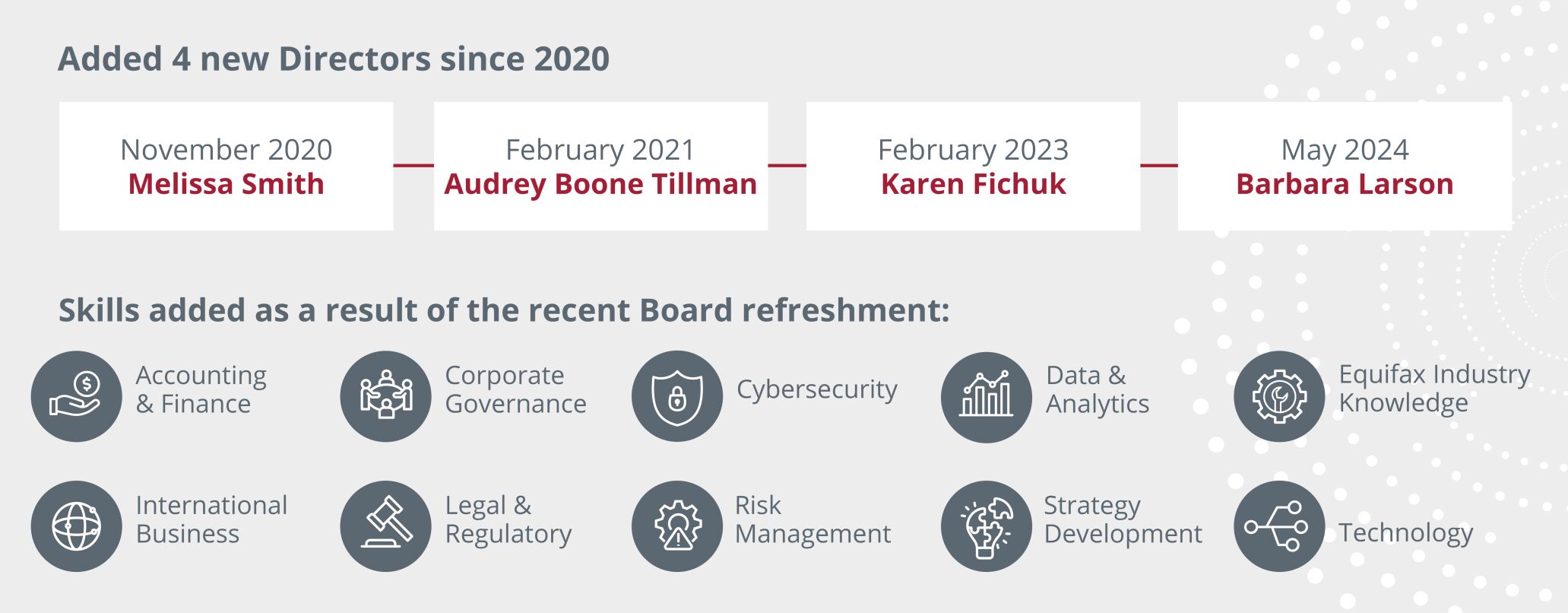
Equifax 2005 Executive Deferred Compensation Plan (frozen December 31, 2021)
This nonqualified plan was frozen by the Board, effective as of December 31, 2021, and no deferral elections may be made under the plan in respect of compensation earned for services performed after such date. Mr. Begor participated in this plan prior to it being frozen. This plan is a tax deferred compensation program for a limited number of executives, including NEOs, and provides a tax-favorable vehicle for deferring annual compensation, including base salary and annual or periodic incentives. Prior to the freezing of the plan, an executive could defer up to 75% of his or her base salary and up to 100% of any incentive payment. Amounts deferred are credited with gains or losses which mirror the performance of benchmark investment funds selected by the participant from among
|
|
103 |
several publicly-available investment funds. The plan does not offer any above-market or preferential rates of return to the NEOs. Amounts deferred are paid, at the participant’s option, either in a lump sum or in annual installments over a period of up to 15 years for retirement or termination distributions, or up to five years for a scheduled withdrawal.
Equifax Inc. Employee Deferred Compensation Plan (2022)
The Equifax Inc. Employee Deferred Compensation Plan was adopted by the Board, effective as of November 4, 2021. This nonqualified plan allows for certain management or highly compensated employees, including NEOs, to defer the receipt of compensation earned for services performed in calendar years commencing on or after January 1, 2022. The plan is a tax deferred compensation program and provides a tax favorable vehicle for deferring annual compensation, including base salary and annual or periodic incentives, and long-term incentive compensation, including RSUs and performance shares. Under the plan, a participant may defer up to 75% of his or her base salary and up to 100% of any cash or stock-based incentive compensation, including RSUs and performance shares. Any cash-based compensation that is deferred under the plan is credited with gains or losses which mirror the performance of benchmark investment funds selected by the participant from among several publicly-available investment funds. The plan does not offer any above-market or preferential rates of return to the NEOs. Any RSUs or performance shares that are deferred under the plan are credited in shares of deferred stock, which are notional shares equal in value to one share of our common stock. If any cash dividends or other distributions are paid with respect to our common stock between the date the deferred stock is credited to the participant’s account under the plan and the date the deferred stock is delivered to the participant, dividend equivalent units will be credited in respect of the participant’s deferred stock and will be deemed reinvested in additional deferred stock. Deferred stock credited to the plan is paid in shares of our common stock.
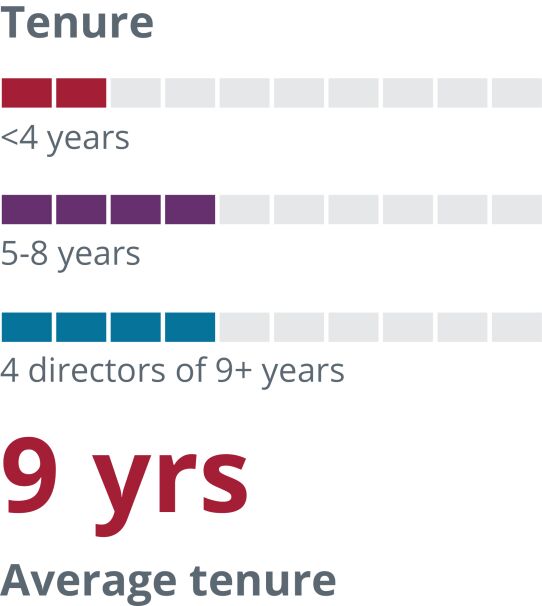
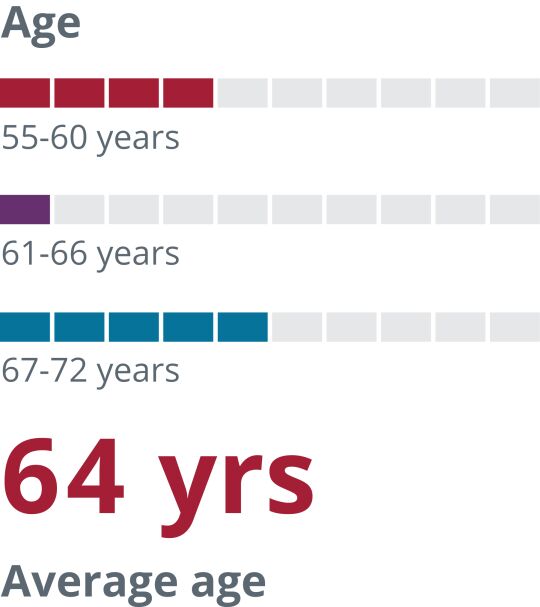
Amounts deferred under the Equifax Inc. Employee Deferred Compensation Plan are paid, at the participant’s option, either in a lump sum or in annual installments over a period of up to 10 years for distributions upon a termination of employment, or up to five years for a scheduled withdrawal. The Supplemental Contribution Program is continued under the Equifax Inc. Employee Deferred Compensation Plan on substantially the same terms as set forth in the frozen Equifax 2005 Executive Deferred Compensation Plan, except that payment of a participant’s vested supplemental contribution amounts will be made following his or her termination of employment either in a lump sum or in annual installments over a period of up to 10 years, as elected by the participant. Participants in the Equifax Inc. Employee Deferred Compensation Plan will be charged a proportionate share of the administrative fees incurred in connection with its administration.
Potential Payments Upon Termination or Change In Control
The following tables summarize the value of potential payments and benefits that our NEOs would receive if they had terminated employment on December 31, 2025 under the circumstances shown. The tables exclude amounts that would be paid in the normal course of continued employment, such as accrued but unpaid salary and earned annual cash incentive for 2025, and vested account balances in our 401(k) Plan that are generally available to all of our active U.S. salaried employees. Actual amounts to be paid can only be determined at the time of such executive’s termination of service.
| 104 |
2026 Proxy Statement |
M. Begor
| Payment or benefit |
Voluntary termination by the NEO ($) |
Termination ($) |
Termination by us without cause or by the NEO with good reason ($) |
Termination ($) |
Retirement ($) |
Disability ($) |
Death ($) | ||||||||||||||||||||||||||||
| Severance payments |
0 | 0 | 1 | 0 | 2 | 9,900,000 | 3 | 0 | 0 | 0 | |||||||||||||||||||||||||
| Pension/supplemental retirement plan4 |
3,069,167 | 3,069,167 | 3,069,167 | 3,069,167 | 3,069,167 | 3,482,972 | 3,482,972 | ||||||||||||||||||||||||||||
| Executive compensation deferral program6 |
34,735,321 | 34,735,321 | 34,735,321 | 34,735,321 | 34,735,321 | 34,735,321 | 34,735,321 | ||||||||||||||||||||||||||||
| Life insurance benefits |
0 | 0 | 0 | 0 | 0 | 0 | 250,000 | 7 | |||||||||||||||||||||||||||
| Disability benefits |
0 | 0 | 0 | 0 | 0 | 221,600 | 8 | 0 | |||||||||||||||||||||||||||
| Healthcare benefits |
0 | 0 | 0 | 38,992 | 9 | 0 | 0 | 4,600 | 11 | ||||||||||||||||||||||||||
| Perquisites and other personal benefits12 |
50,000 | 0 | 50,000 | 50,000 | 50,000 | 50,000 | 50,000 | ||||||||||||||||||||||||||||
| Market value of stock options vesting on termination |
0 | 0 | 0 | 13 | 0 | 13 | 0 | 0 | 13 | 0 | 13 | ||||||||||||||||||||||||
| Market value of restricted stock units and performance shares vesting on termination |
0 | 0 | 0 | 14 | 35,659,269 | 14 | 3,953,996 | 29,062,779 | 14 | 29,062,779 | 14 | ||||||||||||||||||||||||
| TOTAL |
37,854,488 | 37,804,488 | 37,854,488 | 83,452,749 | 41,808,484 | 67,552,672 | 67,585,672 | ||||||||||||||||||||||||||||
J. Gamble
| Payment or benefit |
Voluntary termination by the NEO ($) |
Termination by us for cause ($) |
Termination by us without cause or by the NEO with good reason ($) |
Termination ($) |
Retirement ($) |
Disability ($) |
Death3 ($) | ||||||||||||||||||||||||||||
| Severance payments |
0 | 0 | 1 | 400,000 | 2 | 3,520,001 | 3 | 0 | 0 | 0 | |||||||||||||||||||||||||
| Pension/supplemental retirement plan4 |
6,268,600 | 6,268,600 | 6,268,600 | 6,268,600 | 6,268,600 | 6,268,600 | 2,770,300 | 5 | |||||||||||||||||||||||||||
| Executive compensation deferral program6 |
268,399 | 268,399 | 268,399 | 268,399 | 268,399 | 268,399 | 268,399 | ||||||||||||||||||||||||||||
| Life insurance benefits |
0 | 0 | 0 | 0 | 0 | 0 | 1,250,000 | 7 | |||||||||||||||||||||||||||
| Disability benefits |
0 | 0 | 0 | 0 | 0 | 497,800 | 8 | 0 | |||||||||||||||||||||||||||
| Healthcare benefits |
0 | 0 | 0 | 36,667 | 9 | 0 | 10,300 | 10 | 4,600 | 11 | |||||||||||||||||||||||||
| Perquisites and other personal benefits12 |
10,000 | 0 | 10,000 | 10,000 | 10,000 | 10,000 | 10,000 | ||||||||||||||||||||||||||||
| Market value of stock options vesting on termination |
0 | 0 | 0 | 55,788 | 13 | 0 | 55,788 | 13 | 55,788 | 13 | |||||||||||||||||||||||||
| Market value of restricted stock units and performance shares vesting on termination |
0 | 0 | 0 | 7,556,228 | 14 | 0 | 9,457,637 | 14 | 9,457,637 | 14 | |||||||||||||||||||||||||
| TOTAL |
6,546,999 | 6,536,999 | 6,946,999 | 17,715,683 | 6,546,999 | 16,568,524 | 13,816,724 | ||||||||||||||||||||||||||||
|
|
105 |
C. Borton
| Payment or benefit |
Voluntary termination by the NEO ($) |
Termination by us for cause ($) |
Termination by us without cause or by the NEO with good reason ($) |
Termination by us without cause or by the NEO with good reason following a change in control ($) |
Retirement ($) |
Disability ($) |
Death ($) | ||||||||||||||||||||||||||||
| Severance payments |
0 | 0 | 1 | 89,423 | 2 | 3,319,231 | 3 | 0 | 0 | 0 | |||||||||||||||||||||||||
| Pension/supplemental retirement plan4 |
129,341 | 129,341 | 129,341 | 129,341 | 129,341 | 330,094 | 330,094 | ||||||||||||||||||||||||||||
| Executive compensation deferral program6 |
146,629 | 146,629 | 146,629 | 146,629 | 146,629 | 146,629 | 146,629 | ||||||||||||||||||||||||||||
| Life insurance benefits |
0 | 0 | 0 | 0 | 0 | 0 | 250,000 | 7 | |||||||||||||||||||||||||||
| Disability benefits |
0 | 0 | 0 | 0 | 0 | 856,100 | 8 | 0 | |||||||||||||||||||||||||||
| Healthcare benefits |
0 | 0 | 0 | 51,455 | 9 | 0 | 30,000 | 10 | 4,600 | 11 | |||||||||||||||||||||||||
| Perquisites and other personal benefits12 |
0 | 0 | 10,000 | 10,000 | 0 | 10,000 | 10,000 | ||||||||||||||||||||||||||||
| Market value of stock options vesting on termination |
0 | 0 | 0 | 0 | 13 | 0 | 0 | 13 | 0 | 13 | |||||||||||||||||||||||||
| Market value of restricted stock units and performance shares vesting on termination |
0 | 0 | 5,015,366 | 14 | 7,206,635 | 14 | 0 | 10,978,240 | 14 | 10,978,240 | 14 | ||||||||||||||||||||||||
| TOTAL |
275,970 | 275,970 | 5,390,759 | 10,863,291 | 275,970 | 12,351,063 | 11,719,563 | ||||||||||||||||||||||||||||
J. Farshchi
| Payment or benefit |
Voluntary termination by the NEO ($) |
Termination ($) |
Termination by us without cause or by the NEO with good reason ($) |
Termination by us without cause or by the NEO with good reason following a change in control ($) |
Retirement ($) |
Disability ($) |
Death ($) | ||||||||||||||||||||||||||||
| Severance payments |
0 | 0 | 1 | 250,962 | 2 | 2,894,231 | 3 | 0 | 0 | 0 | |||||||||||||||||||||||||
| Pension/supplemental retirement plan4 |
1,042,619 | 1,042,619 | 1,042,619 | 1,042,619 | 1,042,619 | 1,227,136 | 1,227,136 | ||||||||||||||||||||||||||||
| Executive compensation deferral program6 |
0 | 0 | 0 | 0 | 0 | 0 | 0 | ||||||||||||||||||||||||||||
| Life insurance benefits |
0 | 0 | 0 | 0 | 0 | 0 | 750,000 | 7 | |||||||||||||||||||||||||||
| Disability benefits |
0 | 0 | 0 | 0 | 0 | 1,186,700 | 8 | 0 | |||||||||||||||||||||||||||
| Healthcare benefits |
0 | 0 | 0 | 51,455 | 9 | 0 | 30,200 | 10 | 4,600 | 11 | |||||||||||||||||||||||||
| Perquisites and other personal benefits12 |
0 | 0 | 10,000 | 10,000 | 0 | 10,000 | 10,000 | ||||||||||||||||||||||||||||
| Market value of stock options vesting on termination |
0 | 0 | 0 | 23,707 | 13 | 0 | 23,707 | 13 | 23,707 | 13 | |||||||||||||||||||||||||
| Market value of restricted stock units and performance shares vesting on termination |
0 | 0 | 0 | 4,346,501 | 14 | 0 | 5,710,917 | 14 | 5,710,917 | 14 | |||||||||||||||||||||||||
| TOTAL |
1,042,619 | 1,042,619 | 1,303,581 | 8,368,513 | 1,042,619 | 8,188,660 | 7,726,360 | ||||||||||||||||||||||||||||
| 106 |
2026 Proxy Statement |
J. Houston
| Payment or benefit |
Voluntary termination by the NEO ($) |
Termination ($) |
Termination by us without cause or by the NEO with good reason ($) |
Termination by us without cause or by the NEO with good reason following a change in control ($) |
Retirement ($) |
Disability ($) |
Death ($) | ||||||||||||||||||||||||||||
| Severance payments |
0 | 0 | 1 | 350,000 | 2 | 2,336,308 | 3 | 0 | 0 | 0 | |||||||||||||||||||||||||
| Pension/supplemental retirement plan4 |
1,087,014 | 1,087,014 | 1,087,014 | 1,087,014 | 1,087,014 | 1,232,064 | 1,232,064 | ||||||||||||||||||||||||||||
| Executive compensation deferral program6 |
0 | 0 | 0 | 0 | 0 | 0 | 0 | ||||||||||||||||||||||||||||
| Life insurance benefits |
0 | 0 | 0 | 0 | 0 | 0 | 250,000 | 7 | |||||||||||||||||||||||||||
| Disability benefits |
0 | 0 | 0 | 0 | 0 | 880,100 | 8 | 0 | |||||||||||||||||||||||||||
| Healthcare benefits |
0 | 0 | 0 | 17,348 | 9 | 0 | 30,100 | 10 | 4,600 | 11 | |||||||||||||||||||||||||
| Perquisites and other personal benefits12 |
0 | 0 | 10,000 | 10,000 | 0 | 10,000 | 10,000 | ||||||||||||||||||||||||||||
| Market value of stock options vesting on termination |
0 | 0 | 0 | 20,926 | 13 | 0 | 20,926 | 13 | 20,926 | 13 | |||||||||||||||||||||||||
| Market value of restricted stock units and performance shares vesting on termination |
0 | 0 | 0 | 3,337,282 | 14 | 0 | 4,308,590 | 14 | 4,308,590 | 14 | |||||||||||||||||||||||||
| TOTAL |
1,087,014 | 1,087,014 | 1,447,014 | 6,808,878 | 1,087,014 | 6,481,780 | 5,826,180 | ||||||||||||||||||||||||||||
| 1 | The broad-based Equifax Inc. Severance Plan as described on page 109 does not pay a benefit for termination for cause by the Company. |
| 2 | For Mr. Begor, severance benefits for a termination without cause or for good reason were eliminated under the November 2024 Letter Agreement to his employment agreement. For NEOs other than Mr. Begor, reflects the amount payable to such executives under the broad-based Equifax Inc. Severance Plan. |
| 3 | For Mr. Begor, reflects the amount payable under the terms of his employment agreement. For NEOs other than Mr. Begor, reflects the value of lump-sum severance payment to a Tier I participant in the CIC Plan. |
| 4 | For Messrs. Begor, Borton and Farshchi and Ms. Houston, reflects the account balance as of December 31, 2025 under the Supplemental Contribution Program as described under “Non-Qualified Deferred Compensation” on page 102, including a company contribution for 2025 made in February 2026 in the event of disability or death. For Mr. Gamble, reflects pension benefits as described under the “Pension Benefits at 2025 Fiscal Year-End” table on page 101, including commencement at the earliest age for unreduced retirement (age 60 or current age of executives over 60), and determined using interest and mortality rate assumptions consistent with those used in the Company’s financial statements under FASB ASC Topic 715. |
| 5 | Reflects the present value of the death benefit payable under the SERP to Mr. Gamble’s surviving spouse at the executive’s earliest retirement age (age 55 or current age, if older). |
| 6 | Reflects amounts previously earned but deferred by the NEO, as described in the “Non-Qualified Deferred Compensation” table on page 102. |
| 7 | Reflects one-times annual base salary (limited to $250,000) of basic life insurance coverage. In addition, Mr. Gamble elected two-times base annual salary supplemental life coverage limited to $1 million and Mr. Farshchi elected $500,000 of supplemental coverage. The Company also maintains a travel and accidental death insurance policy for most employees, including executive officers that would provide an additional $1 million benefit payable to the executive’s estate if the executive’s death occurred during Company-related travel. |
| 8 | Reflects the present value of the executive’s disability income benefits of $120,000 per annum as of December 31, 2025 determined (a) assuming full disability at December 31, 2025 and continuing until age 65 for those under age 60, for 60 months for those between ages 60 and 65, and to age 70 for those over age 65, (b) assuming mortality according to the Pre-2012 disabled retiree mortality table with fully generational projections using scale MP-2021 published by the Society of Actuaries, and (c) applying a discount rate of 5.23% per annum. |
| 9 | Reflects 24 months of health, dental and vision coverage using our COBRA premium rate. |
| 10 | Reflects the actuarial present value of the employer cost of providing continuing medical coverage assuming disablement at December 31, 2025, with coverage until the earlier of 36 months and age 65, determined using interest and mortality rate assumptions consistent with those used in the Company’s financial statements under FASB ASC Topic 715. |
|
|
107 |
| 11 | Reflects the actuarial present value of the employer cost of providing surviving spouse or domestic partner continuing medical coverage for a period of 12 months from the employee’s date of death, or, if earlier, employee’s age 65, determined using interest rate and mortality rate assumptions consistent with those used in the Company’s consolidated financial statements under FASB ASC Topic 715. |
| 12 | Reflects the estimated cost to us of continuing financial planning and tax services for one year. |
| 13 | Pursuant to the applicable award agreement, executive would become immediately vested in all outstanding stock options. This value reflects the difference between the closing market price of the Company’s common stock ($216.98) on December 31, 2025, the last trading date of the year, as reported on the NYSE and the exercise price of all outstanding unvested options. |
| 14 | Pursuant to our 2008 Omnibus Incentive Plan, 2023 Omnibus Incentive Plan, the applicable grant agreements and Mr. Begor’s employment agreement, executives would generally become immediately vested in all outstanding RSUs and performance shares upon death, disability or termination following a change in control. This excludes Mr. Begor’s July 2022 TSR performance shares, which continue to vest in the event of disability or death. The amount reported represents, based on the closing market price of the Company’s common stock reported on the NYSE on December 31, 2025 ($216.98): |
| (a) | the value of unvested RSUs; |
| (b) | (i) for a termination by us without cause or by the NEO with good reason, the value of the unvested performance shares for Mr. Begor’s July 2022 TSR performance shares and Mr. Borton’s new hire performance share grants, which would be paid at the target award level (100%); |
| (ii) for a termination following a change in control, the value of the unvested performance shares, determined for each outstanding award as follows: (A) the value of TSR performance shares based on the Company’s cumulative TSR percentile rank at December 31, 2025 (except for Mr. Begor’s July 2022 TSR performance shares, which would be paid at the target award level (100%)), and (B) the value of Adjusted EBITDA performance shares based upon the Adjusted EBITDA performance multiplier calculated at December 31, 2025; and |
| (iii) for a termination as a result of death or disability, the value of the unvested performance shares at December 31, 2025, based on the target award payout level (100%). This excludes Mr. Begor’s July 2022 TSR performance shares, which would continue to vest at the original vesting date. |
Horvath Separation Agreement
During 2025, Equifax made several changes to its senior leadership team in connection with ongoing succession management, including the involuntary termination without cause of Todd Horvath in May 2025. Mr. Horvath departed from his role as Executive Vice President, President, USIS, on June 1, 2025. As more fully described below, Mr. Horvath and the Company entered into a separation agreement and general release in connection with his departure pursuant to which Mr. Horvath agreed to certain restrictive covenants in favor of the Company.
Agreements Benefitted Equifax and Our Shareholders
Equifax maintains a broad-based Equifax Inc. Severance Plan, which applies to all full-time U.S. salaried employees and provides guidelines for the amount of severance to be granted to employees based on tenure with the Company. However, the broad-based severance plan is not intended to prescribe the amount or form of severance in the case of an executive separation, nor does it require an employee to enter into the kinds of agreements that the Company required from Mr. Horvath to protect the best interests of shareholders.
Consistent with the Company’s general approach for all NEOs other than the CEO, Mr. Horvath did not have an employment agreement with the Company. At this time, the Board believes that it is not in the best interests of our shareholders and the Company to maintain standing employment agreements with our NEOs (other than the CEO). Our current approach allows the Company to be well-positioned to narrowly tailor the terms of any executive separation agreement to fit the specific facts associated with an executive’s exit, as has been our practice.
The separation agreement and general release that the Company entered into with Mr. Horvath provided numerous benefits to the Company and its shareholders. Under the terms of the separation agreement:
| • | Mr. Horvath signed a general release, which provided the Company with reassurance by securing his ongoing future cooperation in the event of certain matters or proceedings; |
| • | Mr. Horvath agreed to maintain the confidentiality of our sensitive information and proprietary information for a period of 10 years following his employment (as compared to the standard 5-year period); |
| • | Mr. Horvath agreed to a prohibition against soliciting select Equifax customers and employees for a period of 24 months following his separation (as compared to the standard 12-month period); |
| • | Mr. Horvath agreed to a prohibition against engaging in competitive tasks on his own behalf or on behalf of another company for a period of 24 months following his separation (as compared to the standard 12-month period); |
| 108 |
2026 Proxy Statement |
| • | Mr. Horvath agreed to a non-disparagement provision in favor of the Company; and |
| • | Mr. Horvath agreed that 100% of his severance payment is subject to the clawback in the event of non-compliance with the separation agreement. |
In return for these agreements, the Company agreed to provide a severance benefit of approximately $2.9 million, representing approximately two years of his annual cash compensation (minus applicable taxes and withholdings). In addition, the Company agreed that Mr. Horvath was eligible to receive a prorated portion of his annual incentive award for 2025 reflecting his employment through June 1, 2025. The $545,198 value of his prorated annual incentive award was calculated and paid out in the first quarter of 2026 based on the Company’s actual full-year 2025 performance results.
Outstanding Equity Awards Treated Consistent with Pre-Established Terms
Outstanding equity awards held by Mr. Horvath will be treated in accordance with the terms of the grant agreements, including his new hire equity award agreements dated May 2023. As a result of his termination, Mr. Horvath forfeited the unvested portions of his 2023 and 2024 annual long-term incentive awards, with an aggregate target grant date value of $6.3 million. As required by the terms of his new hire equity award agreements, Mr. Horvath received a lump-sum cash payment of $3.2 million in cash, representing the fair market value of the unvested portion of his new hire “make whole” equity award that was intended to compensate him for foregoing unvested equity at his prior employer. The treatment of Mr. Horvath’s equity awards was consistent with the terms of his equity award agreements and no enhanced treatment was provided in connection with his separation.
Kelley Retirement
Mr. Kelley stepped down from his role as Executive Vice President, Chief Legal Officer, on April 1, 2025 and retired from Equifax on January 1, 2026.
Payments Made Upon Termination
Regardless of the manner in which an NEO’s employment terminates, the executive is entitled to receive amounts earned during the executive’s term of employment. The amounts include:
| • | annual incentive compensation earned during the fiscal year for termination due to retirement, job elimination, death or disability; |
| • | vested shares awarded under the Omnibus Incentive Plan; |
| • | amounts contributed under the 401(k) Plan for termination due to retirement, job elimination, death or disability; |
| • | amounts contributed under executive compensation deferral programs for termination due to death or disability; and |
| • | accrued but unused vacation pay and amounts accrued and vested under the SERP. |
Equifax Inc. Severance Plan
Under this plan, our full-time U.S. salaried employees are eligible for a severance benefit in the event: (i) their employment is terminated because of the elimination of their position, unless they were offered replacement employment as defined in the plan; (ii) their office is relocated to a place requiring a commute more than 35 miles longer than their prior commute; or (iii) they are terminated due to inability or failure to meet job expectations, provided the employee signs a general release of claims. The amount of the severance benefit is determined based on the employee’s length of service and base salary. In general, for job elimination or relocation, an eligible exempt employee is entitled to receive four weeks of severance for any portion of their first year of service plus two weeks for each year of completed service, up to 52 weeks. Termination for inability or failure to meet job expectations of eligible exempt employees entitles the employee to four weeks of severance for less than five years of service, eight weeks of severance for at least five but less than 10 years of service, and 12 weeks of severance for 10 or more years of service.
|
|
109 |
Payments Made Upon Retirement
In the event of the retirement of an NEO, in addition to the items identified above, outstanding and unvested equity awards as of December 31, 2025 will be treated as followed:
| Equity Award Type |
Treatment | |
| Premium-priced stock options granted under 2023-2025 annual LTI program to our CEO (exercise price equal to 110% and 120% of closing stock price on grant date) |
Award will continue to vest and remain exercisable for the remainder of the outstanding 7-year or 8-year term, as applicable | |
| Market-priced stock options |
Award will continue to vest and remain exercisable for the remainder of the outstanding 10-year term | |
| TSR performance shares |
Award will remain eligible to vest, subject to completion of the performance milestones | |
| Adjusted EBITDA performance shares |
Award will remain eligible to vest, subject to completion of the performance milestones | |
| Time-based RSUs |
Award will continue to vest (except for RSUs granted to Mr. Begor, which would immediately vest) | |
In addition, in the event of retirement, our NEOs will receive reimbursement by the Company for:
| • | an executive physical in the year of retirement; and |
| • | up to $10,000 of financial planning and tax services incurred in the year of retirement and the subsequent year ($50,000 for the CEO). |
Payments Made Upon Death or Disability
In the event of the death or disability of an NEO, in addition to the benefits listed above, the executive will receive benefits under our disability plan or payments under our group life insurance plan, as appropriate. In addition, pursuant to our 2008 Omnibus Incentive Plan and 2023 Omnibus Incentive Plan, upon death or disability, the executive would become immediately vested in all outstanding RSUs, performance shares and stock options.
Payments Made Upon a Change in Control
Change in Control Severance Plan
In February 2019, the Compensation Committee adopted the CIC Plan. The CIC Plan applies to each of our NEOs, except Mr. Begor whose severance benefits upon a change in control are contained in his employment agreement (see “CEO Employment Agreement” on page 89).
The Compensation Committee adopted the CIC Plan to ensure a uniform set of provisions among participating NEOs that is aligned with best practices. The CIC Plan supports the creation of shareholder value by mitigating economic anxiety that could arise due to uncertainty about future job continuity, which is intended to ensure the delivery of an intact leadership team to the successor organization and focus the team on shareholder objectives rather than how the outcome may affect them personally. The CIC Plan is not intended to replace or affect other compensation elements.
| 110 |
2026 Proxy Statement |
The CIC Plan provides the participating NEOs with severance benefits in the event that (i) a “change in control” of the Company occurs, and (ii) within 6 months prior to or within 24 months after the change in control, a participating NEO is terminated by the Company without “cause” or by the NEO for “good reason” (referred to as a “CIC Qualifying Termination”). If a CIC Qualifying Termination occurs, the NEO is eligible to receive:
| • | a cash payment equal to two times the NEO’s current base salary and target annual incentive for the year of termination; |
| • | a pro rata target annual incentive for the year of termination; |
| • | a cash payment equal to 24 months of the cost of COBRA coverage for the NEO and his or her dependents; and |
| • | full vesting of any unvested supplemental retirement benefits. |
Severance payments to an NEO are generally capped such that the payments will be reduced to satisfy the “parachute payment” limits of Code Section 280G.
Pursuant to the CIC Plan, a “change in control” is deemed to occur upon:
| • | an accumulation by any person, entity or group of 20% or more of the Company’s common stock; |
| • | a business combination resulting in shareholders immediately prior to the combination owning less than two-thirds of the Company’s common stock; |
| • | the members of the current Board of Directors ceasing to constitute a majority of the Board of Directors, except for new directors that are regularly elected; or |
| • | shareholder approval of a plan of complete liquidation or dissolution of the Company or an agreement for the sale of disposition of all or substantially all of the Company’s assets. |
Under the terms of the CIC Plan, the participating NEOs become subject to standard definitions of “Cause” and “Good Reason” that align with contemporary best practices and severance benefits become subject to the Company’s compensation clawback policy. An NEO can be terminated for “cause” as a result of: (i) conviction or plea of guilty or nolo contendere to a felony or other serious crime involving moral turpitude; (ii) willful misconduct that is materially injurious to the Company or any of its subsidiaries (whether financially, reputationally, or otherwise); (iii) willful and continued failure of an NEO to perform his or her duties and responsibilities (other than as a result of physical or mental illness or injury) after receipt of written notice of such failure, provided that the NEO shall have 30 days after the date of receipt of such notice in which to cure such failure (to the extent cure is possible); (iv) gross negligence in managing the material risks of the Company or its subsidiaries; (v) material breach of the CIC Plan or of the restrictive covenants after receipt of written notice of such breach, provided, that the NEO shall have 30 days after the date of receipt of such notice in which to cure such breach (to the extent cure is possible); or (vi) material violations of law or the Company’s Code of Conduct or insider trading policy, any of which results in material financial or reputational harm to the Company. An NEO can terminate his or her employment for “good reason” based upon (i) a material adverse change in the NEO’s duties, authority, or responsibilities; (ii) a material reduction in the NEO’s base salary (which for purposes of the CIC Plan shall mean a reduction of 10% or more) or the target percentage of base salary under the Annual Incentive Plan; (iii) a material reduction in the value of the NEO’s annual equity or long term incentive award opportunity; (iv) a relocation of the NEO’s primary work location of more than 35 miles; or (v) the material breach by the Company of the terms of the CIC Plan.
In order to be eligible to receive severance benefits, the NEO must execute a release of claims against the Company and comply with confidentiality, non-competition and non-solicitation restrictive covenants. In addition, severance benefits are subject to the Company’s clawback policy.
Change in Control and Termination Provisions of Other Plans
Annual Incentive Plan
Under the AIP, which is established under the 2023 Omnibus Incentive Plan, an NEO would forfeit his or her award if he or she voluntarily terminated his or her employment other than for “good reason” (as defined in the plan) prior to year-end or if he or she is terminated by us for “cause” (as defined in the plan). However, the executive would receive a pro rata award under the plan if the executive’s employment is terminated prior to year-end as a result of death, disability, retirement or job elimination. If there is a change in control event and an NEO is terminated without cause or terminates for “good reason,” payments for annual incentive opportunities would be made to the executive in the manner described under “Payments Made Upon a Change in Control” on page 110.
|
|
111 |
Omnibus Incentive Plans
Although subject to the discretion of the Compensation Committee, under the 2008 Omnibus Incentive Plan, 2023 Omnibus Incentive Plan and applicable award agreements, equity awards to our NEOs include a “double-trigger” change in control provision to limit accelerated vesting in the event of a change in control of Equifax to those situations where an executive is terminated without cause, the executive terminates for good reason or the acquirer fails to assume the awards.
Rabbi Trust
We maintain a trust agreement with an independent trustee establishing a springing rabbi trust for the purpose of funding benefits payable to participants (including participating NEOs) under our SERP. The trust is a grantor trust, irrevocable except in the event of an unfavorable ruling by the IRS as to the tax status of the trust or certain changes in tax law. It is currently funded with a nominal amount of cash. Future contributions will be made to the grantor trust if and when required by the provisions of the trust or at the discretion of the Company. If there is a change in control, the grantor trust must be fully funded, within 10 days following the change in control, with an amount equal to the entire benefit to which each participant would be entitled under the covered plan as of the date of the change in control (calculated on the basis of the present value of the projected future benefits payable under the covered plan). “Change in Control” is defined in substantially the same manner as in the CIC Plan described under “Payments Made Upon a Change in Control,” except that (i) there is no “double trigger,” (ii) a business combination resulting in shareholders immediately prior to the combination owning equal to or less than two-thirds of the Company’s common stock constitutes a change in control, (iii) a business combination in which there is not a change in at least a majority of the members of the Board of Directors does not constitute a change in control and (iv) a change in a majority of the members of the Board of Directors does not constitute a change in control. The assets of the grantor trust are required to be held separate and apart from the other funds of Equifax and its subsidiaries, but remain subject to the claims of general creditors under applicable state and federal law.
CEO Pay Ratio
As required by Item 402(u) of Regulation S-K, we are providing the following information concerning the ratio of the pay of our CEO to the median pay of all other employees.
| • | For fiscal 2025: (i) the annual total compensation of our median employee (excluding our CEO) was $79,492 (comprised of base salary, paid time off, an award from a points-based employee recognition program and a company match to the 401(k) Plan); and (ii) the annual total compensation of our CEO was $23,387,653 as reported on the Summary Compensation Table on page 93. Based on this information, the ratio of the annual total compensation of our CEO to the median employee is 294 to 1. |
| • | The pay ratio reported above is a reasonable estimate calculated in a manner consistent with SEC rules based on our internal records and the methodology described below. |
| - | We are using the same median employee that we identified on November 30, 2023 using annual base salary as of November 30, 2023, which was annualized for all permanent employees who did not work the entire fiscal year, plus short-term incentives paid in the 12-month period ended November 30, 2023. We do not believe there has been a change in employee population or employee compensation arrangements that would result in a significant change in the pay ratio disclosure. Our median employee is a full-time employee located in the United States. No employee groups were excluded from the employee population. |
| 112 |
2026 Proxy Statement |
Year |
Summary Compensation Table Total for PEO 1 ($) |
Compensation Actually Paid to PEO 1, 2, 3 ($) |
Average Summary Compensation Table Total for Non-PEO NEOs 1 ($) |
Average Compensation Actually Paid to Non-PEO NEOs 1,2,3 ($) |
Value of Initial Fixed $100 Investment based on: 4 |
Net Income 5 ($ Millions) |
Adjusted EBITDA 6 ($ Millions) |
|||||||||||||||||||||||||
TSR ($) |
Peer Group TSR ($) |
|||||||||||||||||||||||||||||||
2025 |
( |
) |
||||||||||||||||||||||||||||||
2024 |
||||||||||||||||||||||||||||||||
2023 |
||||||||||||||||||||||||||||||||
2022 |
( |
) |
( |
) |
||||||||||||||||||||||||||||
2021 |
||||||||||||||||||||||||||||||||
1 |
Non-PEO NEOs for each year are listed below. |
2021 |
2022 |
2023 |
2024 |
2025 | ||||
John W. Gamble, Jr. |
John W. Gamble, Jr. | ||||
Rodolfo O. Ploder |
Rodolfo O. Ploder |
Rodolfo O. Ploder |
Chad M. Borton |
Chad M. Borton | ||||
Sid Singh |
Sid Singh |
Bryson R. Koehler |
Todd Horvath |
Todd Horvath | ||||
Bryson R. Koehler |
Bryson R. Koehler |
Todd Horvath |
Jamil Farshchi |
Jamil Farshchi | ||||
John J. Kelley III |
Rodolfo O. Ploder |
Julia A. Houston | ||||||
| |
|
|
|
John Kelley | ||||
2 |
The amounts shown for Compensation Actually Paid have been calculated in accordance with Item 402(v) of Regulation S-K and do not reflect compensation actually earned, realized, or received by the Company’s NEOs. These amounts reflect the Summary Compensation Table Total with certain adjustments as described in footnote 3 below. |
3 |
Compensation Actually Paid reflects the exclusions and inclusions of certain amounts for the PEO and the Non-PEO NEOs as set forth below. Equity values are calculated in accordance with FASB ASC Topic 718. Amounts in the Exclusion of Stock Awards and Option Awards column are the totals from the Stock Awards and Option Awards columns set forth in the Summary Compensation Table. Amounts in the Exclusion of Change in Pension Value column reflect the amounts attributable to the Change in Pension Value reported in the Summary Compensation Table. Amounts in the Inclusion of Pension Service Cost are based on the service cost for services rendered during the listed year. |
Year |
Summary Compensation Table Total for PEO ($) |
Exclusion of Change in Pension Value for PEO ($) |
Exclusion of Stock Awards and Option Awards for PEO ($) |
Inclusion of Pension Service Cost for PEO ($) |
Inclusion of Equity Values for PEO ($) |
Compensation Actually Paid to PEO ($) |
||||||||||||||||||
2025 |
( |
) |
( |
) |
( |
) | ||||||||||||||||||
|
113 |
Year |
Average Summary Compensation Table Total for Non-PEO NEOs ($) |
Average Exclusion of Change in Pension Value for Non-PEO NEOs ($) |
Average Exclusion of Stock Awards for Non-PEO NEOs ($) |
Average Inclusion of Pension Service Cost for Non-PEO NEOs ($) |
Average Inclusion of Equity Values for Non-PEO NEOs ($) |
Average Compensation Actually Paid to Non-PEO NEOs ($) |
||||||||||||||||||
2025 |
( |
) |
( |
) |
( |
) |
||||||||||||||||||
Year |
Year-End Fair Value of Equity Awards Granted During Year That Remained Unvested as of Last Day of Year for PEO ($) |
Change in Fair Value from Last Day of Prior Year to Last Day of Year of Unvested Equity Awards for PEO ($) |
Vesting- Date Fair Value of Equity Awards Granted During Year that Vested During Year for PEO ($) |
Change in Fair Value from Last Day of Prior Year to Vesting Date of Unvested Equity Awards that Vested During Year for PEO ($) |
Fair Value at Last Day of Prior Year of Equity Awards Forfeited During Year for PEO ($) |
Value of Dividends or Other Earnings Paid on Equity Awards Not Otherwise Included for PEO ($) |
Total - Inclusion of Equity Values for PEO ($) |
|||||||||||||||||||||
2025 |
( |
) |
( |
) |
( |
) | ||||||||||||||||||||||
Year |
Average Year- End Fair Value of Equity Awards Granted During Year That Remained Unvested as of Last Day of Year for Non-PEO NEOs ($) |
Average Change in Fair Value from Last Day of Prior Year to Last Day of Year of Unvested Equity Awards for Non-PEO NEOs ($) |
Average Vesting-Date Fair Value of Equity Awards Granted During Year that Vested During Year for Non-PEO NEOs ($) |
Average Change in Fair Value from Last Day of Prior Year to Vesting Date of Unvested Equity Awards that Vested During Year for Non-PEO NEOs ($) |
Average Fair Value at Last Day of Prior Year of Equity Awards Forfeited During Year for Non-PEO NEOs ($) |
Average Value of Dividends or Other Earnings Paid on Equity Awards Not Otherwise Included for Non-PEO NEOs ($) |
Total -Average Inclusion of Equity Values for Non-PEO NEOs ($) |
|||||||||||||||||||||
2025 |
( |
) |
( |
) |
( |
) |
( |
) | ||||||||||||||||||||
4 |
5 |
This column presents the Company’s consolidated net income as reported in our Form 10-K for each covered year. |
6 |
Non-PEO NEOs in 2025. Adjusted EBITDA is a non-GAAP financial measure defined in Annex A to this Proxy Statement. |
114 |
2026 Proxy Statement |
|
115 |
116 |
2026 Proxy Statement |
Equity Compensation Plan Information
The following table shows information, as of December 31, 2025, concerning shares of the Company’s common stock authorized for issuance under the Company’s equity compensation plans.
| Plan category |
Number of securities upon exercise of |
Weighted-average exercise price of outstanding options, warrants and rights1,2 (b) |
Number of securities remaining available for future issuance under equity compensation plans (excluding securities reflected in column (a)) (c) |
|||||||||
| Equity compensation plans approved by shareholders |
2,634,465 | 3 | $ | 208 | 3,781,619 | |||||||
| Equity compensation plans not approved by shareholders |
0 | $ | 0 | 0 | ||||||||
| Total Equity Compensation Plans |
2,634,465 | $ | 208 | 3,781,619 | ||||||||
| 1 | The weighted-average exercise price is calculated based solely on the exercise prices of the outstanding options and does not reflect the shares that will be issued upon the vesting of outstanding awards of RSUs and performance shares, which have no exercise price. |
| 2 | The weighted-average remaining contractual term of the Company’s outstanding options as of December 31, 2025 was 5.3 years. |
| 3 | This number reflects 2,634,465 shares for issuance under the 2023 Omnibus Incentive Plan, of which 1,386,945 shares were subject to outstanding options, 490,804 shares were subject to outstanding RSU awards and 756,716 shares were subject to outstanding performance share awards (assumes the maximum 200% of target award payout is realized and includes dividend equivalent units). |
See Part II, Item 8, “Financial Statements and Supplementary Data,” of our 2025 Annual Report on Form 10-K in the Notes to Consolidated Financial Statements at Note 8, “Stock-Based Compensation,” for further information regarding our equity compensation plans.
Compensation Committee Report
The Compensation, Human Resources and Management Succession Committee (the “Compensation Committee”) has reviewed and discussed with management the Compensation Discussion and Analysis contained in this Proxy Statement. Based upon this review and discussion, the Compensation Committee recommended to the Board of Directors that the Compensation Discussion and Analysis be included in this Proxy Statement and incorporated by reference in the Company’s Annual Report on Form 10-K for the fiscal year ended December 31, 2025.
Submitted by the Compensation Committee:
Robert D. Marcus (Chair) Mark L. Feidler G. Thomas Hough Melissa D. Smith
|
|
117 |
Director Compensation
The table below sets forth the compensation received by our non-management directors during 2025:
| Name |
Fees Earned or Paid in Cash ($) |
Stock Awards1 ($) |
All Other Compensation2 ($) |
Total ($) | ||||||||||||||||
| Mark L. Feidler |
282,500 | 220,182 | 359 | 503,041 | ||||||||||||||||
| Karen L. Fichuk |
115,000 | 220,182 | 359 | 335,541 | ||||||||||||||||
| G. Thomas Hough |
142,500 | 220,182 | 20,359 | 383,041 | ||||||||||||||||
| Barbara A. Larson |
115,000 | 220,182 | 17,859 | 353,041 | ||||||||||||||||
| Robert D. Marcus |
135,000 | 220,182 | 20,359 | 375,541 | ||||||||||||||||
| Scott A. McGregor |
130,000 | 220,182 | 5,084 | 355,266 | ||||||||||||||||
| John A. McKinley |
145,000 | 220,182 | 359 | 365,541 | ||||||||||||||||
| Melissa D. Smith |
122,500 | 220,182 | 0 | 342,682 | ||||||||||||||||
| Audrey Boone Tillman |
125,000 | 220,182 | 10,859 | 356,041 | ||||||||||||||||
| 1 | Represents the grant date fair value for RSU awards made on May 8, 2025 (812 RSUs for each director then serving), computed in accordance with FASB ASC Topic 718. |
| 2 | Reflects the market price of annual membership to certain of our credit monitoring products, third-party internet data removal services and Company-matching charitable contributions under the Equifax Matching Gift Program. Under the Matching Gift Program, the Company will match contributions to eligible non-profit organizations, up to a maximum of $20,000 per director per calendar year. In 2025, the Company made or committed to make matching contributions on behalf of our outside directors as follows: Mr. Hough ($20,000); Ms. Larson ($17,500); Mr. Marcus ($20,000); and Ms. Tillman ($10,500). |
Director Fees
By paying directors an annual retainer, the Company compensates each non-management director for his or her role and judgment as an advisor to the Company, rather than for his or her attendance or effort at individual meetings. Directors with added responsibility are recognized with higher cash compensation as noted above.
Director cash compensation in 2025 consisted of the following:
| • | Annual retainer of $100,000 paid to all non-employee directors. |
| • | Annual committee chair retainers in the amount of $20,000 for the Governance Committee Chair, $25,000 for the Compensation Committee Chair and $30,000 for the Audit Committee and Technology Committee Chairs. |
| • | Annual non-chair committee member retainers in the amount of $10,000 for Governance Committee members, $12,500 for Compensation Committee members and $15,000 for Audit Committee and Technology Committee members. |
| • | Annual retainer of $150,000 paid to Mr. Feidler as Independent Chairman. |
Effective January 1, 2026, the annual cash retainer for the Audit Committee Chair increased to $40,000 and the annual cash retainers for the Compensation Committee Chair and Governance Committee Chair each increased to $30,000.
| 118 |
2026 Proxy Statement |
Equity Awards
Upon joining our Board, each independent director receives a one-time grant of RSUs with a grant date fair value of $200,000 under our shareholder-approved Omnibus Incentive Plan. In addition, each independent director receives an annual long-term incentive grant of RSUs with a grant date fair value of $220,000 on the date of the annual meeting of shareholders. The initial and annual grants vest three years and one year, respectively, after the grant date, with accelerated vesting in the event of the director’s death, disability, retirement or a change in control of the Company. These equity grants are designed to further align the interests of our directors with those of our shareholders and to attract and retain highly-qualified directors through equity ownership. RSUs granted to directors accrue dividend equivalent units.
Stock Ownership Requirement
Each independent director is required to own Equifax common stock with a market value of at least five times his or her annual cash retainer. New directors have five years to achieve the ownership requirement. Under our insider trading policy, our directors are prohibited from purchasing or selling financial instruments (including prepaid variable forward contracts, equity swaps, collars, exchange funds and other derivative securities), or otherwise engaging in transactions that hedge or offset, or are designed to hedge or offset, any decrease in the market value of Equifax securities. We also prohibit our directors from holding our stock in a margin account or pledging our stock as collateral for a loan.
Equifax 2005 Director Deferred Compensation Plan (frozen December 31, 2021)
The Equifax 2005 Director Deferred Compensation Plan was frozen by the Board, effective as of December 31, 2021, and no deferral elections may be made under the plan in respect of compensation earned for services performed after such date. Prior to the freezing of the plan, each director could elect to defer receipt of up to 100% of his or her stock-based or cash retainer fees. A director who elected to defer his or her fees is credited with a number of share units having an equivalent value at the end of each quarter based on his or her advance deferral election, with credit for dividends beginning with grants made in 2020. Share units are equivalent to shares of the Company’s common stock, except that share units have no voting rights. In general, amounts deferred are not paid until the director retires from the Board. However, directors may also establish sub-accounts from which amounts are to be paid on specific pre-retirement timetables established by the director. At the end of the applicable deferral period, the director receives a share of common stock for each share unit awarded. Such shares are received either in a lump sum or over a period not to exceed 15 years for retirement distributions, or up to five years for a scheduled withdrawal, as elected in advance by each director.
Director and Executive Stock Deferral Plan (frozen December 31, 2021)
The Director and Executive Stock Deferral Plan was frozen by the Board, effective as of December 31, 2021, and no deferral elections may be made under the plan in respect of compensation earned for services performed after such date. Prior to the freezing of the plan, each director could elect to defer up to 100% of his or her annual and/or new director RSU grant, including dividend equivalent units, plus taxes otherwise due upon the vesting of RSUs. A director who elected to defer his or her annual and/or new director RSU grant is credited with a number of share units as of the vesting date based on his or her advance deferral election. In general, amounts deferred under the plan are not paid until the director retires from the Board. However, directors may also establish sub-accounts from which amounts are to be paid on specific pre-retirement timetables established by the director. Amounts deferred are paid in shares of our common stock, at the director’s option, either in a lump sum or in annual installments over a period of up to 15 years for retirement distributions, or up to five years for a scheduled withdrawal.
|
|
119 |
Equifax Inc. Board of Directors Deferred Compensation Plan (2022)
The Equifax Inc. Board of Directors Deferred Compensation Plan was adopted by the Board, effective as of November 4, 2021. This nonqualified plan allows for non-employee members of the Board to defer the receipt of compensation earned for services performed in calendar years commencing on or after January 1, 2022. The plan is a tax deferred compensation program and provides a tax favorable vehicle for deferring stock-based and cash retainer fees. Under the plan, a director may defer up to 100% of his or her stock-based and/or cash retainer fees. Any compensation that is deferred by a director is credited in shares of deferred stock, which are notional shares equal in value to one share of our common stock. If any cash dividends or other distributions are paid with respect to our common stock between the date the deferred stock is credited to the director’s account under the plan and the date the deferred stock is delivered to the director, dividend equivalent units will be credited in respect of the director’s deferred stock and will be deemed reinvested in additional deferred stock. Deferred stock credited to the plan is paid in shares of our common stock.
Amounts deferred under the Equifax Inc. Board of Directors Deferred Compensation Plan are paid, at the director’s option, either in a lump sum or in annual installments over a period of up to 10 years for distributions upon a termination of services as a member of the Board, or up to five years for a scheduled withdrawal. Participants in the Equifax Inc. Board of Directors Deferred Compensation Plan will be charged a proportionate share of the administrative fees incurred in connection with its administration.
| 120 |
2026 Proxy Statement |
Security Ownership of Management and Certain Beneficial Owners
Securities Owned by Certain Beneficial Owners
The table below contains information as of March 9, 2026, unless otherwise indicated, with respect to the beneficial ownership of the Company’s common stock by each person the Company believes beneficially holds more than 5% of the outstanding shares of the Company’s common stock, based solely on the Company’s review of SEC filings.
| Beneficial Ownership of Common Stock | ||||||||||
| Name and Address of Beneficial Owner |
Number of Shares | % of Class1 | ||||||||
| The Vanguard Group2 |
15,282,951 | 12.7 | % | |||||||
| BlackRock, Inc.3 |
8,547,536 | 7.1 | % | |||||||
| Harris Associates L.P.4 |
7,557,127 | 6.3 | % | |||||||
| Capital International Investors5 |
6,591,029 | 5.5 | % | |||||||
| 1 | Based upon 120,634,597 shares of common stock outstanding as of March 9, 2026. Beneficial ownership is determined in accordance with the rules of the SEC under which shares are beneficially owned by the person or entity that holds investment and/or voting power. |
| 2 | Based on a Schedule 13G/A filed on October 30, 2025 by The Vanguard Group (“Vanguard”), which listed its address as 100 Vanguard Boulevard, Malvern, Pennsylvania 19355, Vanguard possesses sole voting power with respect to 0 shares of common stock, shared voting power with respect to 731,561 shares of common stock, sole dispositive power with respect to 14,103,287 shares of common stock and shared dispositive power with respect to 1,179,664 shares of common stock. |
| 3 | Based on a Schedule 13G/A filed on February 5, 2025 by BlackRock, Inc. (“BlackRock”), which listed its address as 50 Hudson Yards, New York, NY 10001, BlackRock possesses sole voting power with respect to 7,628,013 shares of common stock, shared voting power with respect to 0 shares of common stock, sole dispositive power with respect to 8,547,536 shares of common stock and shared dispositive power with respect to 0 shares of common stock. |
| 4. | Based on a Schedule 13G filed on February 17, 2026 by Harris Associates L.P. (“Harris”), which listed its address as 111 South Wacker Drive, Suite 4600, Chicago, IL 60606, Harris possesses sole voting power with respect to 7,014,715 shares of common stock, shared voting with respect to 0 shares of common stock, sole dispositive power with respect to 7,557,127 shares of common stock and shared dispositive power with respect to 0 shares of common stock. |
| 5 | Based on a Schedule 13G/A filed on February 13, 2026 by Capital International Investors (“CII”), which listed its address as 333 South Hope Street, 55th Fl, Los Angeles, California 90071, CII possesses sole voting power with respect to 6,530,805 shares of common stock, shared voting power with respect to 0 shares of common stock, sole dispositive power with respect to 6,591,029 shares of common stock and shared dispositive power with respect to 0 shares of common stock. |
|
|
121 |
Securities Owned by Directors and Management
The table below contains information as of March 9, 2026 (except where otherwise indicated), concerning the beneficial ownership of Company common stock by (i) each director and nominee, (ii) each NEO listed in the Summary Compensation Table, and (iii) all directors, nominees and other executive officers as a group. Except as otherwise noted, the named individuals had sole voting and investment power with respect to such securities. In accordance with our insider trading policy, none of these shares were pledged or hedged. All persons named in the table can be reached at 1550 Peachtree Street, N.W., Atlanta, Georgia 30309.
| Name |
Number of Shares Owned1 |
Exercisable Stock Options2 |
Number of Deferred Share Equivalent Units3 |
% of Common Stock Outstanding4 | ||||||||||||||||
| Mark W. Begor |
90,660 | 5 | 409,244 | 200,448 | 6 | * | ||||||||||||||
| Chad M. Borton |
2 | 26,389 | 0 | * | ||||||||||||||||
| Jamil Farshchi |
33,618 | 44,503 | 0 | * | ||||||||||||||||
| Mark L. Feidler |
24,933 | 7 | 0 | 5,895 | * | |||||||||||||||
| Karen L. Fichuk |
1,433 | 8 | 0 | 2,302 | * | |||||||||||||||
| John W. Gamble, Jr. |
50,073 | 106,273 | 0 | * | ||||||||||||||||
| Todd M. Horvath9 |
14,780 | 0 | 0 | * | ||||||||||||||||
| G. Thomas Hough |
5,331 | 0 | 8,906 | * | ||||||||||||||||
| Julia A. Houston |
13,085 | 29,383 | 0 | * | ||||||||||||||||
| John J. Kelley III10 |
15,175 | 0 | 0 | * | ||||||||||||||||
| Barbara A. Larson |
0 | 0 | 901 | * | ||||||||||||||||
| Robert D. Marcus |
13,459 | 0 | 5,106 | * | ||||||||||||||||
| Scott A. McGregor |
9,236 | 0 | 0 | * | ||||||||||||||||
| John A. McKinley |
15,838 | 0 | 23,270 | * | ||||||||||||||||
| Melissa D. Smith |
6,316 | 11 | 0 | 0 | * | |||||||||||||||
| Audrey Boone Tillman |
0 | 0 | 4,605 | * | ||||||||||||||||
| All directors, nominees and executive officers as a group (22 persons including those named above)12 |
|
926,429
|
|
|
713,898
|
|
|
251,672
|
|
|
1.7
|
%
| ||||||||
| * | Less than one percent. |
| 1 | Includes shares held of record and Company shares owned through a bank, broker, trust or other nominee. It also includes all shares owned through our 401(k) Plan, Employee Stock Purchase Plan, vested RSUs and related dividend equivalent units. Excludes unvested RSUs and related unvested dividend equivalent units for: Mr. Begor (62,802); Mr. Borton (33,804); Mr. Farshchi (20,472); Mr. Feidler (817); Ms. Fichuk (817); Mr. Gamble (26,811); Mr. Horvath (0); Mr. Hough (817); Ms. Houston (15,513); Mr. Kelley (0); Ms. Larson (1,718); Mr. Marcus (817); Mr. McGregor (817); Mr. McKinley (817); Ms. Smith (817); and Ms. Tillman (817). The RSUs represent a contingent right to receive one share of common stock. There are no voting rights associated with RSUs. |
| 2 | This column lists the number of shares that the directors, nominees and executive officers had a right to acquire as of or within 60 days after March 9, 2026 through the exercise of director or employee stock options, as applicable. |
| 3 | Reported in this column are share equivalent units credited to a director or executive officer account under the Company’s Director and Executive Stock Deferral Plan and/or Director Deferred Compensation Plan. The units track the performance of Company common stock but do not confer on the holder voting or investment power over shares of common stock. The units are payable in shares on final distribution and include the reinvestment of dividends for compensation deferred in 2020 and thereafter. |
| 122 |
2026 Proxy Statement |
| 4 | Based upon 120,634,597 shares of common stock outstanding as of March 9, 2026. Beneficial ownership is determined in accordance with the rules of the SEC under which shares are beneficially owned by the person or entity that holds investment and/or voting power. |
| 5 | Includes 82,449 shares held in grantor retained annuity trusts for which Mr. Begor is the sole trustee. |
| 6 | Amount does not include equity subject to a deferral election but not yet vested. See “CEO Equity Deferrals” on page 83 for more information regarding our CEO’s irrevocable elections to defer $48 million of equity over a 10 to 15-year period following his retirement from Equifax. |
| 7 | Includes 7,823 shares held in a 501(c)(3) charitable family foundation in which Mr. Feidler has no pecuniary interest. |
| 8 | Includes 415 shares held in a trust. |
| 9 | Mr. Horvath’s employment with Equifax ended on June 1, 2025. |
| 10 | Mr. Kelley stepped down from his role as Executive Vice President, Chief Legal Officer, on April 1, 2025 and retired from Equifax on January 1, 2026. |
| 11 | Includes 1,586 shares held in a trust. |
| 12 | Includes 600,000 shares (0.5% of the shares outstanding on March 9, 2026) as to which beneficial ownership is disclaimed by executive officers of the Company who, in their capacity as investment officers and/or plan administrators for certain Company employee benefit plans, have shared voting and/or investment power with respect to shares of Company common stock held in such benefit plans. |
Delinquent Section 16(a) Reports
Section 16(a) of the Securities Exchange Act of 1934 requires the Company’s directors, executive officers, and persons who own more than ten percent of a registered class of the Company’s equity securities to file reports of securities ownership and changes in such ownership with the SEC. Directors, executive officers and greater than ten percent shareholders also are required by SEC rules to furnish the Company with copies of all Section 16(a) forms they file. Based upon a review of copies of such forms furnished to the Company and written representations provided by the reporting persons, the Company believes that all Section 16(a) filing requirements were timely met in 2025.
|
|
123 |
Audit Committee Report
The Audit Committee consists of the five directors named below. The Audit Committee operates pursuant to a written charter adopted by the Board of Directors, which is reviewed annually by the Audit Committee. The Board has determined that each member of the Audit Committee is independent and qualified to serve in accordance with the NYSE listing standards, applicable SEC rules and the Audit Committee charter.
The Audit Committee assists the Board in its oversight of: (i) the integrity of the Company’s financial statements and other financial information provided to its shareholders; (ii) the Company’s compliance with legal and regulatory requirements; (iii) the qualifications, independence and performance of the Company’s independent auditor; (iv) the performance of the Company’s internal audit function; (v) and the integrity of the Company’s internal control over financial reporting and its financial reporting processes. The Audit Committee also oversees risk management with respect to cybersecurity in coordination with the Technology Committee.
Management of the Company is responsible for the preparation and presentation of the Company’s financial statements, the effectiveness of internal control over financial reporting, and maintaining procedures that are reasonably designed to assure compliance with accounting standards and applicable laws and regulations. The Company’s independent registered public accounting firm, Ernst & Young LLP, is responsible for performing an independent audit of the consolidated financial statements and of the Company’s internal control over financial reporting in accordance with the standards of the Public Company Accounting Oversight Board (United States) (the “PCAOB”). The Audit Committee’s responsibility is to monitor and oversee these processes on behalf of the Board of Directors.
In fulfilling its oversight responsibilities, the Audit Committee has reviewed and discussed with management and Ernst & Young the audited financial statements for the fiscal year ended December 31, 2025. The Audit Committee has reviewed and discussed with management and Ernst & Young the quarterly financial statements for each quarter in such fiscal year, management’s assessment of the effectiveness of the Company’s internal control over financial reporting as of December 31, 2025, Ernst & Young’s evaluation of the Company’s internal control over financial reporting as of that date, and audit plans and results. The Audit Committee has also discussed with Ernst & Young the matters required to be discussed with the independent auditor by the applicable requirements of the PCAOB.
The Audit Committee has received from Ernst & Young the written disclosures required by applicable requirements of the PCAOB regarding Ernst & Young’s communications with the Audit Committee concerning independence, and has discussed with Ernst & Young its independence. The Audit Committee has also considered whether the provision of specific non-audit services by Ernst & Young is compatible with maintaining its independence and determined that the services provided by Ernst & Young for fiscal year 2025 were compatible with, and did not impair, its independence.
In reliance on the reviews and discussions referred to above, the Audit Committee has recommended to the Board of Directors that the financial statements referred to above be included in the Company’s Annual Report on Form 10-K for the fiscal year ended December 31, 2025.
Submitted on February 17, 2026 by the Audit Committee:
G. Thomas Hough (Chair) Karen L. Fichuk Barbara A. Larson Scott A. McGregor John A. McKinley
| 124 |
2026 Proxy Statement |
Proposal 3
Ratification of Appointment of Ernst & Young LLP as Independent Registered Public Accounting Firm for 2026
The Audit Committee has selected Ernst & Young LLP (“Ernst & Young”) as the Company’s independent registered public accounting firm for fiscal year 2026, and the Board is asking shareholders to ratify that selection. Although current laws, rules, and regulations, as well as the charter of the Audit Committee, require the Audit Committee to engage, retain, and supervise the Company’s independent registered public accounting firm, the Board considers the selection of the independent registered public accounting firm to be an important matter of shareholder concern and is submitting the selection of Ernst & Young for ratification by shareholders as a matter of good corporate practice. Additionally, in conjunction with the mandated rotation of the Audit Firm’s lead engagement partner, the Audit Committee and its chair are directly involved in the selection of Ernst & Young’s new lead engagement partner. The members of the Audit Committee and the Board believe that the continued retention of Ernst & Young is in the best interests of the Company and its shareholders. If the shareholders do not ratify the selection of Ernst & Young, the Audit Committee will review the Company’s relationship with Ernst & Young and take such action as it deems appropriate, which may include continuing to retain Ernst & Young as the Company’s independent registered public accounting firm.
Ernst & Young has served as our independent registered public accounting firm since 2002. A representative of Ernst & Young will be available during the 2026 Annual Meeting to make a statement if such representative desires to do so and to respond to appropriate questions.
Independent Registered Public Accounting Firm Fees
The following table sets forth the fees of Ernst & Young for services rendered to the Company for the fiscal years ended December 31, 2024 and 2025:
| Fee Category |
2024 | 2025 | ||||||
| Audit Fees1 |
$ | 6,287,020 | $ | 6,116,950 | ||||
| Audit-Related Fees2 |
0 | 0 | ||||||
| Tax Fees3 |
769,060 | 1,026,830 | ||||||
| All Other Fees4 |
19,700 | 7,200 | ||||||
| TOTAL |
$ | 7,075,780 | $ | 7,150,980 | ||||
| 1 | Services normally provided by the Company’s independent registered public accounting firm consists of fees and expenses for professional services rendered for: (i) the integrated audit of our annual consolidated financial statements and internal control over financial reporting; (ii) review of the interim consolidated financial statements included in our quarterly reports to the SEC; (iii) statutory and regulatory filings or engagements; (iv) accounting consultations on matters addressed during the audit or interim reviews; and (v) SEC filings, including comfort letters, consents and comment letters. |
| 2 | Consists of fees and expenses for services that reasonably are related to the performance of the audit, review of our consolidated financial statements or diligence-related efforts and are not reported under “Audit Fees.” |
| 3 | Consists of fees and expenses for professional services related to tax planning and tax advice. |
| 4 | Consists of fees for products and services provided by Ernst & Young which are not included in the first three categories above. |
|
|
125 |
Policy on Audit Committee Pre-Approval of Audit and Non-Audit Services Performed by the Independent Registered Public Accounting Firm
The Company maintains a pre-approval policy that mandates that the Audit Committee approve the audit and non-audit services in advance. All audit and non-audit services for the fiscal year ended December 31, 2025 were either pre-approved by the Audit Committee or were approved pursuant to the Audit Committee’s pre-approval policy. The Audit Committee has authorized its Chair to pre-approve certain permissible audit and non-audit services that arise between Audit Committee meetings, provided the Audit Committee is informed of the decision to pre-approve the services at its next scheduled meeting. In its pre-approval of non-audit services and fees, the Audit Committee considers, among other factors, the possible effect of the performance of such services on the auditor’s independence. The Audit Committee has determined that performance of services other than audit services is compatible with maintaining the independence of the Company’s independent registered public accounting firm. See “Audit Committee Report” on page 124.
To avoid potential conflicts of interest in maintaining auditor independence, the law prohibits a publicly traded company from obtaining certain non-audit services from its independent registered public accounting firm. In 2024 and 2025, we did not obtain any of these prohibited services from Ernst & Young. The Company uses other accounting firms for these types of non-audit services.
| Board Recommendation | ||
|
|
THE BOARD RECOMMENDS A VOTE “FOR” PROPOSAL 3. | |
| 126 |
2026 Proxy Statement |
Proposal 4
Advisory Vote to Lower Ownership Threshold to Call a Special Meeting of Shareholders to 25%
General
The Company’s Amended and Restated Bylaws (the “Bylaws”) currently provide that a special meeting of the shareholders may be called by unanimous call of the shareholders. If shareholders approve this proposal, the Board intends to amend the Bylaws to provide shareholders owning at least 25% of our outstanding common stock with the right to request a special meeting of shareholders.
Our Board regularly considers a broad range of corporate governance topics and is committed to adopting governance practices that are beneficial to the Company and its shareholders. After careful consideration of shareholder feedback, current market practice, the receipt of the shareholder proposal regarding special meeting rights included in this Proxy Statement (Proposal 5), and the recommendation of the Governance Committee, the Board believes that the adoption of a right for shareholders to request a special meeting at an ownership threshold of 25% in this proposal, instead of the 10% ownership threshold suggested in the shareholder proposal (Proposal 5), establishes the appropriate balance between enhancing shareholder rights and adequately protecting shareholder interests.
The Board is now asking the Company’s shareholders to approve this advisory resolution to amend the Bylaws (the “Proposed Amendments”) to provide shareholders owning at least 25% of our outstanding common stock who have held such shares in a net long position continuously for at least one year to call a special meeting of shareholders by written request filed with the Corporate Secretary and otherwise in accordance with the Bylaws (the “Company Special Meeting Proposal”).
Rationale for the Proposed Amendments
The Company is committed to maintaining governance practices that are responsive to shareholder interests and aligned with evolving market standards. While our Board recognizes that providing shareholders with the right to request special meetings is a meaningful governance mechanism, our Board also believes special meetings to be extraordinary events. Special meetings should be held only if a substantial number of shareholders agree that a special meeting is necessary to discuss time-sensitive and critical matters that our Board has failed to address or should consider addressing. Special meetings should not be a mechanism that a small group of shareholders may wield to advance private agendas or interests that our broader shareholder base may not share and might not ultimately adopt at the special meeting.
Currently, the Bylaws allow shareholders the right to call a special meeting of the shareholders upon unanimous consent of the shareholders. Under the Proposed Amendments, shareholders owning at least 25% of our outstanding common stock would have a clear, practical mechanism to raise matters requiring shareholder action outside the regular annual meeting cycle.
The Board believes that a 25% ownership threshold strikes an appropriate balance between meaningful shareholder empowerment and responsible corporate governance. This threshold is firmly aligned with prevailing practices among large public companies. According to data from FactSet, approximately 75% of S&P 500 company bylaws give shareholders the right to call a special meeting. Of those 75%, over half require an ownership threshold of 25% or more to call a special meeting, reflecting that this ownership threshold represents an appropriate standard.
The 25% threshold ensures that the right to call special meetings remains available for matters of genuine importance to the shareholder base, while providing appropriate safeguards against potential abuse. By requiring that
|
|
127 |
shareholders collectively own at least 25% of our outstanding shares of common stock, the Proposed Amendments ensure that special meetings will be called only when there is significant, broad-based support – not at the behest of a small minority with narrow interests. This approach protects the Company and all shareholders from unnecessary disruption, excessive costs, and the diversion of management and Board attention from long-term value creation.
Proposed Amendments
The Proposed Amendments provide that when determining the 25% ownership threshold, a shareholder will be deemed to own only those shares of common stock where such person has held such shares continuously for at least one year prior to the date such request is received by the Secretary of the Company and possesses both (i) the full voting and investment rights pertaining to such shares and (ii) the full economic interest in such shares. The Board believes that this definition of ownership is appropriate so that only shareholders with full and continuing interests and rights in our common stock would be entitled to request that a special meeting be called.
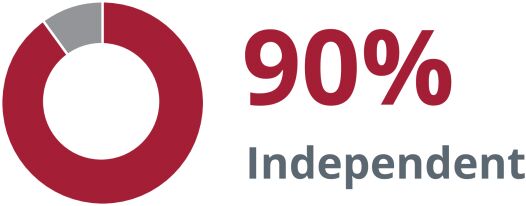
In addition to the ownership threshold, the Proposed Amendments contain procedural and informational requirements that are intended to facilitate the Company and shareholders receiving basic information about the meeting and to ensure, among other things, that the special meeting is not duplicative of matters that were or, in the near term, could be covered at an annual meeting. In particular, the Proposed Amendments provide, among other things, that: (i) no business may be conducted at the special meeting except as set forth in the Company’s notice of meeting; (ii) no shareholder special meeting request may be made during the period commencing 90 calendar days prior to the anniversary date of the prior year’s annual meeting of shareholders and ending on the date of the final adjournment of the next annual meeting of shareholders; (iii) a special meeting request cannot cover business substantially similar to what was covered at any meeting of shareholders held within 90 calendar days prior to receipt by the Secretary of the Company of the special meeting request; (iv) a special meeting will not be held if similar business is to be covered at an annual or special meeting called by the Board to be held within 90 days after the special meeting request is received by the Secretary of the Company; (v) any reduction in shares owned by the requesting holder as of the date of the special meeting request shall be deemed to be a revocation of such special meeting request to the extent such reduction causes the requisite percentage to no longer be reached; and (vi) and the requesting shareholders’ notice must include information (as specified in the Proposed Amendments) as to the business proposed to be conducted and as to each director nominee (if applicable).
This description of the Proposed Amendments is a summary and is qualified by the complete text of Section 1.2 of the Bylaws, as proposed to be amended with deletions indicated by strike-throughs and additions indicated by underlining, which is set forth in Annex B to this Proxy Statement.
Impact of Vote
This advisory vote gives our shareholders the opportunity to consider an alternative proposal from the unanimous requirement in our existing Bylaws and from the lower threshold set forth in the shareholder proposal (Proposal 5). Because the vote on this proposal is advisory in nature, it is not binding on the Company or the Board. However, the Board and the Governance Committee will consider the results of this advisory vote and the advisory vote set forth in Proposal 5 in determining next steps. If this Proposal 4 is approved and Proposal 5 is not approved by shareholders, the Board intends to adopt the Proposed Amendments.
Vote Required
This Proposal 4 will be approved if more votes are cast “for” than are cast “against” the proposal. Abstentions and broker non-votes are not considered votes cast or shares entitled to vote with respect to this proposal and therefore will have no effect on the outcome of Proposal 4.
| 128 |
2026 Proxy Statement |
Board Recommendation
After careful consideration of the Company’s current corporate governance practices, recent trends and best practices in corporate governance both within and outside of our peer group, and the receipt of the shareholder proposal regarding shareholder special meeting rights included in this Proxy Statement (Proposal 5), our Board and our Governance Committee believe that the adoption of the advisory resolution requesting the Board to grant the right to shareholders to request a special meeting at an ownership threshold of at least 25% in this proposal (Proposal 4), instead of the 10% ownership threshold suggested in Proposal 5, establishes the appropriate balance between enhancing shareholder rights and adequately protecting shareholder interests. Our Board has approved the Company Special Meeting Proposal and has directed that it be submitted to shareholders for approval.
| Board Recommendation | ||
|
|
THE BOARD RECOMMENDS A VOTE “FOR” PROPOSAL 4. | |
|
|
129 |
Proposal 5
Shareholder Proposal to Lower Ownership Threshold to Call a Special Meeting of Shareholders to 10%
John Chevedden, whose address is 2215 Nelson Ave., No. 205, Redondo Beach, CA 90278, has requested that the following proposal be included in this Proxy Statement and has indicated that he intends to bring such proposal before the Annual Meeting. Mr. Chevedden has submitted documentation indicating that he is the beneficial owner of at least 50 shares of our common stock and has advised the Company that he intends to continue to hold the requisite amount of shares through the date of the Annual Meeting. Mr. Chevedden’s proposal and his related supporting statement are followed by a recommendation from our Board. Our Board disclaims any responsibility for the content of the proposal and the statement in support of the proposal, which are presented in the form received from the shareholder. Upon receiving an oral or written request, the Company will promptly provide to shareholders more specific information regarding Mr. Chevedden’s share ownership.
The shareholder proposal may contain assertions about the Company or other matters that we believe are incorrect, but we have not attempted to refute all of those assertions.
|
|
THE BOARD RECOMMENDS A VOTE AGAINST SHAREHOLDER PROPOSAL 5 BASED ON THE REASONS SET FORTH IN THE BOARD’S STATEMENT IN OPPOSITION FOLLOWING THE SHAREHOLDER PROPOSAL.
|
Proposal 5 – Give Shareholders a Reasonable Ability to Call for a Special Shareholder Meeting
Shareholders ask our Board of Directors to take the steps necessary to amend the appropriate company governing documents to give the owners of a combined 10% of our outstanding common stock the power to call a special shareholder meeting or the owners of the lowest percentage of shareholders, as governed by state law, the power to call a special shareholder meeting. Such a special shareholder meeting can be an online shareholder meeting.
There shall be no poison pill discriminatory rule to require ownership of shares for a specific period of time in order for shares to participate in calling for a special shareholder meeting. This proposal includes that Cincinnati Financial incorporates this right in its bylaws and that such bylaws be published on the Cincinnati Financial website for easy access.
Shareholders may especially seek a reasonable right to call for a special shareholder meeting after unfavorable news reports.
In January 2025, the Consumer Financial Protection Bureau (CFPB) fined Equifax $15 million for failing to properly investigate consumer disputes over inaccurate credit reports. The CFPB found that Equifax ignored documents from consumers, allowed deleted inaccuracies to reappear, and used confusing language in its follow-up letters.
Also in January 2025, the New York Attorney General’s office announced a $725,000 settlement with Equifax. This was for a 2022 coding error that caused the company to misreport the credit scores of tens of thousands of New Yorkers. The error resulted in higher costs for consumer loans.
| 130 |
2026 Proxy Statement |
In May 2025, the Morgan & Morgan law firm posted about an inaccurate credit reports settlement.
In October 2025, Fair Isaac Corp. (FICO) announced a plan to license its credit scores directly to mortgage resellers, threatening to cut out major credit bureaus like Equifax. The move sent “shockwaves” through the credit reporting industry and caused Equifax’s stock to fall over concerns about future profits.
Following the FICO announcement, Yahoo Finance highlighted the potential negative impact on Equifax’s revenue and stock price, noting the share drop and the market’s reaction to the news. During Equifax’s Q2 2025 earnings call, the company noted negative factors impacting its business, including continued weakness in the mortgage market, higher litigation costs, and economic uncertainty.
There is no concern that allowing 10% of shares to call for a special shareholder meeting, as called for in this proposal, is too easy. It is almost unheard of for any special shareholder meeting, called for by shareholders, to ever occur at any company even though a significant number of companies allow 10% of shareholders to call for a special shareholder meeting.
In the vast majority of cases or in most cases, once a special meeting is called for by shareholders, the issues behind calling for a special shareholder meeting are quickly resolved.
Please vote yes:
Give Shareholders a Reasonable Ability to Call for a Special Shareholder Meeting - Proposal 5
Statement of the Board in Opposition to Proposal 5
Our Board has carefully considered this shareholder proposal and believes that it is not in the best interests of the Company or its shareholders for the reasons outlined below. Accordingly, our Board unanimously recommends that shareholders vote AGAINST this Proposal 5 and instead approve the alternate proposal (Proposal 4) to provide shareholders owning at least 25% of our outstanding common stock who have held such shares continuously for at least one year to call a special meeting.
In response to ongoing shareholder engagement and in recognition of evolving governance standards, our Board is proactively proposing a significant enhancement to shareholder rights as outlined in Proposal 4. As further described in Proposal 4, the Board believes a 25% threshold represents a meaningful expansion of shareholder rights, providing shareholders with a clear and practical mechanism to raise urgent matters between annual meetings, while also ensuring that special meetings are reserved for issues with broad-based support. Although the Company Special Meeting Proposal relates to the same subject matter as this Proposal 5, the terms and effects of the proposals differ and shareholders should carefully read the description of each proposal to understand these differences.

Our Board believes that the Company Special Meeting Proposal is a balanced and responsible approach that aligns with prevailing practices among large public companies and addresses the interests of the Company’s diverse shareholder base. Our Board recommends that shareholders vote AGAINST Proposal 5 and instead support the Company Special Meeting Proposal as a prudent and substantial improvement to the Company’s corporate governance.
The Company’s commitment to corporate governance and shareholder engagement prioritizes long-term shareholder value.
The Company is committed to maintaining strong corporate governance practices that reflect the evolving expectations of its shareholders and the broader market. Our Board and management team place a high value on constructive feedback received through proactive and regular engagement with investors. The decision to propose the Company Special Meeting Proposal is a direct result of this engagement process. Shareholders have expressed a desire for a meaningful, yet balanced, mechanism to raise urgent matters between annual meetings—one that empowers shareholders while safeguarding the Company from the risks associated with a lower threshold.
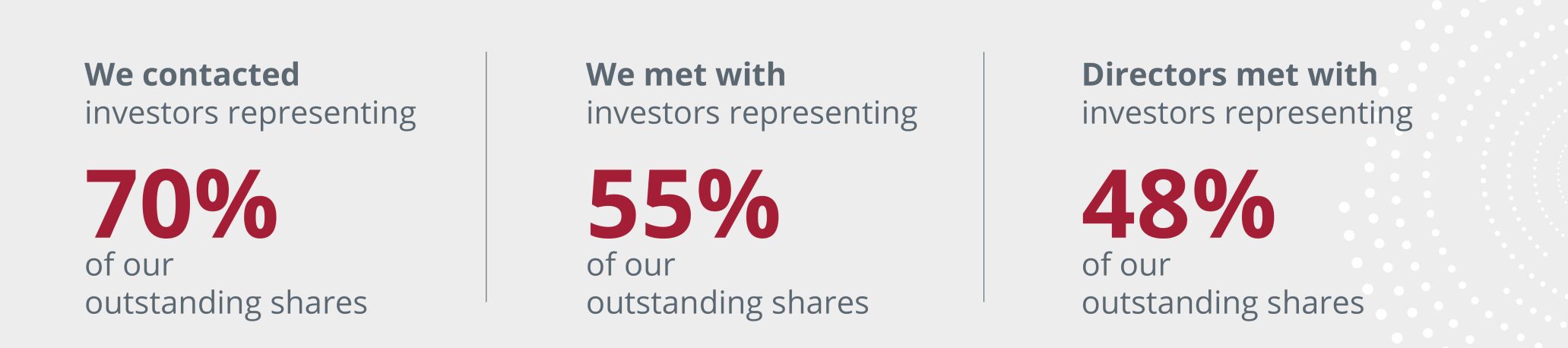

Our existing corporate governance policies and practices provide shareholders with numerous avenues to address and discuss our business and governance policies and help ensure that our Board acts independently and maintains accountability to our shareholders without the additional expense and risk associated with a special meeting
|
|
131 |
threshold that would allow a small number of shareholders to call a special meeting. Some of the Company’s governance practices include the following:
| • | 9 of our 10 director nominees are independent; |
| • | Separate CEO and Chairman roles; |
| • | Fully independent Board committees; |
| • | All directors stand for election annually; |
| • | Majority of votes cast standard in uncontested director elections; |
| • | Robust annual Board and committees self-evaluation process; |
| • | Shareholders have proxy access to include director nominees in the Company’s proxy statement; |
| • | Regular engagement with major shareholders to seek their input on important issues and to address their questions and concerns and incorporate these views in our consideration of these issues; |
| • | Our shareholders vote annually on our compensation practices; and |
| • | No supermajority voting requirements on actions requiring a shareholder vote. |
The Company Special Meeting Proposal More Appropriately Balances Shareholder Rights with the Protection of the Long-Term Interests of the Company and its Shareholders
The Company Special Meeting Proposal is firmly in line with the prevailing practices among S&P 500 companies. According to data from FactSet, a majority of S&P 500 companies that permit shareholders to call special meetings have set the threshold at 25% or higher. This is also the most common standard among large-cap U.S. public companies that permit shareholders the right to call a special meeting. This approach is designed to ensure that the right to call a special meeting is accessible while protecting against the risk of disruption from a small group of investors.
Our Board believes the 10% threshold in this Proposal 5 increases the risk that a small minority of shareholders (as few as one or two institutional investors or activist groups) could call a special meeting, regardless of whether their interests align with those of the broader shareholder base. This dynamic increases the risk that special meetings could be used to advance narrow, short-term, or disruptive agendas, rather than issues of genuine importance to the majority of shareholders.
Special meetings are extraordinary events that require substantial time, resources, and attention from both management and our Board. Convening a special meeting involves preparing and distributing proxy materials, engaging with shareholders, and dedicating significant management and Board time to address the matters raised. These efforts divert focus from the Company’s core operations and long-term strategic initiatives, potentially impacting value creation for all shareholders. The risk of disruption is heightened if special meetings are called for reasons that do not have broad shareholder support or are intended to further the interests of a small minority.
Impact of Vote
Because the vote on this proposal is advisory in nature, it is not binding on the Company or the Board. However, the Board and the Governance Committee will consider the results of this advisory vote and Proposal 4 in determining next steps. If both the Company Special Meeting Proposal (Proposal 4) and this proposal (Proposal 5) regarding special meeting rights are approved, the Board will consider the voting results of both proposals, the difference in support for each proposal and the feedback from our shareholders received through engagement efforts. Based on the totality of such information, the Board will take such actions as it deems to be in the best interest of all shareholders.
| 132 |
2026 Proxy Statement |
Vote Required
This Proposal 5 will be approved if more votes are cast “for” than are cast “against” the proposal. Abstentions and broker non-votes are not considered votes cast or shares entitled to vote with respect to this proposal and therefore will have no effect on the outcome of Proposal 5.
Board Recommendation
After careful consideration of this Proposal 5, our Board believes that, in light of our existing governance policies and practices and the Company Special Meeting Proposal outlined in Proposal 4, the approval of this Proposal 5 is not consistent with market practice, does not impact our shareholders’ ability to engage with our Board, will risk giving one or a small number of shareholders a disproportionate amount of influence over our business to advance special interests at substantial cost and distraction to our Board and management, and accordingly is not in the best interests of the Company or its shareholders. Therefore, the Board of Directors unanimously recommends a vote AGAINST this Proposal 5.
| Board Recommendation | ||
|
|
THE BOARD RECOMMENDS A VOTE “AGAINST” PROPOSAL 5 AND “FOR” PROPOSAL 4. | |
|
|
133 |
Questions and Answers About the Annual Meeting
How do I attend the 2026 Annual Meeting?
Only Equifax shareholders as of the March 9, 2026 record date are entitled to attend the 2026 Annual Meeting in person. Our 2026 Annual Meeting will be held using a “hybrid” in-person and virtual format. Shareholders of record can attend the meeting in person or virtually using the meeting webcast, as described below:
How do I ask questions at the 2026 Annual Meeting?
Shareholders as of the March 9, 2026 record date will be able to submit questions during the meeting by (i) attending in person or (ii) by accessing the meeting at www.virtualshareholdermeeting.com/EFX2026 using their 16-digit control number, typing the question into the “Ask a Question” field, and clicking submit.
Only questions pertinent to meeting matters will be answered during the meeting, subject to time constraints. Questions regarding personal matters, including those related to employment, products and services or individual disputes, are not pertinent to meeting matters and therefore will not be answered.
Who may vote at the 2026 Annual Meeting?
Shareholders as of the close of business on March 9, 2026 may vote at the 2026 Annual Meeting. As of such date, there were 120,634,597 shares of Company common stock outstanding, each entitled to one vote.
| 134 |
2026 Proxy Statement |
How do I vote shares at the 2026 Annual Meeting?
Shareholders who have not voted their shares prior to the meeting or who wish to change their vote will be able to vote their shares at the 2026 Annual Meeting by: (i) attending in person; or (ii) by accessing the meeting at www.virtualshareholdermeeting.com/EFX2026, entering their 16-digit control number and clicking “Vote Here” on the meeting website.
Whether or not shareholders plan to attend the meeting, they are encouraged to vote their shares prior to the meeting by one of the methods described in the proxy materials. Shareholders may continue to use the proxy materials to vote their shares in connection with the meeting.
Shareholders who have already voted do not need to vote again unless they wish to change their prior vote.
How can I review the list of shareholders entitled to vote?
For those attending in person, a printed copy of the shareholders of record will be available for examination by shareholders at the physical meeting location in St. Louis, Missouri. For those attending virtually, an electronic list of the shareholders of record as of the record date will be available for examination by shareholders at www.virtualshareholdermeeting.com/EFX2026 during the meeting. Shareholders attending virtually will need to enter their 16-digit control number to access the shareholder list.
Can I attend the meeting if I am not a shareholder?
Only Equifax shareholders as of the record date are entitled to attend the 2026 Annual Meeting. Non-shareholders may access the live meeting webcast, but will not be eligible to vote or submit questions. If you do not have a 16-digit control number, you may still attend the meeting as a guest in listen-only mode. To attend as a guest, please access www.virtualshareholdermeeting.com/EFX2026 and enter the information requested on the screen to register as a guest. Please note that you will not have the ability to ask questions, vote or examine the list of shareholders during the meeting if you participate as a guest.
A replay of the virtual annual meeting webcast will be available on our investor relations website through June 30, 2026.
What if during the meeting I have technical difficulties or trouble accessing the virtual meeting website?
On the morning of the Annual Meeting, we will have technicians ready to assist you with any technical difficulties you may have accessing the virtual meeting. If you encounter any difficulties accessing the virtual meeting please call the toll-free number that will be available on the morning of the meeting.
What is the difference between holding shares as a registered shareholder and as a beneficial owner?
If your shares are registered directly in your name with our transfer agent, Equiniti Trust Company, LLC, you are considered the “registered stockholder” of those shares. We mail the proxy materials and our Annual Report to you directly.
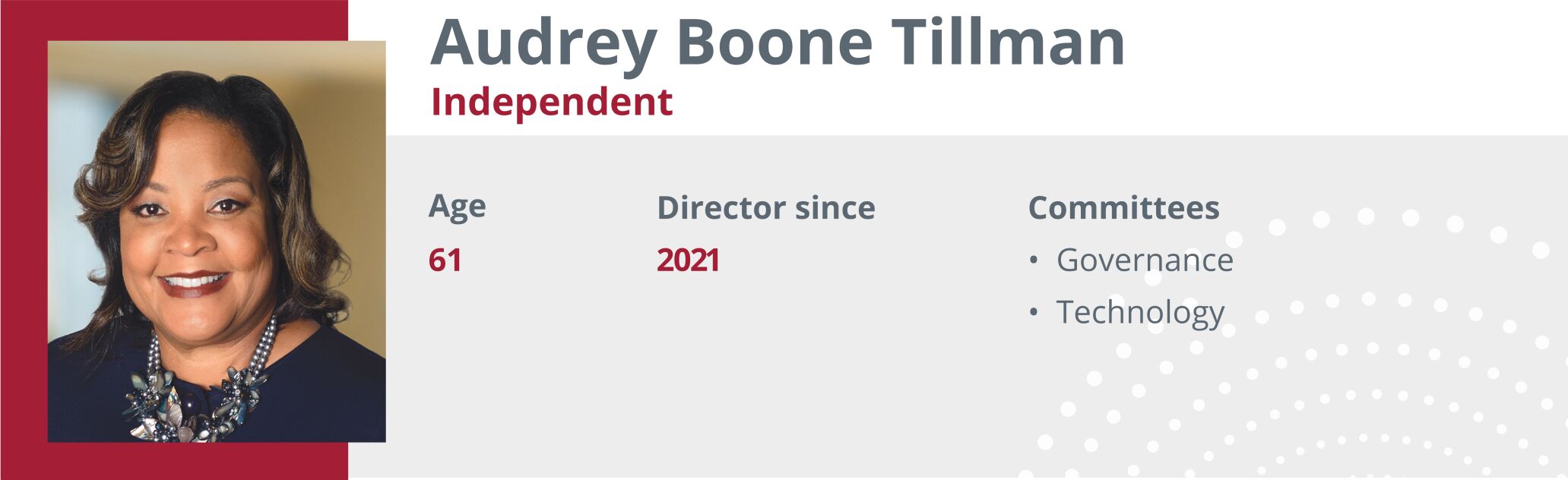
If your shares are held in street name with a stock brokerage account or by a bank or other nominee, you are considered the “beneficial owner” of the shares that are registered in street name. In this case, the proxy materials and our Annual Report will be forwarded to you by your broker, bank, or other nominee. As the beneficial owner, you have the right to direct your broker, bank or other nominee on how to vote your shares by following the voting instructions included in the materials.
Employees with shares allocated in an employee benefit plan account will vote shares allocated to their benefit plan account electronically and will not receive a paper mailing for those shares. Such employees should review the information on procedures for voting by employees on page 137.

|
|
135 |
What am I voting on and what are the Board’s voting recommendations?
| Agenda Item |
Board Voting Recommendation |
Page Reference (for more detail) | ||||||||||
| Proposal 1 |
Election of Ten Director Nominees | |
FOR EACH NOMINEE |
|
11 | |||||||
| Proposal 2 |
Non-binding, Advisory Vote to Approve Named Executive Officer Compensation | FOR | 40 | |||||||||
| Proposal 3 |
Ratification of Appointment of Ernst & Young LLP as Independent Registered Public Accounting Firm for 2026 | FOR | 108 | |||||||||
| Proposal 4 |
Non-binding, Advisory Vote to Lower Ownership Threshold to Call a Special Meeting of Shareholders to 25% | FOR | 110 | |||||||||
| Proposal 5 |
Shareholder Proposal to Lower Ownership Threshold to Call a Special Meeting of Shareholders to 10% | AGAINST | 113 | |||||||||
What if our shareholders approve both Proposal 4 and Proposal 5, or approve only one of them?
Our Board recommends a vote “FOR” Proposal 4 and “AGAINST” Proposal 5, however, our shareholders may choose to vote in favor of both Proposal 4 and Proposal 5.
If Proposal 4 is approved and Proposal 5 is not approved by our shareholders, the Board intends to adopt an amendment to the Bylaws that would lower the required ownership threshold for shareholders to call a special meeting to 25%.
If both Proposal 4 and Proposal 5 are approved by our shareholders, or if Proposal 5 is approved but Proposal 4 is not approved by our shareholders, the Board will consider the voting results of both proposals, the difference in support for each proposal and the feedback from its shareholders received through engagement efforts. Based on the totality of such information, the Board will take such actions as it deems to be in the best interest of all shareholders.
Can other matters be decided at the 2026 Annual Meeting?
The Company is not aware, as of the date of this Proxy Statement, of any other matters to be voted on at the 2026 Annual Meeting. If any other matters are properly brought before the meeting for a vote, the persons named as proxies on the proxy card will vote all shares represented at the meeting (other than shares that are voted by the holder during the meeting) on such matters in accordance with the Board’s recommendation.
What is the procedure for voting?
Shareholders of record
Shareholders of record may attend and cast their votes by attending the 2026 Annual Meeting in person or virtually, as described on page 134.
In addition, shareholders of record may cast their vote by proxy and participants in the Company’s benefit plans may submit their voting instructions by:
| • | Using the internet at the web address noted in the proxy materials email or proxy card you received (if you have access to the internet, we encourage you to vote in this manner); |
| • | Using the toll-free telephone number listed on the proxy card (if you received one); or |
| • | Signing, completing and returning a proxy card (if you received one) in the provided postage-paid envelope. |
| 136 |
2026 Proxy Statement |
Votes cast through internet and telephone voting procedures are authenticated by use of a personal identification number. This procedure allows shareholders to appoint a proxy (or Company benefit plan participants to provide voting instructions) and to confirm that their actions have been properly recorded. Specific instructions to be followed are set forth on the proxy materials email or proxy card (if you received one).
Beneficial owners
If you are the beneficial owner of shares held in “street name,” you have the right to direct your bank, broker or other nominee on how to vote your shares by using the voting instruction form provided to you by them, or by following their instructions for voting through the Internet or by telephone. In the alternative, you may attend and cast your vote during the meeting as described on page 134. If you are a beneficial owner but do not have a control number, you may gain access to the meeting by contacting your broker or by following the instructions included with your proxy materials. In order for your shares to be voted on all matters presented at the meeting, we urge all shareholders whose shares are held in street name by a bank, brokerage firm or other nominee to provide voting instructions to your bank, brokerage firm or other nominee.
Can I change my proxy vote?
Yes. If you are a registered shareholder, you can change your proxy vote or revoke your proxy at any time before the 2026 Annual Meeting by:
| • | Authorizing a new vote electronically through the Internet or by telephone up until 11:59 p.m., Eastern Time, on May 6, 2026; |
| • | Delivering a written revocation of your proxy to Equifax Inc., Attn: Office of Corporate Secretary, P.O. Box 4081, Atlanta, Georgia 30302, before your original proxy is voted at the Annual Meeting; |
| • | Returning a signed proxy card with a later date; or |
| • | Voting during the Annual Meeting. |
If you are a beneficial owner of shares, you can submit new voting instructions by contacting your broker, bank or other nominee. You can also vote during the 2026 Annual Meeting as described above.
Your attendance at the 2026 Annual Meeting does not revoke your proxy. Unless you vote during the meeting, your last valid proxy prior to or at the 2026 Annual Meeting will be used to cast your vote.
What if I return my proxy card but do not provide voting instructions?
Proxies that are signed and returned but do not contain voting instructions will be voted:
| • | FOR the election of the ten director nominees listed in Proposal 1. |
| • | FOR the advisory vote to approve the compensation of our NEOs (Proposal 2). |
| • | FOR the ratification of the appointment of Ernst & Young LLP as our independent registered public accounting firm for the 2026 fiscal year (Proposal 3). |
| • | FOR the advisory vote to lower the ownership threshold to call a special meeting of shareholders to 25% (Proposal 4). |
| • | AGAINST the shareholder proposal to lower the ownership threshold to call a special meeting of shareholders to 10% (Proposal 5). |
In accordance with the Board’s recommendation by the individuals named as proxy holders in the proxy card, if any other matters are properly brought before the 2026 Annual Meeting.
How do I vote if I participate in one of the Company’s 401(k) or defined contribution plans?
Participants in the Equifax Inc. 401(k) Plan and the Equifax Canada Retirement Savings Program for Salaried Employees (collectively, the “Company Plans”) may instruct the applicable plan trustee how to vote all shares of
|
|
137 |
Company common stock allocated to their accounts. To allow sufficient time for the plan trustees to vote, the trustees must receive your voting instructions no later than 11:59 p.m., Eastern Time, on May 5, 2026. The 401(k) Plan trustee will vote shares for which it has not received instructions in the same proportion as the shares for which it has received instructions. The Canada Retirement Savings Program trustee will only vote those plan shares for which voting instructions are received prior to this deadline. Participants in the Company Plans may not vote the shares owned through such plans after this deadline, including at the Annual Meeting.
How many shares must be present to hold the 2026 Annual Meeting?
In order for us to lawfully conduct business at our 2026 Annual Meeting, a majority of the shares outstanding and entitled to vote as of March 9, 2026 must be present or represented by proxy. This is referred to as a quorum. Your shares are counted as present at the meeting if you attend the 2026 Annual Meeting and vote during the meeting or if you properly return a proxy by Internet, by telephone, or by mail in advance of the meeting and do not revoke the proxy. If a quorum is not present, the meeting may be adjourned from time to time until a quorum is present.
Will my shares be voted if I do not provide my proxy or instruction card?
Registered Shareholders
If your shares are registered in your name, your shares will not be voted unless you provide a proxy by internet, telephone or mail, or vote during the 2026 Annual Meeting.
Plan Participants
If you are a participant in one of our employee 401(k) or defined contribution plans and you do not provide timely instructions to the plan trustee, shares allocated to your account(s) will be voted by the plan trustee depending on the terms of your plan and other legal requirements.
Beneficial Owners
If you hold shares through an account with a broker and you do not provide voting instructions, under NYSE rules, your broker may vote your shares on routine matters only. The ratification of the appointment of Ernst & Young LLP (Proposal 3) is considered a routine matter, and your nominee can therefore vote your shares on that proposal even if you do not provide voting instructions. Proposals 1, 2, 4 and 5 are not considered routine matters, and your nominee cannot vote your shares on these proposals unless you provide voting instructions. Votes withheld by brokers in the absence of voting instructions from a beneficial owner are referred to as “broker non-votes.”
Multiple Forms of Ownership
The Company cannot provide a single proxy or instruction card for shareholders who own shares in different forms of accounts (employee benefit plan shares, registered shares, and beneficially-owned shares). As a result, if your shares are held in multiple types of accounts, you must submit your votes for each type of account in accordance with the instructions you receive for that account.
What is the vote required for each proposal?
For Proposal 1, Election of Director Nominees, each director nominee for whom more shares are voted “for” than “against” his or her election will be elected as a director at the meeting. Under our Bylaws, if more votes are cast “against” than are cast “for” a nominee, the nominee shall offer his or her resignation. The independent members of the Board will determine and promptly publicly announce the action to be taken with respect to acceptance or rejection of the resignation offer.
For each of Proposal 2, Advisory Vote to Approve Named Executive Officer Compensation, Proposal 3, Ratification of Appointment of Ernst & Young LLP as Independent Registered Public Accounting Firm for 2026, Proposal 4, Advisory Vote to
| 138 |
2026 Proxy Statement |
to Lower Ownership Threshold to Call a Special Meeting of Shareholders to 25%, and Proposal 5, Shareholder Proposal to Lower Ownership Threshold to Call a Special Meeting of Shareholders to 10%, the proposal will be approved if more votes are cast “for” than are cast “against” the proposal. Proposals 2, 3, 4 and 5 are advisory and nonbinding. The Board will review the voting results on these proposals and take the results into account when making future decisions regarding these matters. “Votes cast” exclude abstentions and broker non-votes.
What is the effect of an abstention?
A shareholder who abstains on some or all matters is considered present for purposes of determining if a quorum is present at the 2026 Annual Meeting, but an abstention is not counted as a vote cast. An abstention has no effect for the vote on any proposal.
What is the effect of a broker non-vote?
Broker non-votes will be counted for purposes of calculating whether a quorum is present at the 2026 Annual Meeting, but will not be counted as votes cast for or against any particular proposal. Thus, a broker non-vote will not impact our ability to obtain a quorum, will not affect the outcome with respect to the election of directors, and will not otherwise affect the outcome of the vote on a proposal that requires the affirmative vote of a majority of the votes cast on the proposal.
Who will count the votes?
A representative of Broadridge Financial Services will tabulate the votes and act as independent inspector of election for the 2026 Annual Meeting.
Where can I find the voting results of the 2026 Annual Meeting?
The preliminary voting results will be announced at the Annual Meeting. The final voting results will be tallied by the inspector of election and disclosed by the Company in a Current Report on Form 8-K filed with the SEC within four business days following the 2026 Annual Meeting.
What is “householding” and how does it affect me?
We have adopted a procedure approved by the SEC called “householding.” Under this procedure, we send only one Annual Report and Proxy Statement to eligible shareholders who share a single address, unless we have received instructions to the contrary from any shareholder at that address. The practice is designed to reduce our printing and postage costs. Shareholders who participate in householding will continue to be able to separately vote their proxies. We do not use householding for any other shareholder mailings, such as dividend checks, Form 1099s or account information statements.
If you are eligible for householding, but received multiple copies of our Annual Report and Proxy Statement and prefer to receive only a single copy for your household, please contact Equifax Inc., Attn: Office of Corporate Secretary, P.O. Box 4081, Atlanta, Georgia 30302, telephone (404) 885-8000. If you are a registered shareholder residing at an address with other registered shareholders and wish to receive a separate Annual Report or Proxy Statement at this time or in the future, we will provide you with a separate copy. To obtain this copy, please contact the Office of Corporate Secretary. If you own shares through a broker, bank or other nominee, you should contact the nominee concerning householding procedures.

The Company cannot provide a single proxy or voting instruction card for shareholders who own shares in different forms of accounts (employee benefit plan shares, registered shares, and beneficially-owned shares). Accordingly, you will receive a separate solicitation and proxy for each type of account in which shares are held and you must submit your votes for each type of account in accordance with the instructions received for that account.
|
|
139 |
Can I receive a copy of the Annual Report?
Yes. We will provide a copy of our Annual Report without charge, upon written request, to any registered or beneficial owner of common stock entitled to vote at the 2026 Annual Meeting. Requests should be made in writing addressed to the Equifax Inc., Attn: Office of Corporate Secretary, P.O. Box 4081, Atlanta, Georgia 30302, or by calling (404) 885-8000.

Can I view the Proxy Statement and Annual Report on the Internet?
Yes. The Proxy Statement and Annual Report are available on the internet at https://investor.equifax.com/financial-information/annual-reports-and-proxy-statements. Most shareholders will receive their annual meeting materials via electronic delivery. The SEC also maintains a website at https://www.sec.gov that contains reports, proxy statements and other information regarding Equifax.


Can I choose to receive the Proxy Statement and Annual Report on the internet instead of receiving them by mail?
Yes. If you are a registered shareholder or beneficial owner, you can elect to receive future annual reports and proxy statements on the internet only and not receive copies in the mail by following the instructions on your proxy card or voting instruction form. Your request for electronic transmission will remain in effect for all future annual reports and proxy statements, unless withdrawn. Most active employees who participate in the Company’s savings plans will receive an online notification announcing Internet availability of the annual report and proxy statement; a paper copy will not be provided unless requested by following the instructions in the email notification.
Who pays the cost of this proxy solicitation?
The Company has retained Innisfree M&A Incorporated to assist in soliciting proxies for an annual fee of $25,000 plus expenses, and will bear the cost of soliciting proxies. Directors, officers and other Company associates also may solicit proxies by telephone or otherwise. Brokers and other nominees will be requested to solicit proxies or authorizations from beneficial owners and will be reimbursed for their reasonable expenses.
How do I recommend a director nominee or submit a proposal or director nominee for the 2027 Annual Meeting of Shareholders?
The Governance Committee will consider for possible nomination qualified Board candidates that are submitted by our shareholders using the same process that applies to candidates identified by other sources. Shareholders wishing to make such a submission may do so by sending the following information to the Governance Committee no later than [ ], 2026 and no earlier than [ ], 2026, c/o Equifax Inc., Attn: Office of Corporate Secretary, P.O. Box 4081, Atlanta, Georgia 30302: (1) a nomination notice in accordance with the procedures set forth in Section 1.12 of our Bylaws; (2) a request that the Governance Committee consider the shareholder’s candidate for inclusion in the Board’s slate of nominees for the applicable meeting; and (3) along with the shareholder’s candidate, an undertaking to provide all other information the Committee or the Board may request in connection with their evaluation of the candidate. A copy of our Bylaws is available on our website at www.equifax.com/about-equifax/corporate-governance or by writing to the Corporate Secretary.
Any shareholder’s nominee must satisfy the minimum qualifications for any director described above in the judgment of the Governance Committee and the Board. In evaluating shareholder nominees, the Governance Committee and the Board may consider all relevant information, including the factors described above, and additionally may consider the size and duration of the nominating shareholder’s holdings in the Company; whether the nominee is independent of the nominating shareholder and able to represent the interests of the Company and its shareholders as a whole; and the interests and/or intentions of the nominating shareholder.
Shareholders may also submit proposals and director nominations through our proxy access procedures for consideration at the 2027 Annual Meeting, including proposals submitted for inclusion in the Company’s proxy
| 140 |
2026 Proxy Statement |
materials for the 2027 Annual Meeting. Notice of such proposals or director nominations must be delivered to us no later than [ ], 2026 (and, in the case of a director nomination pursuant to proxy access, no earlier than [ ], 2026). The proposal or director nomination must satisfy the information and other requirements specified in our Bylaws and, if to be included in our proxy materials for the 2027 Annual Meeting, must comply with SEC Rule 14a-8 and other applicable rules and interpretations of the SEC.
Any shareholder proposal or director nomination submitted to the Company in connection with the 2027 Annual Meeting should be addressed to the Corporate Secretary at the address above. In addition, the shareholder proponent or a duly authorized representative must appear in person at the 2027 Annual Meeting to present the proposal.
In addition to satisfying the foregoing advance notice requirements under our Bylaws, to comply with the universal proxy rules under the Securities Exchange Act of 1934, shareholders who intend to solicit proxies in support of director nominees other than the Company’s nominees must provide notice that sets forth the information required by Rule 14a-19 under the Securities Exchange Act of 1934.
How can I contact the Company’s directors?
Shareholders and other interested parties who wish to communicate with our directors, a committee of the Board of Directors, the Independent Chairman, the non-management directors as a group, or the Board generally should address their correspondence accordingly and send by mail to Equifax Inc., c/o Corporate Secretary, P.O. Box 4081, Atlanta, Georgia 30302. Correspondence will be forwarded as directed by the shareholder. The Company may first review such communications and screen out solicitations for goods and services and similar inappropriate communications unrelated to the Company or its business. All concerns related to audit or accounting matters will be referred to the Audit Committee.
Can I find additional information on the Company’s website?
Yes. Although information contained on our website is not part of this Proxy Statement, you will find information about the Company and our corporate governance practices at www.equifax.com/about-equifax/corporate-governance. Our website contains information about our Board, Board committees, Articles of Incorporation and Bylaws, Code of Ethics and Business Conduct, Governance Guidelines, and information about insider transactions. Shareholders may obtain, without charge, hard copies of the above documents by writing to Equifax Inc., Attn: Office of Corporate Secretary, P.O. Box 4081, Atlanta, Georgia 30302, telephone (404) 885-8000.
|
|
141 |
ANNEX A:
Reconciliation of Non-GAAP Financial Measures
We refer in this Proxy Statement to Adjusted EPS and Adjusted EBITDA, which are non-GAAP financial measures.
Adjusted EPS attributable to Equifax is diluted EPS attributable to Equifax, defined as net income adjusted for acquisition-related amortization expense of certain acquired intangibles, accrual for legal and regulatory matters related to the 2017 cybersecurity incident, gain on sale of equity investment, pension mark-to-market fair value adjustment, foreign currency impact of certain intercompany loans, acquisition-related costs other than acquisition amortization, realignment of resources and other costs, income tax effect of stock awards recognized upon vesting or settlement, Argentina highly inflationary foreign currency adjustment, reversal of a valuation allowance for certain deferred tax assets, legal settlement, antitrust litigation costs and aggregated tax impact of these adjustments.
Adjusted EBITDA is defined as net income excluding income taxes, interest expense, net, depreciation and amortization expense, accrual for legal and regulatory matters related to the 2017 cybersecurity incident, gain on sale of equity investment, pension mark-to-market fair value adjustment, foreign currency impact of certain intercompany loans, acquisition-related costs other than acquisition amortization, realignment of resources and other costs, Argentina highly inflationary foreign currency adjustment, legal settlement and antitrust litigation costs.
Adjusted EPS and Adjusted EBITDA are provided to show the performance of our core operations without the effect of the excluded items, consistent with how our management reviews and assesses our historical performance when measuring operating profitability, evaluating performance trends and setting performance objectives. This non-GAAP measure is not a measurement of financial performance under GAAP and should not be considered as an alternative to EPS, and may not be comparable to non-GAAP financial measures used by other companies.
The following table reconciles Adjusted EPS to net income attributable to Equifax, the most directly comparable financial measure calculated in accordance with GAAP:
| Twelve Months Ended December 31, |
||||||||||||||||
| (In millions, except per share amounts) |
2025 | 2024 | $ Change | % Change | ||||||||||||
| Net income attributable to Equifax |
$ | 660.3 | $ | 604.1 | $ | 56.2 | 9 | % | ||||||||
| Acquisition-related amortization expense of certain acquired intangibles (1) |
250.2 | 261.1 | (10.9 | ) | (4 | )% | ||||||||||
| Accrual for legal and regulatory matters related to the 2017 cybersecurity incident (2) |
1.0 | 0.3 | 0.7 | nm | ||||||||||||
| Gain on sale of equity investment (3) |
(1.2 | ) | — | (1.2 | ) | nm | ||||||||||
| Pension mark-to-market fair value adjustment (4) |
(0.6 | ) | 11.6 | (12.2 | ) | nm | ||||||||||
| Foreign currency impact of certain intercompany loans (5) |
(0.3 | ) | 0.4 | (0.7 | ) | nm | ||||||||||
| Acquisition-related costs other than acquisition amortization (6) |
35.0 | 68.4 | (33.4 | ) | (49 | )% | ||||||||||
| Realignment of resources and other costs (7) |
49.9 | 48.0 | 1.9 | 4 | % | |||||||||||
| Income tax effects of stock awards that are recognized upon vesting or settlement (8) |
(2.4 | ) | (8.2 | ) | 5.8 | (71 | )% | |||||||||
| Argentina highly inflationary foreign currency adjustment (9) |
3.3 | 1.1 | 2.2 | nm | ||||||||||||
| Reversal of valuation allowance for certain deferred tax assets (10) |
— | (4.6 | ) | 4.6 | nm | |||||||||||
| Legal Settlement (11) |
30.0 | 15.0 | 15.0 | 100 | % | |||||||||||
| Antitrust litigation costs (12) |
5.4 | — | 5.4 | nm | ||||||||||||
| Tax impact of adjustments (13) |
(81.4 | ) | (87.1 | ) | 5.7 | (7 | )% | |||||||||
| Adjusted net income attributable to Equifax |
$ | 949.2 | $ | 910.1 | $ | 39.1 | 4 | % | ||||||||
| Adjusted diluted EPS attributable to Equifax |
$ | 7.65 | $ | 7.29 | $ | 0.36 | 5 | % | ||||||||
| Weighted-average shares used in computing diluted EPS |
124.1 | 124.9 |
|
|
|
|
|
| ||||||||
nm - not meaningful
| 142 |
2026 Proxy Statement |
| (1) | For the year ended December 31, 2025, we recorded acquisition-related amortization expense of certain acquired intangibles of $250.2 million ($200.2 million, net of tax). The $50.0 million of tax is comprised of $66.2 million of tax expense, net of $16.2 million of a cash income tax benefit. For the year ended December 31, 2024, we recorded acquisition-related amortization expense of certain acquired intangibles of $261.1 million ($207.5 million, net of tax). The $53.6 million of tax is comprised of $70.0 million of tax expense, net of $16.4 million of a cash income tax benefit. See the Notes to this reconciliation for additional detail. |
| (2) | During the year ended December 31, 2025, we recorded an accrual for legal and regulatory matters related to the 2017 cybersecurity incident of $1.0 million ($0.9 million, net of tax). During the year ended December 31, 2024, we recorded an accrual for legal and regulatory matters related to the 2017 cybersecurity incident of $0.3 million ($0.2 million, net of tax). See the Notes to this reconciliation for additional detail. |
| (3) | During the year ended December 2025, we recorded a gain on sale of equity investments of $1.2 million ($0.7 million, net of tax). The impact was recorded to the Other Income (Expense), net line item within the Consolidated Statements of Income. See the Notes to this reconciliation for additional detail. |
| (4) | During the year ended December 31, 2025, we recorded a gain of $0.6 million ($0.6 million, net of tax) related to the mark-to-market fair value adjustment of our pension and postretirement benefit plans. During the year ended December 31, 2024, we recorded a loss of $11.6 million ($8.7 million, net of tax) related to the mark-to-market fair value adjustment of our pension and postretirement benefit plans. See the Notes to this reconciliation for additional detail. |
| (5) | During the year ended December 31, 2025, we recorded a foreign currency gain of $0.3 million on certain intercompany loans. During the year ended December 31, 2024, we recorded a foreign currency loss of $0.4 million related to certain intercompany loans. The impact was recorded to the Other Income (Expense), net line item within the Consolidated Statements of Income. See the Notes to this reconciliation for additional detail. |
| (6) | During the year ended December 31, 2025, we recorded $35.0 million ($24.4 million, net of tax) for acquisition-related costs other than acquisition amortization. During the year ended December 31, 2024, we recorded $68.4 million ($51.8 million, net of tax) for acquisition-related costs other than acquisition amortization. These costs primarily related to integration costs resulting from recent acquisition activity and were recorded in operating income. See the Notes to this reconciliation for additional detail. |
| (7) | During the year ended December 31, 2025, we recorded $49.9 million ($37.4 million, net of tax) of restructuring charges for the realignment of resources and other costs, which predominantly relate to the reduction of headcount to support the Company’s global strategic objectives. During the year ended December 31, 2024, we recorded $48.0 million ($34.1 million, net of tax) of restructuring charges related to the realignment of resources and other costs. These restructuring charges predominantly related to our ongoing efforts toward completion of our technology transformation in order to support the Company’s strategic objectives. See the Notes to this reconciliation for additional detail. |
| (8) | During the year ended December 31, 2025, we recorded a tax benefit of $2.4 million related to the tax effects of deductions for stock compensation in excess of amounts recorded for compensation costs. During the year ended December 31, 2024, we recorded a tax benefit of $8.2 million related to the tax effects of deductions for stock compensation in excess of amounts recorded for compensation costs. See the Notes to this reconciliation for additional detail. |
| (9) | Argentina experienced multiple periods of increasing inflation rates, devaluation of the peso, and increasing borrowing rates. As such, Argentina was deemed a highly inflationary economy by accounting policymakers. During the year ended December 31, 2025, we recorded a foreign currency loss of $3.3 million related to the impact of remeasuring the peso denominated monetary assets and liabilities as a result of Argentina being a highly inflationary economy. During the year ended December 31, 2024, we recorded a foreign currency loss of $1.1 million related to the impact of remeasuring the peso denominated monetary assets and liabilities as a result of Argentina being a highly inflationary economy. See the Notes to this reconciliation for additional detail. |
| (10) | During the year ended December 31, 2024, we recorded a full reversal of a valuation allowance for certain deferred tax assets of $4.6 million that was initially recorded in 2020. See the Notes to this reconciliation for additional detail. |
| (11) | During the year ended December 31, 2025, we recorded a $30.0 million ($22.6 million, net of tax) charge for a settlement associated with the resolution of inquiry disputes related claims. During the year ended December 31, 2024, we recorded a $15.0 million charge for a settlement associated with the resolution of a matter with the Consumer Financial Protection Bureau (“CFPB”). See the Notes to this reconciliation for additional detail. |
| (12) | During the year ended December 31, 2025, we recorded costs related to antitrust litigation pertaining to our Workforce Solutions business unit in the amount of $5.4 million ($4.1 million, net of tax). See the Notes to this reconciliation for additional detail. |
| (13) | For the year ended December 31, 2025, we recorded the tax impact of adjustments of $81.4 million comprised of (i) acquisition-related amortization expense of certain acquired intangibles of $50.0 million ($66.2 million of tax expense, net of $16.2 million of a cash income tax benefit), (ii) a tax adjustment of $0.1 million related to an accrual for legal and regulatory matters related to the 2017 cybersecurity incident, (iii) a tax adjustment of $0.5 million related to the gain on sale of equity investments, (iv) a tax adjustment of $10.6 million related to acquisition-related costs other than acquisition amortization, (v) a tax adjustment of $12.5 million related to the realignment of resources and other costs, (vi) a tax adjustment of $7.4 million related to an accrual for a settlement associated with the resolution of inquiry disputes related claims and (vii) a tax adjustment of $1.3 million related to antitrust litigation costs. |
| For the year ended December 31, 2024, we recorded the tax impact of adjustments of $87.1 million comprised of (i) acquisition-related amortization expense of certain acquired intangibles of $53.6 million ($70.0 million of tax expense, net of $16.4 million of a cash income tax benefit), (ii) a tax adjustment of $0.1 million related to an accrual for legal and regulatory matters related to the 2017 cybersecurity incident, (iii) a tax adjustment of $2.9 million related to the fourth quarter mark-to-market fair value adjustment of our pension and postretirement benefit plans, (iv) a tax adjustment of $16.6 million related to acquisition-related costs other than acquisition amortization, and (v) a tax adjustment of $13.9 million related to the realignment of resources and other costs. |
|
|
143 |
The following table reconciles Adjusted EBITDA to net income attributable Equifax, the most directly comparable financial measure calculated in accordance with GAAP:
| Twelve Months Ended December 31, |
||||||||||||||||
| (In millions) |
2025 | 2024 | $ Change | % Change | ||||||||||||
| Revenue |
$ | 6,074.5 | $ | 5,681.1 | $ | 393.4 | 7 | % | ||||||||
| Net income attributable to Equifax |
$ | 660.3 | $ | 604.1 | $ | 56.2 | 9 | % | ||||||||
| Income taxes |
230.6 | 203.2 | 27.4 | 13 | % | |||||||||||
| Interest expense, net* |
202.4 | 214.2 | (11.8 | ) | (6 | )% | ||||||||||
| Depreciation and amortization |
719.5 | 669.8 | 49.7 | 7 | % | |||||||||||
| Accrual for legal and regulatory matters related to 2017 cybersecurity incident (1) |
1.0 | 0.3 | 0.7 | nm | ||||||||||||
| Gain on sale of equity investment (2) |
(1.2 | ) | — | (1.2 | ) | nm | ||||||||||
| Pension mark-to-market fair value adjustment (3) |
(0.6 | ) | 11.6 | (12.2 | ) | nm | ||||||||||
| Foreign currency impact of certain intercompany loans (4) |
(0.3 | ) | 0.4 | (0.7 | ) | nm | ||||||||||
| Acquisition-related costs other than acquisition amortization (5) |
35.0 | 68.4 | (33.4 | ) | (49 | )% | ||||||||||
| Realignment of resources and other costs (6) |
49.9 | 48.0 | 1.9 | 4 | % | |||||||||||
| Argentina highly inflationary foreign currency adjustment (7) |
3.3 | 1.1 | 2.2 | nm | ||||||||||||
| Legal Settlement (8) |
30.0 | 15.0 | 15.0 | 100 | % | |||||||||||
| Antitrust litigation costs (9) |
5.4 | — | 5.4 | nm | ||||||||||||
| Adjusted EBITDA, excluding the items listed above |
$ | 1,935.3 | $ | 1,836.1 | $ | 99.2 | 5 | % | ||||||||
| Adjusted EBITDA margin |
31.9 | % | 32.3 | % |
|
|
|
|
|
| ||||||
nm - not meaningful
| * | Excludes interest income of $9.9 million and $14.9 million for the years ended December 31, 2025 and 2024, respectively. |
| (1) | During the year ended December 31, 2025, we recorded an accrual for legal and regulatory matters related to the 2017 cybersecurity incident of $1.0 million ($0.9 million, net of tax). During the year ended December 31, 2024, we recorded an accrual for legal and regulatory matters related to the 2017 cybersecurity incident of $0.3 million ($0.2 million, net of tax). See the Notes to this reconciliation for additional detail. |
| (2) | During the year ended December 31, 2025, we recorded a gain on sale of equity investments of $1.2 million ($0.7 million, net of tax). The impact was recorded to the Other Income (Expense), net line item within the Consolidated Statements of Income. See the Notes to this reconciliation for additional detail. |
| (3) | During the year ended December 31, 2025, we recorded a gain of $0.6 million ($0.6 million, net of tax) related to the mark-to-market fair value adjustment of our pension and postretirement benefit plans. During the year ended December 31, 2024, we recorded a loss of $11.6 million ($8.7 million, net of tax) related to the mark-to-market fair value adjustment of our pension and postretirement benefit plans. See the Notes to this reconciliation for additional detail. |
| (4) | During the year ended December 31, 2025, we recorded a foreign currency gain of $0.3 million on certain intercompany loans. During the year ended December 31, 2024, we recorded a foreign currency loss of $0.4 million related to certain intercompany loans. The impact was recorded to the Other Income (Expense), net line item within the Consolidated Statements of Income. See the Notes to this reconciliation for additional detail. |
| (5) | During the year ended December 31, 2025, we recorded $35.0 million ($24.4 million, net of tax) for acquisition-related costs other than acquisition amortization. During the year ended December 31, 2024, we recorded $68.4 million ($51.8 million, net of tax) for acquisition-related costs other than acquisition amortization. These costs primarily related to integration costs resulting from recent acquisition activity and were recorded in operating income. See the Notes to this reconciliation for additional detail. |
| (6) | During the year ended December 31, 2025, we recorded $49.9 million ($37.4 million, net of tax) of restructuring charges for the realignment of resources and other costs, which predominantly relate to the reduction of headcount to support the Company’s global strategic objectives. For the year ended December 31, 2024, we recorded $48.0 million ($34.1 million, net of tax) of restructuring charges related to the realignment of resources and other costs. These restructuring charges predominantly related to our ongoing efforts toward completion of our technology transformation in order to support the Company’s strategic objectives. See the Notes to this reconciliation for additional detail. |
| 144 |
2026 Proxy Statement |
| (7) | Argentina experienced multiple periods of increasing inflation rates, devaluation of the peso, and increasing borrowing rates. As such, Argentina was deemed a highly inflationary economy by accounting policymakers. During the year ended December 31, 2025, we recorded a foreign currency loss of $3.3 million related to the impact of remeasuring the peso denominated monetary assets and liabilities as a result of Argentina being a highly inflationary economy. During the year ended December 31, 2024, we recorded a foreign currency loss of $1.1 million related to the impact of remeasuring the peso denominated monetary assets and liabilities as a result of Argentina being a highly inflationary economy. See the Notes to this reconciliation for additional detail. |
| (8) | During the year ended December 31, 2025, we recorded a $30.0 million ($22.6 million, net of tax) charge for a settlement associated with the resolution of inquiry disputes related claims. During the year ended December 31, 2024, we recorded a $15.0 million charge for a settlement associated with the resolution of a matter with the CFPB. See the Notes to this reconciliation for additional detail. |
| (9) | During the year ended December 31, 2025, we recorded costs related to antitrust litigation pertaining to our Workforce Solutions business unit in the amount of $5.4 million ($4.1 million, net of tax). See the Notes to this reconciliation for additional detail. |
Notes to Reconciliations of Non-GAAP Financial Measures to the Comparable GAAP Financial Measures
Acquisition-related amortization expense - For the years ended December 31, 2025 and 2024, we recorded acquisition-related amortization expense of certain acquired intangibles of $250.2 million ($200.2 million, net of tax) and $261.1 million ($207.5 million, net of tax), respectively. We calculate this financial measure by excluding the impact of acquisition-related amortization expense and including a benefit to reflect the material cash income tax savings resulting from the income tax deductibility of amortization for certain acquired intangibles. These financial measures are not prepared in conformity with GAAP. Management believes excluding the impact of amortization expense is useful because excluding acquisition-related amortization, and other items that are not comparable allows investors to evaluate our performance for different periods on a more comparable basis. Certain acquired intangibles result in material cash income tax savings which are not reflected in earnings. Management believes that including a benefit to reflect the cash income tax savings is useful as it allows investors to better value Equifax. Management makes these adjustments to earnings when measuring profitability, evaluating performance trends, setting performance objectives and calculating our return on invested capital.
Accrual for legal and regulatory matters related to the 2017 cybersecurity incident - Accrual for legal and regulatory matters related to the 2017 cybersecurity incident includes legal fees to respond to subsequent litigation and government investigations for the periods presented. During the year ended December 31, 2025, we recorded an accrual for legal and regulatory matters related to the 2017 cybersecurity incident of $1.0 million ($0.9 million, net of tax). During the year ended December 31, 2024, we recorded an accrual for legal and regulatory matters related to the 2017 cybersecurity incident of $0.3 million ($0.2 million, net of tax). Management believes excluding these charges is useful as it allows investors to evaluate our performance for different periods on a more comparable basis. Management makes these adjustments to net income when measuring profitability, evaluating performance trends, setting performance objectives and calculating our return on invested capital. This is consistent with how management reviews and assesses Equifax’s historical performance and is useful when planning, forecasting and analyzing future periods.
Gain on sale of equity investment - During the year ended December 31, 2025, we recorded a gain on sale of equity investments of $1.2 million ($0.7 million, net of tax). Management believes excluding this charge from certain financial results provides meaningful supplemental information regarding our financial results for the twelve months ended December 31, 2025, since the non-operating gains are not comparable among the periods. This is consistent with how our management reviews and assesses Equifax’s historical performance and is useful when planning, forecasting and analyzing future periods.
Pension mark-to-market fair value adjustment - We utilize a mark-to-market method of accounting for recognizing actuarial gains and losses and expected return on plan assets for our defined benefit pension and other postretirement benefit plans. Under our accounting methodology for recognizing actuarial gains and losses and expected return on plan assets for our defined benefit pension and other postretirement benefit plans, remeasurement of projected benefit obligation and plan assets are immediately recognized in earnings through net periodic benefit cost within Other Income (Expense), net on the Consolidated Statements of Income, with pension and postretirement plans to be remeasured annually in the fourth quarter, or on an interim basis as triggering events require remeasurement. During the year ended December 31, 2025, we recorded a gain of $0.6 million ($0.6 million, net of tax) related to the mark-to-market fair value adjustment of our pension and postretirement benefit plans. During the year ended December 31, 2024, we recorded a loss of $11.6 million ($8.7 million, net of tax) related to the
|
|
145 |
mark-to-market fair value adjustment of our pension and postretirement benefit plans. Management believes excluding these charges from certain financial results provides meaningful supplemental information regarding our financial results, since the non-operating gains and losses are not comparable among the periods. This is consistent with how our management reviews and assesses Equifax’s historical performance and is useful when planning, forecasting and analyzing future periods.
Foreign currency impact of certain intercompany loans - During the year ended December 31, 2025, we recorded a foreign currency gain of $0.3 million on certain intercompany loans. During the year ended December 31, 2024, we recorded a foreign currency loss of $0.4 million related to certain intercompany loans. The impact was recorded to the Other Income (Expense), net line item within the Consolidated Statements of Income. Management believes excluding this charge is useful as it allows investors to evaluate our performance for different periods on a more comparable basis. This is consistent with how management reviews and assesses Equifax’s historical performance and is useful when planning, forecasting and analyzing future periods.
Acquisition-related costs other than acquisition amortization - During the year ended December 31, 2025, we recorded $35.0 million ($24.4 million, net of tax) for acquisition-related costs other than acquisition amortization. During the year ended December 31, 2024, we recorded $68.4 million ($51.8 million, net of tax) for acquisition-related costs other than acquisition amortization. These costs primarily related to transaction and integration costs resulting from recent acquisitions and were recorded in operating income. Management believes excluding this charge from certain financial results provides meaningful supplemental information regarding our financial results, since a charge of such an amount is not comparable among the periods. This is consistent with how our management reviews and assesses Equifax’s historical performance and is useful when planning, forecasting, and analyzing future periods.
Charge related to the realignment of resources and other costs - During the year ended December 31, 2025, we recorded $49.9 million ($37.4 million, net of tax) of restructuring charges for the realignment of resources and other costs, which predominantly relate to the reduction of headcount to support the Company’s global strategic objectives. For the year ended December 31, 2024, we recorded $48.0 million ($34.1 million, net of tax) of restructuring charges related to the realignment of resources and other costs. These restructuring charges predominantly related to our ongoing efforts toward completion of our technology transformation in order to support the Company’s strategic objectives. Management believes excluding these charges from certain financial results provides meaningful supplemental information regarding our financial results for the twelve months ended December 31, 2025 and 2024, since the charges are not comparable among the periods. This is consistent with how our management reviews and assesses Equifax’s historical performance and is useful when planning, forecasting and analyzing future periods.
Income tax effects of stock awards that are recognized upon vesting or settlement - During the year ended December 31, 2025, we recorded a tax benefit of $2.4 million related to the tax effects of deductions for stock compensation in excess of amounts recorded for compensation costs. During the year ended December 31, 2024, we recorded a tax benefit of $8.2 million related to the tax effects of deductions for stock compensation in excess of amounts recorded for compensation costs. Management believes excluding this tax effect from financial results provides meaningful supplemental information regarding our financial results for the twelve months ended December 31, 2025, as compared to 2024, because these amounts are non-operating and relate to income tax benefits or deficiencies for stock awards recognized when tax amounts differ from recognized stock compensation cost. This is consistent with how management reviews and assesses Equifax’s historical performance and is useful when planning, forecasting and analyzing future periods.
Argentina highly inflationary foreign currency adjustment - Argentina experienced multiple periods of increasing inflation rates, devaluation of the peso, and increasing borrowing rates. As such, Argentina was deemed a highly inflationary economy by accounting policymakers. During the year ended December 31, 2025, we recorded a $3.3 million foreign currency loss related to the impact of remeasuring the peso denominated monetary assets and liabilities as a result of Argentina being a highly inflationary economy. During the year ended December 31, 2024, we recorded a foreign currency loss of $1.1 million. Management believes excluding this charge is useful as it allows investors to evaluate our performance for different periods on a more comparable basis. This is consistent with how management reviews and assesses Equifax’s historical performance and is useful when planning, forecasting and analyzing future periods.
| 146 |
2026 Proxy Statement |
Reversal of a valuation allowance for certain deferred tax assets - During the year ended December 31, 2024, we recorded a full reversal of a valuation allowance for certain deferred tax assets of $4.6 million. The valuation allowance was initially recorded in the first quarter of 2020 for deferred tax assets where the benefit was not expected to be realized. In the fourth quarter of 2024, we determined the benefit is expected to be realized for the deferred tax assets and therefore we fully reversed the valuation allowance initially recorded. The tax effect of the initial valuation allowance recorded was excluded from financial results in the first quarter of 2020, and therefore the tax effect of the reversal of the valuation allowance has been excluded from financial results in the fourth quarter of 2024. Management believes excluding this tax effect from financial results provides meaningful supplemental information regarding our financial results for the twelve months ended December 31, 2024 because this amount is not comparable among the periods. This is consistent with how management reviews and assesses Equifax’s historical performance and is useful when planning, forecasting and analyzing future periods.
Legal settlement - During the year ended December 31, 2025, we recorded a $30.0 million ($22.6 million, net of tax) charge for a settlement associated with the resolution of inquiry disputes related claims. During the year ended December 31, 2024, we recorded a $15.0 million charge for a settlement associated with the resolution of a matter with the CFPB. Management believes excluding this charge from certain financial results provides meaningful supplemental information regarding our financial results for the twelve months ended December 31, 2025 and 2024, since a charge of such an amount is not comparable among the periods. This is consistent with how our management reviews and assesses Equifax’s historical performance and is useful when planning, forecasting and analyzing future periods.
Antitrust litigation costs - Antitrust litigation costs include legal fees to respond to antitrust litigation pertaining to our Workforce Solutions business unit. During the year ended December 31, 2025, we recorded costs related to antitrust litigation pertaining to our Workforce Solutions business unit in the amount of $5.4 million ($4.1 million, net of tax). Management believes excluding these charges is useful as it allows investors to evaluate our performance for different periods on a more comparable basis, as these legal matters are outside of the normal course of Equifax’s continuing business operations. Management makes these adjustments to net income when measuring profitability, evaluating performance trends, setting performance objectives and calculating our return on invested capital. This is consistent with how management reviews and assesses Equifax’s historical performance and is useful when planning, forecasting and analyzing future periods.
Adjusted EBITDA and EBITDA margin - Management defines adjusted EBITDA as consolidated net income attributable to Equifax plus net interest expense, income taxes, depreciation and amortization, and also excludes certain one-time items. Management believes the use of adjusted EBITDA and adjusted EBITDA margin allows investors to evaluate our performance for different periods on a more comparable basis.
|
|
147 |
ANNEX B:
Proposed Amendments to Section 1.2 of the Bylaws
The complete text of the Proposed Amendments are set forth below with deletions indicated by strike-throughs and additions indicated by underlining:
Section 1.2: Special Meetings.
| a. | Special meetings of the Shareholders may be held at the principal office of the Company in the State of Georgia or at such other place, within or without the State of Georgia, as may be named in the call therefor. Such special meetings may be called by the Chairman of the Board of Directors, the Lead Independent Director, the Chief Executive Officer or the Board of Directors by vote at a meeting, a majority of the Directors in writing without a meeting, or subject to the requirements of this Section 1.2 and such other sections of these Bylaws as applicable, by unanimous call of the Shareholders the Secretary of the Company upon written request to the Secretary of the Company (each such request, a “Special Meeting Request” and such meeting a “Shareholder Requested Special Meeting”) of the holders of record of, individually or in the aggregate, at least twenty-five (25%) of the voting power of all shares of stock of the Company issued and outstanding and entitled to vote at such meeting, which shares are determined to be “owned” (as defined in Section 1.13(d)) (the “Requisite Percentage”) (each such holder, a “Requesting Shareholder”), who each (A) have owned such shares continuously for at least one (1) year (such period, the “One-Year Period”) as of the date (the “Request Date”) such Special Meeting Request is received by the Secretary of the Company at the principal executive office of the Company in accordance with this Section 1.2, (B) continue to own the Requisite Percentage through such Shareholder Requested Special Meeting date, and (C) satisfy all other requirements of, and comply with all applicable procedures set forth in, this Section 1.2. Only such business as is specified in the Company’s notice of any special meeting of shareholders shall come before such meeting; provided, that the Board of Directors shall have the authority in its discretion to submit additional matters to the shareholders and to cause other business to be transacted pursuant to the Company’s notice of meeting for any Shareholder Requested Special Meeting. |
| b. | The date of any Shareholder Requested Special Meeting shall be no fewer than thirty (30) calendar days and no more than ninety (90) calendar days from the date a Special Meeting Request(s) satisfying the requirements set forth in these Bylaws is received by the Secretary of the Company (or, in the case of any litigation related to the validity of the Special Meeting Request(s), ninety (90) calendar days after the resolution of such litigation); provided, further, that the Board of Directors shall have the discretion to cancel any Shareholder Requested Special Meeting that has been called but not yet held for any of the reasons set forth in Section 1.2(e) below. Except in accordance with this Section 1.2, shareholders shall not be permitted to propose business to be brought before a special meeting of the shareholders. |
| c. | To be in proper written form and valid, a Special Meeting Request must be signed by the holders of the Requisite Percentage (or their duly authorized agents), be delivered to or mailed to and received by the Secretary of the Company at the principal executive office of the Company and shall (i) set forth a statement of the specific purpose or purposes of the special meeting and the matters proposed to be acted on at such special meeting (including the text of any resolutions proposed for consideration and, if such business includes a proposal to amend the bylaws, the language of the proposed amendment), (ii) bear the date of signature of each shareholder (or duly authorized agent) signing the request, (iii) include: (A) the name and address, as they appear in the Company’s books (if they so appear), of each shareholder signing such request (or on whose behalf the request is signed); (B) the number of shares “owned” by each such shareholder; (C) one or more written statements from the record holders of the shares (and from each intermediary through which the shares are or have been held during the One-Year Period) verifying that, as of a date within |
| 148 |
2026 Proxy Statement |
| seven (7) calendar days prior to the Request Date, the Requesting Shareholders own in the aggregate the Requisite Percentage and that each Requesting Shareholder has owned continuously for the One-Year Period the applicable number of shares; and (D) a certification from the shareholder submitting the request that the shareholders signing the request in the aggregate satisfy the Requisite Percentage, (iv) describe any material interest of each such shareholder in the specific purpose or purposes of the special meeting, (v) contain any other information that would be required to be provided by a shareholder seeking to nominate directors or bring an item of business before an annual meeting of shareholders pursuant to Section 1.12 , (vi) include an acknowledgment by each shareholder and any duly authorized agent that any reduction in shares “owned” by such shareholder as of the date of delivery of the Special Meeting Request shall be deemed to be a revocation of such Special Meeting Request to the extent such reduction causes the Requisite Percentage to no longer be reached, (vii) include an agreement by each shareholder and any duly authorized agent to continue to satisfy the Requisite Percentage through the date of the Shareholder Requested Special Meeting and to notify the Company promptly in the event of any decrease in shares “owned” by such shareholder following the delivery of the Special Meeting Request, and (viii) include an agreement by each shareholder and any duly authorized agent to update the information provided to the Company to ensure that it is true and correct as of the record date for the Shareholder Requested Special Meeting and as of the date that is five (5) business days prior to the Shareholder Requested Special Meeting or any adjournment or postponement thereof, and such update shall be delivered to the Secretary of the Company at the principal executive office of the Company not later than five (5) business days after the record date for the Shareholder Requested Special Meeting in the case of the update required to be made as of the record date, and not later than three (3) business days prior to the date of the Shareholder Requested Special Meeting or, if practicable, any adjournment or postponement thereof (and, if not practicable, on the first practicable date prior to the date to which the Shareholder Requested Special Meeting has been adjourned or postponed) in the case of the update required to be made as of five (5) business days prior to the Shareholder Requested Special Meeting or any adjournment or postponement thereof. In addition, the shareholder and any duly authorized agent shall promptly provide any other information reasonably requested by the Company. For the avoidance of doubt, in the event that the Requesting Shareholder consists of a group of shareholders, the requirements and obligations applicable to an individual Requesting Shareholder that are set forth in these Bylaws, including the One-Year Period, shall apply to each member of such group individually; provided, however, that the Requisite Percentage shall apply to the continuous ownership of the eligible group in the aggregate. |
| d. | In determining whether a special meeting of shareholders has been requested by the record holders of shares representing in the aggregate at least the Requisite Percentage who have owned such shares continuously for the One-Year Period, multiple Special Meeting Requests delivered to the Secretary of the Company will be considered together only if (i) each Special Meeting Request identifies substantially the same purpose or purposes of the special meeting and substantially the same matters proposed to be acted on at the special meeting, in each case as determined by the Board of Directors (which, if such purpose is the nominating of a person or persons for election to the Board of Directors, will mean that the exact same person or persons are nominated in each relevant Special Meeting Request), and (ii) such Special Meeting Requests have been dated and delivered to the Secretary of the Company within sixty (60) calendar days of the earliest dated Special Meeting Request. A shareholder may revoke a Special Meeting Request at any time by written revocation delivered to the Secretary of the Company. If, following such revocation, there are unrevoked requests from shareholders representing in the aggregate less than the Requisite Percentage, the Board of Directors, in its discretion, may cancel the special meeting. |
| e. | Notwithstanding the foregoing provisions of this Section 1.2, a Shareholder Requested Special Meeting shall not be held if (i) the Special Meeting Request does not comply with these Bylaws, (ii) the business specified in the Special Meeting Request is not a proper subject for shareholder action under applicable law, (iii) the Board of Directors has called or calls for an annual or special meeting of shareholders to be held within ninety (90) calendar days after the Secretary of the Company receives the Special Meeting Request and the Board of Directors determines that the business of such meeting includes (among any other matters properly brought before the annual or special meeting) the business specified in the Special Meeting Request, (iv) the |
|
|
149 |
| Special Meeting Request is received by the Secretary of the Company during the period commencing ninety (90) calendar days prior to the anniversary date of the prior year’s annual meeting of shareholders and ending on the date of the final adjournment of the next annual meeting of shareholders, (v) an identical or substantially similar item (a “Similar Item”) was presented at any meeting of shareholders held within ninety (90) calendar days prior to receipt by the Secretary of the Company of the Special Meeting Request (and, for purposes of this clause (v), the nomination, election or removal of directors shall be deemed a “Similar Item” with respect to all items of business involving the nomination, election or removal of directors, the changing of the size of the Board of Directors and the filling of vacancies and/or newly created directorships), or (vi) the Special Meeting Request was made in a manner that involved a violation of Regulation 14A under the Securities Exchange Act of 1934, as amended (the “Exchange Act”) or other applicable law. |
| f. | Except to the extent previously determined by the Board of Directors in connection with a Special Meeting Request, the chairperson of the Shareholder Requested Special Meeting shall determine at such meeting whether any proposed business or other matter to be transacted by the shareholders has not been properly brought before the special meeting and, if he or she should so determine, the chairperson shall declare that such proposed business or other matter was not properly brought before the meeting and such business or other matter shall not be presented for shareholder action at the meeting. In addition, notwithstanding the foregoing provisions of this Section 1.2, unless otherwise required by law, if none of the Requesting Shareholders (or a qualified representative of the shareholder) appear at the Shareholder Requested Special Meeting to present a nomination or other proposed business, such nomination shall be disregarded and such proposed business shall not be transacted, notwithstanding that proxies in respect of such vote may have been received by the Company. |
| 150 |
2026 Proxy Statement |
ANNEX C:
Forward-Looking Statements
This Proxy Statement contains information that may constitute “forward-looking statements.” Generally, the words “believe,” “expect,” “intend,” “estimate,” “anticipate,” “project,” “will,” “may” and similar expressions identify forward-looking statements, which generally are not historical in nature. All statements that address events or developments that we expect or anticipate will occur in the future, including statements related to our strategy, our long-term financial framework, our future operating results, improvements in our information technology and data security infrastructure, the expected financial and operational benefits, synergies and growth from our acquisitions, the expected benefits of our use of artificial intelligence, the pricing strategies, benefits and value proposition of product offerings of Equifax and its competitors, changes in the U.S. mortgage market environment (as well as changes more generally in U.S. and worldwide economic conditions), such as changes in interest rates and inflation levels, and similar statements about our financial outlook and business plans, are forward-looking statements. Management believes that these forward-looking statements are reasonable as and when made. However, forward-looking statements are subject to certain risks and uncertainties that could cause actual results to differ materially from the Company’s historical experience and our present expectations or projections, including without limitation our expectations regarding the Company’s outlook, long-term organic and inorganic growth, and customer acceptance of our business solutions referenced in “Item 1. Business” and in “Item 7. Management’s Discussion and Analysis of Financial Condition and Results of Operation – Business Overview” of our Annual Report on Form 10-K for the year ended December 31, 2025. These risks and uncertainties include, but are not limited to, those described in “Item 1A. Risk Factors,” and elsewhere in our Annual Report on Form 10-K for the year ended December 31, 2025, and those described from time to time in our future reports filed with the United States Securities and Exchange Commission. As a result of such risks and uncertainties, we urge you not to place undue reliance on any such forward-looking statements. Forward-looking statements speak only as of the date when made. We undertake no obligation to publicly update or revise any forward-looking statements, whether as a result of new information, future events or otherwise, except as required by law.
|
|
151 |
|
Mark W. Begor Chief Executive Officer, Equifax Inc. |
|
Mark L. Feidler Independent Chairman, | |||
|
Karen L. Fichuk Former Chief Executive |
|
G. Thomas Hough Retired Americas Vice Chair, | |||
|
Barbara A. Larson Chief Financial Officer, |
|
Robert D. Marcus Former Chairman and Chief | |||
|
Scott A. McGregor Former President and Chief |
|
John A. McKinley Founder, Great Falls Ventures | |||
|
Melissa D. Smith Chair and Chief Executive Officer, |
|
Audrey Boone Tillman Senior Executive Vice President | |||
1550 Peachtree Street NW, Atlanta, GA 30309 • 404.885.8000 • equifax.com
DETACH AND RETURN THIS PORTION ONLY PRELIMINARY COPY – SUBJECT TO COMPLETION EQUIFAX 1550 PEACHTREE STREET, N.W. ATLANTA, GEORGIA 30309 TO VOTE, MARK BLOCKS BELOW IN BLUE OR BLACK INK AS FOLLOWS: SCAN TO VIEW MATERIALS & VOTE VOTE BY INTERNET Before The Meeting - Go to www.proxyvote.com or scan the QR Barcode above Use the Internet to transmit your voting instructions and for electronic delivery of information up until 11:59 p.m., Eastern Time, on May 6, 2026 for shares held directly and by 11:59 p.m. Eastern Time, on May 5, 2026 for shares held in a Plan. Have your proxy card in hand when you access the website and follow the instructions to obtain your records and to create an electronic voting instruction form. During The Meeting—Go to www.virtualshareholdermeeting.com/EFX2026 You may attend the meeting via the Internet and vote during the meeting. Have the information that is printed in the box marked by the arrow available and follow the instructions. VOTE BY PHONE—1-800-690-6903 Use any touch-tone telephone to transmit your voting instructions up until 11:59 p.m., Eastern Time, on May 6, 2026 for shares held directly and by 11:59 p.m. Eastern Time, on May 5, 2026 for shares held in a Plan. Have your proxy card in hand when you call and then follow the instructions. VOTE BY MAIL Mark, sign and date your proxy card and return it in the postage-paid envelope we have provided or return it to Vote Processing, c/o Broadridge, 51 Mercedes Way, Edgewood, NY 11717. PLEASE DO NOT MAIL YOUR PROXY CARD IF YOU VOTE BY INTERNET OR TELEPHONE. V86113-P46179-Z92057 KEEP THIS PORTION FOR YOUR RECORDS THIS PROXY CARD IS VALID ONLY WHEN SIGNED AND DATED. EQUIFAX INC.The Board of Directors recommends that you vote “FOR” each of the following director nominees: 1. Election of ten Director Nominees: Nominees: 1a. Mark W. Begor 1b. Mark L. Feidler 1c. Karen L. Fichuk 1d. G. Thomas Hough 1e. Barbara A. Larson 1f. Robert D. Marcus 1g. Scott A. McGregor 1h. John A. McKinley 1i. Melissa D. Smith 1j. Audrey Boone Tillman For Against Abstain For Against Abstain For Against Abstain For Against Abstain For Against Abstain The Board of Directors recommends that you vote “FOR” Item 2. 2. Advisory vote to approve named executive officer compensation (“say-on-pay”). The Board of Directors recommends that you vote “FOR” Item 3. 3. Ratification of the appointment of Ernst & Young LLP as independent registered public accounting firm for 2026. The Board of Directors recommends that you vote “FOR” Item 4. 4. Advisory vote to lower the ownership threshold to call a special meeting of shareholders to 25%. The Board of Directors recommends that you vote “AGAINST” Item 5.5. Shareholder proposal to lower the ownership threshold to call a special meeting of shareholders to 10%. The proxies are authorized to vote in their discretion upon other matters that may properly come before the meeting or any adjournment thereof. Please sign exactly as your name(s) appear(s) hereon. When signing as attorney, executor, administrator, or other fiduciary, please give full title as such. Joint owners must each sign personally. All holders must sign. If a corporation or partnership, please sign in full corporate or partnership name by authorized officer. Signature [PLEASE SIGN WITHIN BOX] Date Signature (Joint Owners) Date
Important Notice Regarding the Availability of Proxy Materials for the Annual Meeting: The Notice and Proxy Statement and Annual Report are available at www.proxyvote.com. Notice to participants in the Equifax Inc. 401(k) Plan and the Equifax Canada Retirement Savings Program for Salaried Employees (the “Equifax Plans”): If you participate in the Equifax Plans, your proxy card includes shares that the relevant plan has credited to this account. To allow sufficient time for the Equifax Plans’ trustees to vote, the trustees must receive your voting instructions no later than 11:59 p.m., Eastern Time, on May 5, 2026. The Equifax Inc. 401(k) Plan trustee will vote those plan shares that are not voted by this deadline in the same proportion as the shares held by the trustees for which voting instructions have been received. The Equifax Canada Retirement Savings Program for Salaried Employees trustee will only vote those plan shares for which voting instructions are received prior to this deadline. Participants in the Equifax Plans may not vote the shares owned through such plans after this deadline, including at the Annual Meeting. TO CHANGE YOUR VOTE If you vote again by any means prior to the meeting, it will cancel your prior vote. For example, if you voted by telephone, a later Internet vote will change your vote. The last vote received before 11:59 p.m., Eastern Time, on May 6, 2026 will be the one counted. You may also revoke your proxy by voting at the Annual Meeting. V86114-P46179-Z92057 EQUIFAX EQUIFAX INC. Annual Meeting of Shareholders May 7, 2026, at 8:00 a.m., Central Time THIS PROXY IS SOLICITED ON BEHALF OF THE BOARD OF DIRECTORS OF EQUIFAX INC. This proxy, when properly executed, will be voted in the manner directed by the shareholder whose name appears on the reverse (the “Shareholder”). If no direction is given, this Proxy will be voted “FOR” the election of the ten director nominees, each for a one-year term, in Item 1; “FOR” an advisory vote to approve named executive officer compensation in Item 2; “FOR” the ratification of the appointment of Ernst & Young LLP as independent registered public accounting firm for 2026 in Item 3; “FOR” the approval of the advisory vote on reducing the ownership threshold to call a special meeting of shareholders in Item 4; “AGAINST“the shareholder proposal as described in the Proxy Statement, if properly presented at the meeting and not previously withdrawn in Item 5; and with discretionary authority on all other matters that may properly come before the Annual Meeting. By this document, the Shareholder appoints Mark W. Begor and Mark L. Feidler, and each of them, with power of substitution in each, proxies to appear and vote all common stock of the Shareholder in Equifax Inc. at the Annual Meeting of Shareholders to be held at The Ritz-Carlton, St. Louis, 100 Carondelet Plaza, St. Louis, Missouri 63105 and virtually via our live webcast at www.virtualshareholdermeeting.com/EFX2026 on Thursday, May 7, 2026 at 8:00 a.m., Central Time, and at any adjournment thereof. Continued and to be signed on reverse side